Vibe Coding an AI Product for Global Markets: The Complete Path to Getting a First Paying Customer in 7 Days

Indie dev builds AI product in 3 days with Vibe Coding, lands first paying customer via precision SEO
Chinese creator Ouwei used Cursor + Gemini in a Vibe Coding workflow to build Brandmaker, an AI brand design tool, in just 3 days. By focusing on AI Logo Design as a vertical entry point and executing a long-tail keyword SEO strategy, he acquired his first $9/month paying subscriber with fewer than 100 site visitors—proving that precise targeting matters more than traffic volume.
Introduction
How can indie developers use AI tools to rapidly build products and achieve commercialization? Chinese content creator Ouwei shared his hands-on experience: using a Vibe Coding approach with Cursor and Google Gemini models, he built an AI brand asset design tool called Brandmaker in just two to three days in March, then spent a week optimizing the product and SEO. With fewer than 100 visitors, he landed his first paying subscriber ($9/month).
The core insight from this case: It's not about traffic volume—it's about precision. Let's break down his complete operational path in detail.
Vibe Coding: A New Paradigm for AI-Assisted Programming
Vibe Coding is a programming approach proposed by OpenAI co-founder Andrej Karpathy in early 2025 that quickly gained popularity. The core idea is that developers no longer write code line by line—instead, they describe requirements in natural language and let AI models (such as Cursor's built-in Claude, GPT-4, or Gemini) automatically generate, modify, and debug code. The developer's role shifts from "the person who writes code" to "the person who describes requirements and validates results." This approach dramatically lowers the technical barrier for indie developers, enabling non-professional programmers to build fully functional web applications.
Cursor is one of the most popular Vibe Coding IDEs today. Built on top of VS Code with deeply integrated AI capabilities, it supports multi-turn conversational development and can auto-complete entire functions or even entire modules. Combined with large models like Google Gemini, developers can accomplish in days what previously took weeks. It was precisely this toolchain that enabled Ouwei to complete Brandmaker's initial version in two to three days.
AI Product Positioning for Global Markets: From Broad Scenarios to Vertical Entry Points
Brandmaker is an AI brand asset design tool that supports generating logos, mascots, emoji packs, comics, social media graphics, and other brand materials while maintaining brand consistency (primary colors, fonts, distinctive features, etc.).
However, with so many brand asset categories, if you promote every scenario, users will have trouble remembering you. Ouwei's strategy was: Find a vertical but high-demand scenario as the primary focus.
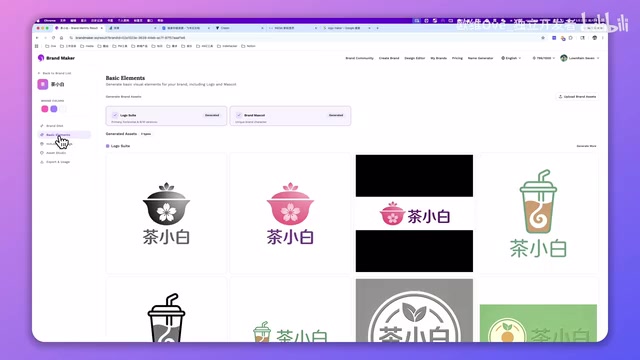
After competitive research, he chose AI Logo Design as the core scenario for three reasons:
- High certainty: Users have clear needs and know what they want
- Strong willingness to pay: Logos are a hard requirement, and users are willing to pay for good design
- Fragmented market: Although competition is fierce, no single product dominates user mindshare, so small products can still capture a slice of the pie
Polishing Product Strength: Balancing Quality and Experience
After settling on the direction, Ouwei did three things to boost product competitiveness:
Updated Homepage Case Showcase
He replaced all design examples on the homepage with logo design work, so users with logo needs would immediately see numerous high-quality examples upon arriving, building trust.
Optimized AI Generation Quality
He integrated the latest AI models, including Nano, Banana, GPT-2, and Seed Dream, allowing users to choose their preferred model. He also refined the entire workflow so that logo generation quality reached professional standards, competitive with established design products.
Added an AI Design Editor
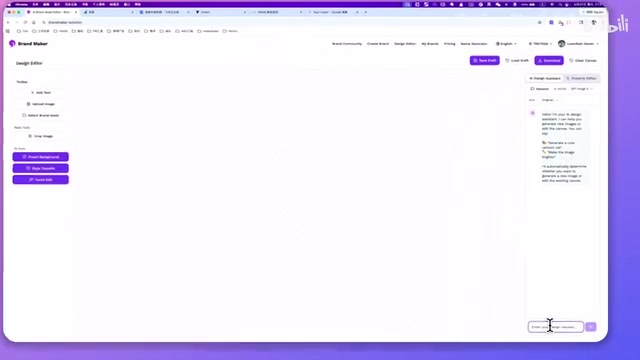
Referencing excellent AI design products like Looka, he added canvas editing capabilities supporting background removal, cropping, style changes, and more. Users can modify designs through conversational interaction, resulting in a well-polished overall experience.
SEO Strategy: Long-Tail Keywords + Landing Pages for Precision Targeting
Once the product was ready, the critical question was: Where does traffic come from?
Free website traffic generally comes from SEO, social media, and owned audiences. With no resources in any of these areas, Ouwei chose SEO as his breakthrough point.
Long-Tail Keywords: The Indie Developer's SEO Survival Playbook
Long-tail keywords are search phrases with relatively low search volume but more specific intent and lower competition. Compared to broad terms like "logo design" that might have hundreds of thousands of monthly searches, phrases like "wedding logo design" or "coffee shop logo design" might only get a few hundred to a few thousand searches per month—but the number of competitors also drops dramatically. For new sites, the SERPs (Search Engine Results Pages) for broad terms are typically dominated by established platforms like Canva and 99designs with millions of backlinks, leaving virtually no ranking opportunity for newcomers. Long-tail keyword SERPs are relatively less competitive, and user search intent is extremely specific—someone searching "coffee shop logo design" is very likely looking for a logo solution for their own coffee shop, with purchase intent far higher than someone generically searching "logo design."
Related articles
 Tutorials
ChatGPT Plus Subscription Guide: Are GPT-5.5, image-2, and Codex Worth the Upgrade?
A detailed look at ChatGPT Plus features — GPT-5.5, image-2, and Codex — with a Plus vs Pro comparison and a complete step-by-step subscription guide for users outside the US.
 Tutorials
Harness AI Engineering in Practice: Using Claude Code to Master Enterprise-Level E-Commerce Development
Deep dive into Harness AI Engineering: master enterprise e-commerce development with Claude Code using the Rules, Skills, Wiki, and Changes framework.
 Tutorials
Cursor + Codex Dual-IDE Collaboration: A Practical Methodology for Open-Source Project Customization
A complete methodology for open-source project customization based on real-world experience, detailing the Cursor+Codex dual-IDE workflow, seven-stage process, MVP validation, and AI source code reading techniques.