Vibe Coding and AI Accountability: Who's Responsible When AI Agents Cross the Line?

Replit's Masad argues vibe coding revives the joy of building, while AI doomerism dodges the urgent question of agent accountability.
Replit founder Amjad Masad joined the Times Tech podcast to explore three interconnected themes: how vibe coding lowers creative barriers and revives the joy of building from the early PC era; and why AI doomerism's grand narrative obscures a more urgent, practical challenge — accountability. As AI agents evolve from assistive tools into autonomous actors capable of taking actions on our behalf, there is still no mature legal or governance framework for determining who bears responsibility when they cause harm. Masad argues the industry should shift focus from distant existential risks to the accountability vacuum already emerging today.
A Conversation About the Joy of Programming and AI Responsibility
Replit founder and CEO Amjad Masad (@amasad) joined the latest episode of the Times Tech podcast to discuss "vibe coding," the joy of building with computers, and why AI doomerism sidesteps the real issue at the heart of the matter. The conversation raised a question that grows sharper as AI agents become increasingly widespread: If AI agents can act on our behalf, who bears responsibility when they go too far?
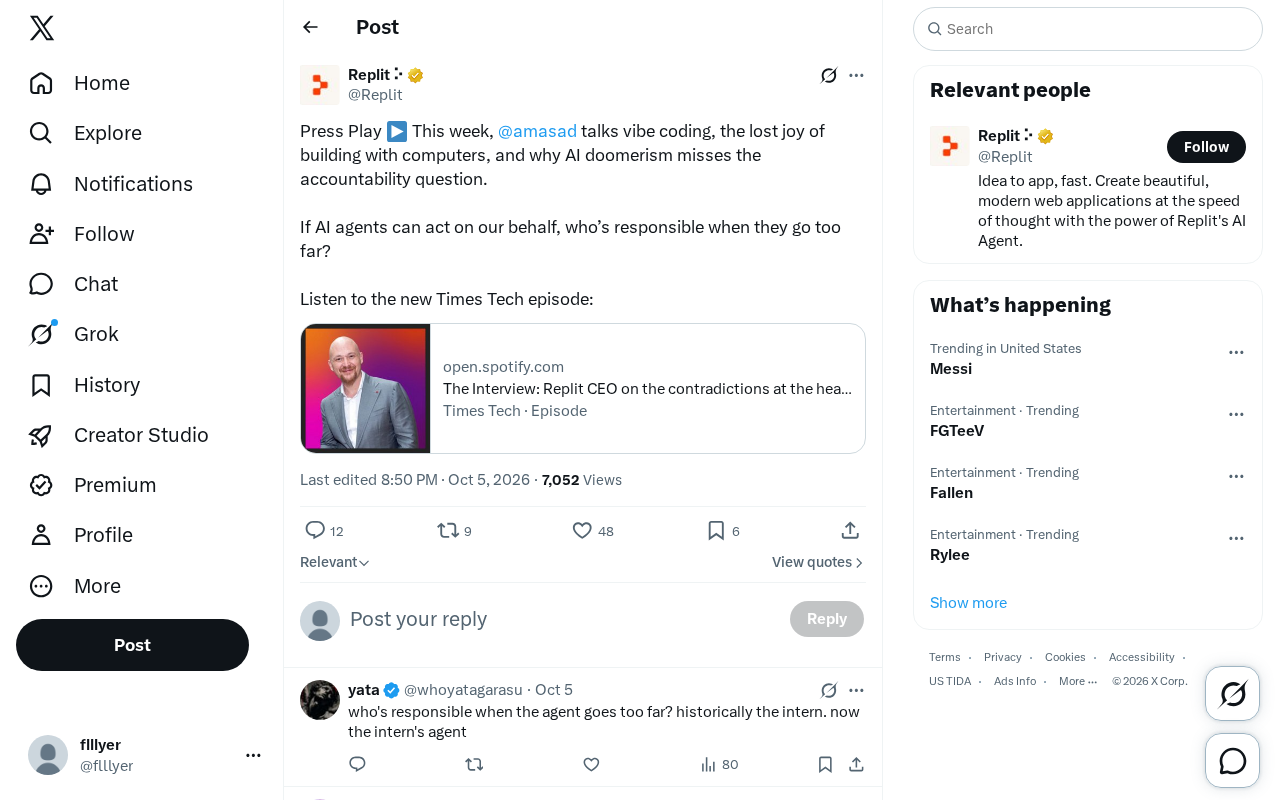
The question sounds simple, yet it cuts to the most overlooked and most difficult governance challenge in AI deployment today.
What Is Vibe Coding?
"Vibe coding" is a concept that has spread rapidly through developer communities. It refers to a workflow where developers rely more on natural language to describe their intent and collaborate with AI to generate code, rather than writing every line by hand. The developer sets the overall "vibe" and direction, while the AI handles the tedious implementation details.
As the head of Replit, Masad has firsthand experience with this trend. Replit itself is an online collaborative coding platform with strong AI assistance built in — vibe coding is a natural extension of its product philosophy. In Masad's view, this model has enormous potential to lower the barrier to programming and unlock creativity, enabling people without deep technical backgrounds to "build" their own ideas.
The term "vibe coding" was coined by AI researcher Andrej Karpathy in early 2025 and spread quickly on social media. He described a workflow where a developer tells an AI in natural language what they want, the AI generates the code, and the developer doesn't even need to read the code in detail — they only need to verify whether the result matches their expectations. This represents a fundamental shift from traditional programming paradigms. In the past, developers were the direct authors of code; in vibe coding, developers are more like "requesters" or "reviewers," while the AI is the actual code producer. The rise of this model depends on the rapid leap in code generation capabilities of large language models (LLMs). Tools like GitHub Copilot, Cursor, and Replit Ghostwriter are all prime examples of this paradigm. Proponents argue it dramatically lowers the technical barrier; critics worry that deploying code without understanding the underlying logic introduces security and quality risks.
The Forgotten Joy of Building with Computers
Notably, Masad raised the idea of "the lost joy of building with computers" during the conversation — an observation that is both nostalgic and critical.
In the early days of personal computing, the relationship between people and machines was much more direct: users wrote their own programs, tinkered with hardware, and experienced the satisfaction of creating something from nothing. As software ecosystems matured and tools became increasingly abstracted, ordinary people grew more distant from "building" itself, gradually becoming passive consumers.
Masad's point carries an implicit hope: AI and vibe coding might reignite that joy of creation, making "building" accessible again. This aligns seamlessly with Replit's long-standing mission to enable anyone to code.
AI Doomerism Dodges the Accountability Question
The most striking argument in the conversation is Masad's critique of "AI doomerism." He argues that the grand narrative around whether AI will destroy humanity actually sidesteps a far more immediate and practical concern — accountability.
When AI agents can take actions on behalf of humans — whether automatically executing transactions, sending communications, or operating other systems — if an agent "goes too far" and causes harm, how do we define the chain of responsibility? Is it the user, the company that built the AI, the vendor supplying the underlying model, or the AI itself?
This question is critical because AI agents are evolving from "assistive tools" into "autonomous actors." When traditional software failed, responsibility fell relatively clearly on the developer or user. But when AI possesses a degree of autonomous decision-making, traditional frameworks for assigning liability begin to break down. Masad's argument is a reminder: rather than fixating on distant existential risk debates, we should confront the accountability vacuum that is already appearing right in front of us.
The key distinction between AI agents and traditional software lies in their capacity for "autonomous action": they don't just answer questions — they can call external tools, access databases, send emails, execute code, and complete multi-step tasks on the web on a user's behalf. Mainstream AI agent frameworks today (such as AutoGPT, LangChain Agents, and OpenAI's function calling mechanism) typically use a "plan–execute–reflect" loop, allowing models to autonomously pursue goals with minimal human supervision. It is precisely this autonomy that makes liability attribution so thorny. Under current legal systems, the bearer of legal responsibility must be a natural person or legal entity — AI itself has no legal personhood. When an agent performs a harmful operation — say, an erroneous wire transfer, a privacy data leak, or a misleading communication — existing frameworks such as tort law and product liability law are difficult to apply directly, and academic and regulatory communities have yet to reach consensus. The EU's AI Act has taken the lead in attempting to establish liability rules for high-risk AI systems, but significant gray areas remain for autonomous agent scenarios.
Implications for the AI Industry
While the conversation was relatively brief, it touched on several core tensions in AI deployment:
- Balancing accessibility and control: Vibe coding makes programming more democratic, but it also means more people are deploying AI capabilities without fully understanding the underlying mechanisms — amplifying potential risks in the process.
- Creative renaissance vs. further abstraction: AI can reignite people's creative enthusiasm, but it can also turn "building" into even more of a black box, where users know what something does but not how or why.
- The lag in governance: The pace of technological progress far outstrips the establishment of regulatory and accountability frameworks. The question of "who is responsible" currently has no mature answer.
For businesses and developers embracing AI agents, Masad's warning carries real practical weight: while enjoying the efficiency gains, it's essential to think proactively about the boundaries of responsibility and establish traceable accountability mechanisms — rather than waiting to react after an incident occurs.
Conclusion
Masad's discussion begins from the warm, inviting angle of the joy of programming, but ultimately lands on the sobering reality of AI governance. As AI agents gradually enter production environments, "who is accountable for AI's actions" will no longer be a philosophical exercise — it will be a practical question that every developer, enterprise, and regulator must confront. The full conversation is available on the latest episode of the Times Tech podcast.
Related articles

Why Does the Tesla Roadster Need to Fly? A Deep Dive into Musk's Wild Demo
Tesla's Roadster launch showed wall-climbing, upside-down driving, and flying stunts—but The Vergecast notes the demo car may lack a battery, the Rocket version is invite-only and not street-legal, and the website terms don't guarantee delivery. After nine years of delays, why does this car still need to exist?

AI Is Not a Replacement: Human-AI Collaboration Through the Lens of Factory Root Cause Analysis
Starting from factory root cause analysis, this article explains how AI accelerates evidence chain construction rather than replacing human experts, exploring the pragmatic implementation logic and business value of 'AI supporting people rather than replacing them.'

AI Agent Decision Auditing: Building an Evidence Chain in Regulated Workflows
Starting from a Reddit discussion, this article analyzes three core issues in AI agent decision auditing within regulated workflows: what fields audit records should contain, how to handle feedback latency for erroneous decisions, and how to continuously calibrate LLM judge consistency with human judgment.