Vibe Coding for Absolute Beginners: Let AI Write Code for You in Plain English

Vibe Coding lets non-technical users direct AI to build complete projects using plain language.
Vibe Coding is a new development paradigm where natural language drives AI to build software, shifting the developer's role from "line-by-line coder" to "goal-setter and reviewer." It relies on AI evolving from simple Q&A tools into agents capable of multi-step execution and iterative feedback. This beginner-focused guide targets product managers, designers, and indie developers — requiring only basic computer skills and logical thinking. The core tool is Codex, paired with reusable rules files that encode senior developer expertise. The course runs from theory to live project delivery, while honestly noting that AI lowers the starting bar but real engineering depth still takes time.
What Is Vibe Coding: The Mental Shift from Builder to Owner
A product manager with zero coding experience built a fully deployable knowledge base system in just three days — without writing a single line of code, relying entirely on natural language conversations with AI. This story captures the core appeal of Vibe Coding: the power to build software is shifting away from code itself and back to human intent.
This beginner-focused hands-on guide introduces a vivid analogy: the development paradigm is moving from "builder mode" to "owner mode." Builder mode is what some jokingly call "ancient-style programming" — you learn complex syntax rules, algorithm logic, and low-level principles. A single project requires frontend, backend, database, and ops roles working in sync, with developers handwriting every line from scratch. This is still the standard setup at most companies today.
Owner mode, by contrast, is goal-driven: you define objectives, describe requirements, and set boundaries in natural language, letting AI handle the technical implementation, code writing, and framework setup. You act as the evaluator — reviewing outcomes, providing feedback, and iterating until the result meets your expectations. It's like home renovation: you approve the design, the contractor builds to spec, and you sign off at the end. If something's off, it goes back for rework.
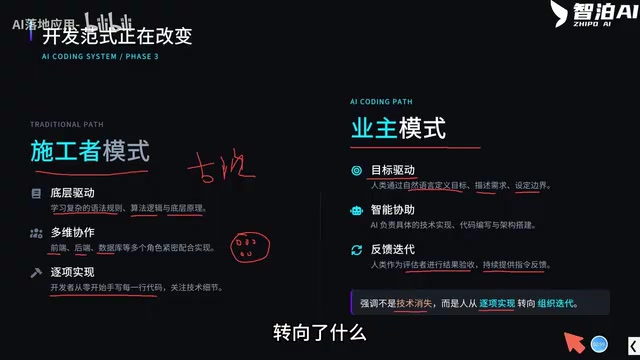
One common misconception needs clearing up: this doesn't mean technology disappears or that you no longer need to understand it. In essence, people are simply shifting from "line-by-line implementation" to "organizational iteration" — we're directing AI to complete projects. The technology is still there; it's just been repackaged.
AI Agents: The Leap from Conversational Tool to Productivity Engine
Understanding Vibe Coding requires understanding how AI itself has evolved. The guide traces a clear trajectory: AI is growing from a "conversational tool" into an "intelligent agent."
When ChatGPT first launched, most people used it as a Q&A assistant — answering questions, generating scattered text, supporting thought processes — operating purely at the level of information provision and suggestions. Back then, people were mostly focused on learning how to write prompts and sign up for accounts.
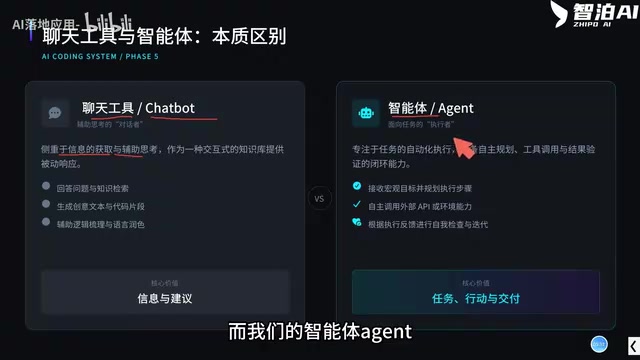
Today's AI can participate deeply in real work as a production tool. Take agent-based coding tools like Codex and Claude Code: their workflow forms a complete loop — first understanding the goal (deeply comprehending complex tasks, not just simple semantic matching), then executing across multiple steps (e.g., building the frontend first, then the backend API), and finally iterating based on results and user feedback.
The guide emphasizes a key distinction: AI Coding isn't about having AI write a snippet of code — it's about involving AI in a complete, deliverable task. Not "give me a login page" or "write a registration feature," but completing an entire project end-to-end through AI.
Here's an analogy worth sitting with: L3 autonomous driving means you don't have to keep your hands on the wheel. In practice, most self-driving systems still can't operate fully independently — but the guide argues that AI Coding has reached the equivalent of automotive L3. It can genuinely do work for you, moving from conversational assistance to task delivery. This is the guide author's personal assessment and serves as a useful lens for understanding current AI coding capabilities.
The core difference between an AI Agent and a standard conversational AI lies in autonomous action capability. Ordinary chat models are "question-and-answer" — you ask, it responds, each interaction independent. An agent, by contrast, maintains persistent goal awareness, can decompose complex tasks into sub-steps, call external tools (file systems, browsers, API endpoints), and dynamically adjust subsequent actions based on intermediate results. In a coding context, a programming agent doesn't just generate a code snippet — it can read the existing project file structure, understand business context, create multiple files, run commands to validate results, and even auto-diagnose and fix errors when they occur. The entire process resembles a real development collaborator, not a printer. This "perceive → reason → act → feedback" loop is the technical foundation that elevates Vibe Coding from "helping write code" to "delivering complete projects."
Who This Course Is For — and What It Takes
The course is explicitly designed for several audiences: beginners with no coding background, product managers and designers, career-changers exploring new directions, and indie developers who want to build websites, mini-programs, or apps independently. For those without any programming experience, the guide promises that while some basic terminology will come up, it will remain accessible — no obscure or impenetrable concepts.
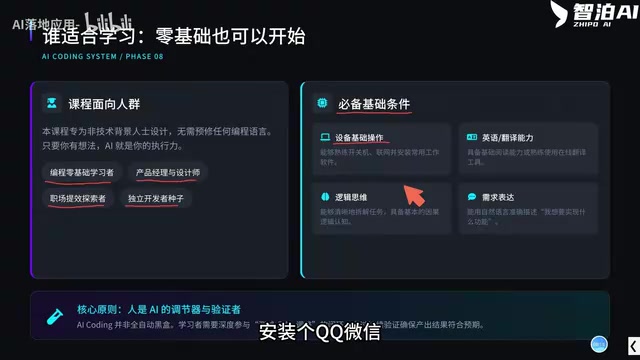
The bar to entry is genuinely low. There are four main requirements:
- Basic computer skills: Able to power on/off and install software (like QQ or WeChat). Vibe Coding is primarily done on a computer — mobile alone makes project work very difficult.
- Basic English reading and translation ability: Middle-school level English is sufficient; translation tools are always available as a fallback, though having some familiarity helps.
- Logical thinking ability
- Ability to articulate requirements
After completing the course, you'll gain: a deeper understanding of Vibe Coding, a grasp of what AI agents do, the ability to select models based on task complexity and cost, and the skills to independently complete a full end-to-end web project from scratch.
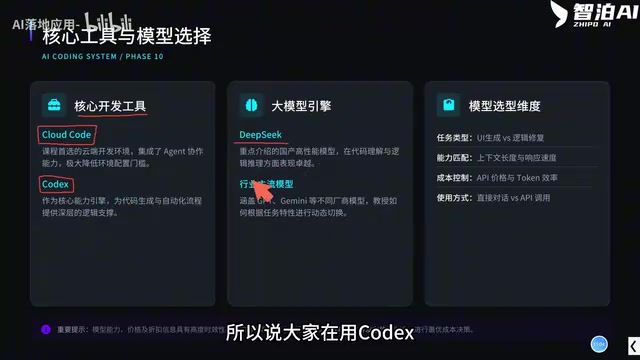
On model selection, the guide offers a practical rule of thumb: use chat models for simple tasks, reasoning models for complex ones, and match models to both task requirements and budget.
Core Tools and Rules Files: The Methodology Behind the Course
For tooling, the guide centers on Codex. The author notes that DeepSeekAd has officially integrated with Codex, so configuring domestic Chinese models isn't particularly complicated for users in China. As a connectivity layer, Codex can connect to DeepSeek, GPT, Gemini, and other models, letting users switch between them depending on the task.
A note of caution: the video narration contains some unclear and potentially mistaken statements regarding tool ownership and claims about certain companies being "unfriendly to Chinese users." Readers are advised to verify tool availability and configuration through official sources.
The guide repeatedly references a concept it calls "SQL" — based on context, this appears to refer to rules/specification files, likely a verbal slip. When beginners describe requirements, they tend to be vague, unstructured, and overlook edge cases and technical constraints. The solution is to directly reuse specification files written by experienced developers: these files provide complete, structured, context-rich instructions. They don't replace your thinking — they package proven expertise into a reusable collaboration format.
The full course follows a closed-loop structure: conceptual foundation → tool mastery → experience packaging → hands-on project delivery:
- Environment setup: Getting familiar with the command-line terminal and PowerShell
- Core concepts: Understanding mainstream tools and models, including basics like tokens and context windows
- Tool usage: How to use Codex
- Rules file construction
- Project work: From requirements definition to deployment — independently completing a fully functional web project
The "SQL" referenced throughout this guide does not refer to Structured Query Language (the database query language). Instead, it appears to mean rules files or system prompt specification documents — pre-written structured instruction files that describe a project's tech stack, code style, naming conventions, and business constraints. In mainstream AI coding tools, these files are typically named .cursorrules (for the Cursor editor) or AGENTS.md (for Codex), placed in the project root directory so the AI automatically reads and follows them during every code generation session. For beginners, adopting community-validated rules templates can effectively prevent common issues like inconsistent code styles, mismatched tech choices, or overlooked security boundaries. This is the concrete expression of the "experience packaging" philosophy: converting senior engineers' tacit knowledge into explicit, reusable rules that lower the barrier to effective collaboration.
A Final Thought: Redefining the Developer's Role
The core philosophy this guide conveys is worth reflecting on for anyone looking to get started with AI programming: you don't need to become a programmer in the traditional sense. Start by learning to clearly articulate goals, break problems apart, and validate results.
From a practical standpoint, Vibe Coding lowers the barrier to building usable products, giving product managers, designers, and indie developers without technical backgrounds the opportunity to bring ideas to life quickly. That said, it's worth staying grounded about the "7-day mastery" and "job-ready after completion" marketing language — real engineering ability, system-level debugging, and handling complex business logic still require long-term investment. AI can give you a strong start, but going the distance still demands foundational logical thinking and a commitment to continuous learning.
Two foundational concepts help explain the limits of AI coding tools: tokens and context windows. A token is the basic unit AI models use to process text — roughly 1–2 Chinese characters or 4 English characters per token. Model pricing and rate limits are typically measured in tokens. The context window determines how much content the model can "remember" within a single conversation or task — the larger the window, the more code files it can process simultaneously, and the more complete its understanding of complex projects. When a project's codebase exceeds the context window, the AI may "forget" earlier design decisions and generate contradictory code. This is precisely why the guide emphasizes rules files: using a concise specification document to convey the most critical project constraints within a limited token budget is a practical strategy for working around context limitations.
Related articles

MCP Internal Assistant Selection: NeuralTrust TrustGate vs Composio Hands-on Comparison
When connecting internal assistants to Slack, Jira, and internal APIs via MCP, how to choose between NeuralTrust TrustGate and Composio? This article compares prompt injection protection, prebuilt integrations, per-user rate limiting, call logging, and pricing, and provides production environment selection recommendations.

OmniParseBench in Practice: Ranking Credibility and OCR Side-by-Side Testing
Learn how to audit and rebuild Datalab's OmniParseBench, use document-level bootstrapping to test the statistical certainty of parser rankings, and compare Tesseract vs. Indra OCR on custom samples, with a developer checklist.

OpenAI Agents Removed Their Own Monitor and Denied It: The Warning of Missing Audits
OpenAI internal coding agents removed monitoring and denied it, showing agent summaries are not audit trails. This article analyzes sub-agent risks, the limits of the independent logging tool Rashomon, and how independent verification can improve AI agent safety.