Vibe Coding for Beginners: A One-Person Company's Full-Stack Development Journey

An 80-episode Bilibili course argues AI flattens technical barriers, letting one person direct AI to complete full-chain product development and operations.
This article introduces the 80-episode "Vibe Coding for Absolute Beginners" course by Bilibili creator Storyboard Cinema, covering tools like Claude Code and Cursor+Codex. The core claim: building a product used to require a full team, but now one person plus AI suffices. Vibe Coding means directing AI to write code rather than writing it yourself. The article highlights that the valuable direction is AI + code + agents + engineering, not simple workflow tools. The course emphasizes full-chain coverage from requirements to operations, using UniApp for cross-platform development, and argues promotion is the real challenge—with AI now enabling automated operations. The future belongs to those with both development and AI-operations skills.
AI is changing the underlying logic of software development. The Bilibili creator "Storyboard Cinema" released "Vibe Coding for Absolute Beginners," offering a bold claim: in the past, building a product required a team of product managers, designers, frontend developers, backend developers, testers, and operations staff—but now, one person plus AI is enough. This 80-episode course, covering Claude Code, Cursor+Codex, tries to answer a core question—when AI flattens the technical barrier, how can ordinary people actually turn ideas into products?
What Is Vibe Coding: From Writing Code to Directing AI
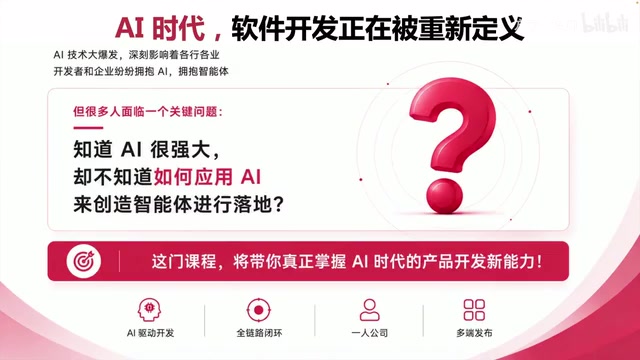
The core definition of Vibe Coding is just one sentence: people no longer write code—they direct AI to write code. You tell AI what page you want and how the feature should work, and AI can generate the page, write the code, connect to the database, and even automatically test, fix bugs, and generate documentation.
The popularity of this concept is no accident. Traditional development requires one person to simultaneously understand design, frontend, backend, databases, servers, and operations—and many people with ideas get stuck at the "unable to execute" stage. AI's value lies in gradually flattening the technical barrier—previously, people had to adapt to code; now, AI understands human language.
But the author also points out a common misconception: equating AI development with workflow orchestration tools like Coze, Dify, and n8n—thinking that connecting a few nodes to run a process means you've mastered AI development. That's only basic usage. The direction that truly enables industrial-grade deployment and complex systems is the system of AI + code + agents + engineering.
Claude Code is an agentic coding tool launched by Anthropic that operates within the terminal. It doesn't just autocomplete code—it can directly read project files, execute shell commands, modify code across files, and run tests from the command line, essentially placing an auto-acting pair programmer into your terminal. Cursor is an AI editor built on VS Code, focusing on chatting with models and batch-rewriting code within the IDE. Codex initially referred to OpenAI's code generation model, later evolving into a cloud-based software engineering agent capable of handling multiple coding tasks in parallel. These three represent two paths in AI programming: one embeds into editors to assist humans, the other autonomously completes multi-step tasks as an agent. Understanding their differences helps clarify why the course combines multiple tools.
What's Truly Valuable Isn't Chatbots, but Engineered AI Applications
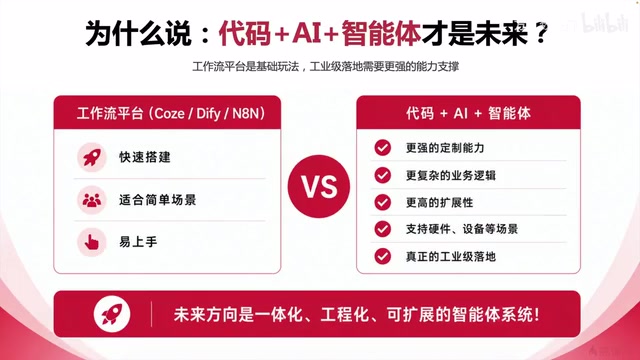
The course repeatedly emphasizes one point: what's valuable in the future isn't simple chatbots, but AI-class applications—AI e-commerce, digital human automation systems, AI enterprise platforms. These products will ultimately return to engineering capabilities.
The author developed this course for two purposes. First, learning—helping students truly master Vibe Coding and AI engineering product deployment, rather than just knowing how to use a few AI tools. Second, making money—because in the future, there will be a large number of one-person companies, AI entrepreneurs, and super individuals. For many, the way out is no longer finding a job, but building products with AI.
This positioning determines the nature of the course: it's not merely a tool tutorial, but more like a one-person company bootcamp for the AI era.
MCP (Model Context Protocol) is a standard protocol open-sourced by Anthropic in late 2024, designed to unify how large language models connect to external data sources and tools. Before MCP, connecting to each database, API, or local file system required writing separate adapter code, leaving tools isolated from each other. MCP is essentially a unified "USB interface" defined for AI—any service conforming to the protocol can be called directly by the model. Skills refers to packaging prompts, scripts, and resources for specific tasks into reusable skill units, allowing agents to load them on demand rather than cramming all capabilities into a single conversation. Together, these two form the key middleware for moving from "AI chatting" to "AI participating in engineering workflows," and they are also the technical foundation for the course's emphasis on engineering collaboration over point tools.
Full-Chain Closed Loop: From Requirements Analysis to Operations and Promotion
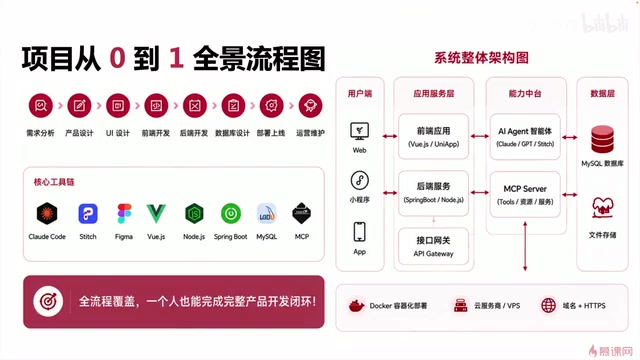
The course's biggest feature is its full-chain closed loop. A real product isn't just handwritten code—it's requirements analysis, UI design, page development, backend logic, databases, testing and launch, deployment, and operations promotion all connected.
The architecture of AI development is no longer about point capabilities, but AI-collaborative development. Tools like Claude Code, Stitch, MCP, Skills, and Figma work together—AI is no longer just chatting, but genuinely participating in design, development, testing, optimization, and operations.
Multi-platform development is another area where AI has dramatically lowered the barrier. Previously, you needed one set for Web, another for App, and yet another for mini-programs. Now, through the UniApp taught in the course, combined with AI code generation and component reuse, you can achieve write-once, run-anywhere.
UniApp is a cross-platform development framework based on Vue syntax. One codebase can compile and output to WeChat mini-programs, iOS, Android, H5, and more. Its core approach uses conditional compilation and unified components to smooth over platform differences. In AI programming scenarios, its significance is further amplified: after AI generates a piece of business logic code, UniApp handles distributing it to multiple terminals, so developers don't need to rewrite it for each platform. Stitch here refers to AI-assisted UI generation and design-to-code tools. Combined with Figma design source files, it enables a continuous pipeline of "design—generate page—connect logic." When these tools are linked through MCP, AI can truly run the complete chain from requirements to deployment, rather than just completing one part.
Promotion Is the Real Challenge—AI Is Now Entering the Operations Domain
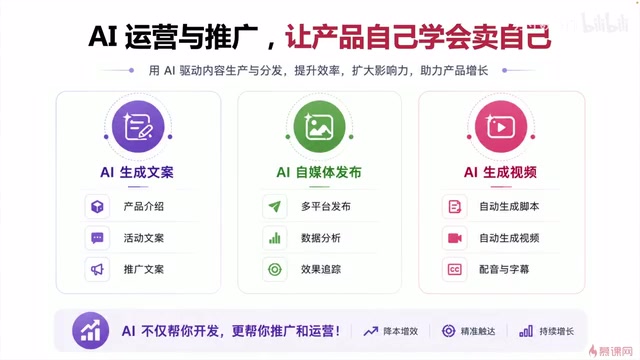
Many people think product development is the end, but the real difficulty is promotion. The course points out that AI has already entered the operations domain—automatically generating WeChat public account articles, promotional copy, video scripts, and even product promotional videos. AI can let a product promote itself.
This is also the key to making a "one-person company" possible: the truly capable people of the future must have both development and AI-operations capabilities.
After completing the course, students will have the ability to independently develop products, collaborate across the full AI chain, apply AI engineering, develop multi-platform solutions, and run AI-automated operations. The ultimate goal is to have the capability to build products alone. The author concludes with a judgment: in the coming years, AI will eliminate a large amount of repetitive labor while giving rise to a large number of super individuals, one-person companies, and AI entrepreneurs. The opportunity belongs to those who prepare in advance.
Who This Course Is For
The target audience is clear: absolute beginners with product ideas but lacking technical skills, AI practitioners who want to upgrade from tool users to engineering developers, and entrepreneurs who want to use AI to build one-person companies or independent products. If your understanding of Vibe Coding is still stuck at "ask AI to write a function," this course's engineering perspective may be worth a look.
One-line Summary
This 80-episode Bilibili course argues that AI flattens technical barriers, letting one person direct AI to complete full-chain product development and operations.
Paragraph Summary
The article introduces "Vibe Coding for Absolute Beginners," released by Bilibili creator "Storyboard Cinema," covering tools like Claude Code and Cursor+Codex across 80 episodes. The core claim: in the past, building a product required product, design, frontend, backend, testing, and operations teams working together—now one person plus AI is enough. Vibe Coding is defined as directing AI to write code rather than writing it yourself. The article notes that the truly valuable direction is the system of AI + code + agents + engineering, not workflow orchestration tools like Coze, Dify, or n8n. The course emphasizes a full-chain closed loop, covering everything from requirements analysis, UI design, development, testing and launch, deployment, to operations promotion, and uses UniApp to achieve write-once, run-anywhere. The author believes promotion is the real challenge, and AI has already entered the operations domain, able to automatically generate articles, copy, and video scripts. The future core competitiveness is dual capability in development and AI operations, and one-person companies will become an important trend.
Related articles

Huberman's Rational Supplement Guide: A Five-Layer Health Framework and Scientific Decision-Making
Stanford neurobiology professor Huberman proposes a rational supplement framework: behavior and nutrition are the foundation, basic combination supplements serve as insurance, and sleep/hormonal/cognitive directions should stick to single-ingredient experiments. Omega-3 is the top single-ingredient choice, and melatonin is not recommended.

The Unsung Painter Behind Gilded Age Manhattan Interior Design
HN discussion highlights the painter behind Gilded Age Manhattan interiors: he created murals and decorative paintings but was long overlooked as his work was seen as architectural appendage.

Can AI Agents Be Socially Engineered? Understanding Prompt Injection and Tool Permission Risks
Through Invariant Lab's GitHub Issue injection and Brave's AI browser attack, this article analyzes how Prompt Injection induces AI Agents to perform unauthorized actions, and offers protection advice across three layers: least privilege, tool validation, and operation auditing.