Vibe Coding for Beginners: Build a Complete AI Application Without Writing Code
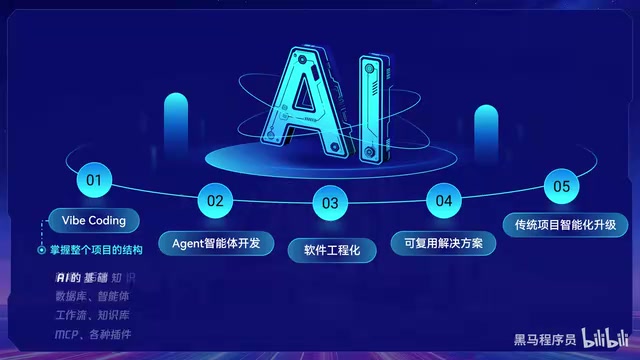
Heima Programmer's course teaches AI app development by building a full project with Claude Code before touching any code.
This article introduces Heima Programmer's AI application development course for beginners, which flips the traditional "learn syntax first" approach — Stage 1 requires zero code, using Vibe Coding tools like Claude Code to build a complete project with frontend, backend, database, agents, and workflows. The five-stage path progresses from Vibe Coding through Agent development, Java engineering, problem-solving, and finally intelligent transformation of legacy systems. The hands-on project is a Job Search Assistant featuring resume evaluation, interview recording analysis, question generation, and mock interviews — with professional output quality driven by complex workflow orchestration rather than raw LLM calls.
The Programming Learning Path Is Being Rebuilt in the AI Era
The traditional path to learning programming has long been accepted as standard: start with basic syntax, move on to frameworks, build projects, then enter the workforce. But under the wave of AI-assisted programming (Vibe Coding), that path is being completely rewritten.
Heima Programmer's AI application development course for beginners puts forward a counterintuitive idea — the first step to learning AI application development isn't writing code. Instead, you use AI coding tools like Claude Code or Codex to build a complete, real-world project from scratch. The core insight is that learners should first understand how a complete project actually works, then circle back to fill in the underlying technical details.
This shift addresses a real pain point: many people have encountered concepts like Agent, Harness, and Claude Code on platforms like Bilibili, and have even tried these tools — but without a foundational understanding of computer science, they can't make sense of the technical terminology. The result is a vicious cycle: learning AI applications seems to require programming knowledge, but learning programming is itself a barrier. So most people stay stuck at the level of "just chatting with AI" — the output feels like a mystery box, with a different interface and feature set every time, and no ability to build an application in a stable, engineering-oriented way.
Five-Stage Learning Path: See the Big Picture First, Then Dig into Details
This course lays out a complete five-stage learning path built on the logic of "understand the whole first, then learn the details, then upgrade and optimize."
Stage 1 is the content of this current course — zero-code Vibe Coding project development. No code is written at this stage. Instead, using tools like Claude Code, learners build a complete project that includes a frontend, backend, database, intelligent agents, workflows, a knowledge base, MCP, and various plugins. The goal is to establish an overall understanding of project architecture, the development process, and how to troubleshoot problems.
Stage 2 dives into the core of AI applications — Agent development. This is where learners begin studying Python fundamentals, web frameworks, and Agent frameworks, then integrate agents into enterprise-level projects. The course's reasoning: standalone agents (like an AI shopping assistant, AI customer service bot, or AI search for an e-commerce platform) have no value in isolation — they only matter when integrated into a complete project.
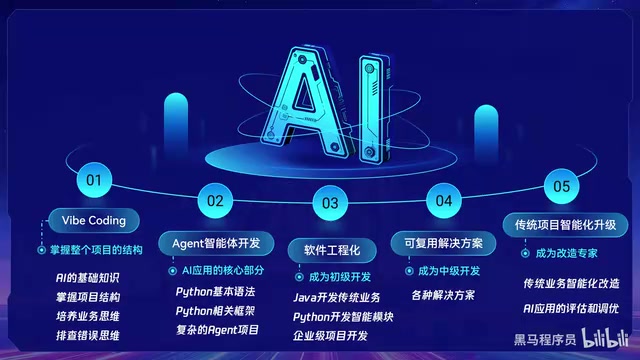
Stage 3 focuses on Java engineering, building complete projects that combine both traditional business logic and intelligent features, reaching the level of a junior developer. Stage 4 concentrates on solving the various problems that come up during development. Stage 5 tackles the intelligent transformation of traditional projects — handing off ambiguous business problems to AI, while also covering AI application evaluation, API integration, and advanced topics like large model fine-tuning.
The course instructor uses LEGO as an analogy: if you want to build a plane or a roller coaster, you don't just dive in — you first decide on the final result, estimate which pieces you need, understand how the mechanics work, then build the core modules, expand them into a finished product, solve problems as they come up, and finally iterate based on better ideas. This maps directly onto the learning sequence of seeing the big picture before drilling into details.
Vibe Coding is a programming paradigm that emerged around 2025, coined by OpenAI co-founder Andrej Karpathy. The core idea is that developers describe what they want in natural language, and AI tools (such as Claude Code, Codex, or Cursor) generate and iterate on the code. Developers focus primarily on reviewing, testing, and steering direction rather than writing code line by line. This approach dramatically lowers the barrier to turning ideas into working software, enabling non-professional programmers to participate in building complex projects. MCP (Model Context Protocol) is an open protocol introduced by Anthropic that allows AI models to call external tools and data sources (such as file systems, databases, and third-party APIs) through standardized interfaces. It is the key infrastructure that enables Agents to "actually do things" rather than just converse. Understanding both concepts helps clarify where the Stage 1 tech stack fits within the broader AI application ecosystem.
The Hands-On Project: Four Core Features of a "Job Search Assistant"
The most compelling part of the course is the final hands-on project — a complete "Job Search Assistant" system. It includes standard modules like user login, registration, and profile management, with its core value concentrated in four key features.

Resume Evaluation: After uploading a resume, the system produces a professional assessment that identifies weaknesses and suggests specific improvements. The instructor claims the results are more actionable than paying someone to review your resume.
Interview Recording Analysis: Upload a recording of an interview, and the system first transcribes it, then identifies who is the interviewer and who is the candidate, and finally conducts a review. It grades each answer during the interview using A, B, C, and D ratings, and provides detailed improvement suggestions for each question.
Interview Question Generation: This is a highly targeted feature. The conventional approach is to download generic interview question lists online — but in real interviews, almost every question is based on your specific resume. So the system generates a customized bank of up to hundreds of interview questions based on your revised resume.

Mock Interview: Using your uploaded resume and the generated question bank, the system conducts a one-on-one mock interview, covering essentially every scenario you might encounter when job hunting.
The Key Insight: Workflows Are the Source of "Professional Quality"
One important technical detail worth noting: the four core features don't simply feed user input directly into a large language model. The course explicitly points out that doing so would produce answers that are "too vague and generic" — nowhere near as specific and professional as what the demo shows.
What actually makes it work is the complex workflow built into the project, which runs resumes, interview recordings, and other inputs through a multi-step, structured analysis pipeline. This is the fundamental difference between engineering an application and just chatting with AI — the former uses workflow orchestration to make AI output stable, controllable, and reusable; the latter is a mystery box.
For learners who aren't planning to enter the programming industry, this Stage 1 course is already sufficient to independently build a complete tool for improving their work or daily life. For those who want to enter the field, it serves as an entry point for understanding the full scope of a project, with lower barriers to entry — the deeper development knowledge can be added later.
In AI application development, a workflow refers to breaking down a complex task into multiple ordered steps, where each step can call different models, tools, or data sources, and the output of one step becomes the input for the next. For resume evaluation, a typical workflow might include: document parsing (extracting resume structure) → job matching analysis (comparing against target role requirements) → item-by-item scoring → generating improvement suggestions → outputting a formatted report. Each step has a defined prompt template and output constraints, rather than cramming all requirements into a single model call. This "step-by-step orchestration" approach significantly improves output stability and controllability, preventing the model from going off-track or giving overly generic answers on complex tasks. Popular workflow orchestration tools include Dify, Coze, and LangChain; Claude Code primarily handles code generation and project scaffolding. In real-world projects, the two are typically used together.
Summary
This course reflects a trend already underway: AI-assisted programming is changing the traditional sequence of "learn syntax first, build projects later," allowing beginners to use natural language to drive tools that produce complete applications — then gradually deepen their understanding of the underlying layers. Its value isn't that "you no longer need to learn programming" — it's that complex engineering capabilities (workflows, Agents, knowledge bases, MCP) are presented in a way that aligns more naturally with how people learn. That said, as promotional material for a training course, actual learning depth and outcomes will depend on the full course content. The framing of "build a professional project without writing a single line of code" carries some marketing flair, and learners should approach it with appropriate expectations.
Related articles

LynnReal-Omni: 32B Unified Video Diffusion Model Goes Open Source with Multi-Task Coverage in Four Steps
LynnReal-Omni is a 32B unified video diffusion model on MiniMax H3, covering text-to-video, pose guidance, style transfer, restoration in 4 steps. Flash version generates 540p video in 377ms on one H100.

Anthropic Co-Founder: AI 'Kill Switch' May Need to Be Mandatory by Law
Anthropic's co-founder tells the BBC that AI 'kill switches' may need to be legally mandated. We analyze the industry logic, technical challenges, and the tension between regulation and innovation.

The AI Data Center Boom Is Colliding With Cities Scarred by Heavy Industry
The AI data center boom is clashing with post-industrial communities. Philadelphia's case reveals structural conflicts between AI growth, energy use, water, and environmental justice.