Vibe Coding from Zero: Master AI Programming in 7 Days with Claude Code and Codex
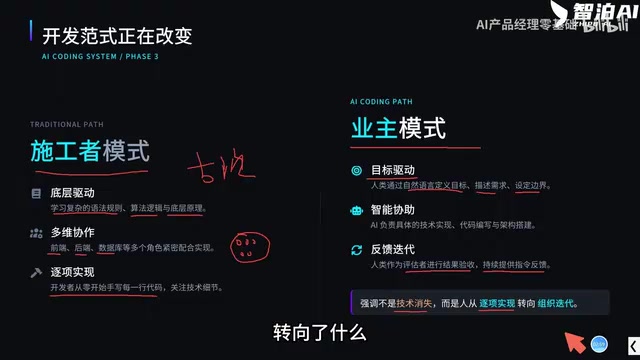
Vibe Coding shifts developers from code-writing builders to AI-organizing homeowners, with AI Coding nearing autonomous driving L3.
The article covers Vibe Coding's paradigm shift: traditional development requires syntax, algorithms, and multi-role collaboration, while Vibe Coding lets developers define goals in natural language with AI handling implementation. AI has evolved from chatbot to agent with planning, tool invocation, and validation abilities, nearing autonomous driving L3. The course recommends Codex over Claude Code and follows task-complexity-based model selection. SKILL packages senior developer experience for reuse, targeting zero-base learners with a theory-to-delivery loop.
From "Traditional Coding" to "Homeowner Mode": The Development Paradigm Is Shifting
A product manager who doesn't know how to code launched a knowledge base system rivaling Feishu in just three days. Not a single line of code was written by hand — the entire project was completed through natural language conversations with AI. This isn't a demo; it's a real case shared by a Bilibili creator in the "Vibe Coding Systematic Tutorial."
Behind this lies a fundamental shift in the development paradigm. The creator refers to the old way of developing as "traditional coding" or "builder mode" — developers need to master syntax rules, algorithm logic, and underlying principles, and a project requires collaboration across multiple roles: frontend, backend, database, operations, testing, and product. Vibe Coding, by contrast, represents "homeowner mode": you define goals, describe requirements, and set boundaries in natural language, while AI handles the technical implementation and code writing. You only need to act as the evaluator, validating results and providing continuous feedback.
The analogy fits well: it's like renovating a house — you first have a designer draw up plans, then construction follows once you're satisfied, you inspect upon completion, and if something doesn't meet standards, it gets redone. In the future, it can be continuously upgraded. The technology hasn't disappeared; the human role has simply shifted from "line-by-line implementation" to "organizational iteration" — organizing AI to help you complete the project.
Agent-Stage Leap: AI Coding Has Reached Autonomous Driving L3
The creator raises a noteworthy point: AI has evolved from a conversational tool into an intelligent agent. When ChatGPT first emerged, everyone was learning how to write prompts, and AI remained at the level of providing information and suggestions. Now, AI as a production tool is deeply involved in work — it can not only answer questions but also act as an executor driving tasks to closed-loop output.
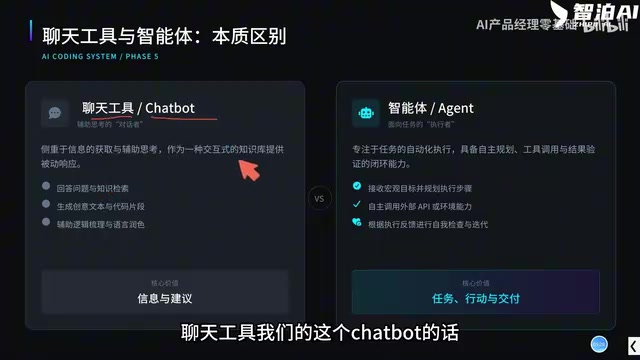
The essential difference between a chatbot and an agent: chatbots focus on information acquisition and assisting thought, while agents specialize in automated task execution, with closed-loop capabilities for autonomous planning, tool invocation, and result validation. The creator uses autonomous driving as an analogy — although cars haven't fully reached L3 yet, AI Coding has basically reached L3 level: it can genuinely do the work for you, moving from assisted conversation to task delivery.
This judgment has room for debate, but the direction aligns with the actual performance of current AI programming tools. Tools like Claude Code, Codex, and Cursor are indeed evolving from "code completion" to "delivering completable tasks."
The Analogy Between Autonomous Driving Levels and AI Coding
Autonomous driving levels were proposed by the Society of Automotive Engineers (SAE), spanning six levels from L0 to L5: L0 is fully manual operation; L1 and L2 are assisted driving, where the system can handle partial steering or acceleration/deceleration but humans must continuously monitor; L3 is conditional autonomous driving, where the system can fully take over in specific scenarios, with humans not needing continuous monitoring but required to take over upon request; L4 and L5 correspond to high automation and full automation respectively. Using this framework to analogize AI Coding: early code completion tools are equivalent to L1/L2, human-led with AI assistance; while agents that can autonomously plan tasks, invoke tools, validate results, and deliver runnable outputs approach L3 — within controlled scope you can "let it run," but complex decisions still require human oversight. The key value of this analogy is that it transforms the vague question of "how powerful is AI really" into a discussable matter of automation level, and also hints at the boundaries of current capabilities — AI Coding has not yet reached the L4/L5 level of full-scenario, human-free intervention.
Tools and Model Selection: Why Codex Is Recommended Over Claude Code
The core development tool of the course is Codex. The creator explicitly recommends that domestic users prioritize Codex over Claude Code, citing that Claude's parent company Anthropic is "extremely unfriendly" to domestic users. Meanwhile, DeepSeekAd has officially adapted to Codex, making domestic model integration very simple to configure.
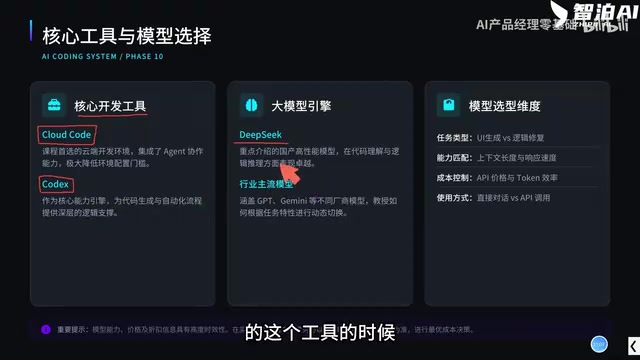
Model selection follows the principle of matching by task: use conversational models for simple tasks and reasoning models for complex ones. Whether to use DeepSeek, GPT, Gemini, or Tongyi Qianwen at any given time depends on business complexity and cost. This approach of "connecting tools to multiple models" reduces the risk of single-model lock-in.
SKILL: Packaging and Reusing Senior Developers' Experience
Common problems when beginners describe requirements: vague expression, lack of structure, and neglect of boundaries and technical constraints. The creator's solution is SKILL — directly borrowing the specifications and context structures that senior developers have already written.
SKILL doesn't replace your thinking; it packages mature experience into a reusable collaboration approach. Someone else packages their experience into a SKILL, and you simply invoke it. This idea closely aligns with the popular "prompt templates" and "rule files" practices in the current AI programming community — the essence is reducing collaboration friction.
Community Practices Around Prompt Templates and Rule Files
The "prompt templates" and "rule files" mentioned in the original text are several concrete artifacts of the current AI programming community. Rule files (such as Cursor's .cursorrules, Claude Code's CLAUDE.md) are documentation placed in the project root directory to tell AI the project's tech stack, code style, directory structure, and prohibited items, so that every conversation automatically carries the project context. Prompt templates are structured instructions pre-polished for specific tasks (such as "write unit tests" or "refactor functions"), including role settings, input/output formats, and constraints. SKILL differs from them in being coarser-grained and more reusable: it typically encapsulates a complete working methodology of a certain type of developer, rather than instruction fragments for a single task. Understanding the commonality of these practices — making tacit expert experience explicit and reusable — reveals that SKILL is not an entirely new invention but a further abstraction of this trend.
Who the Course Is For: Four Prerequisites for Zero-Base Learners
The course targets four groups: zero-base programming learners, product managers and designers, workplace skill explorers, and independent developers.
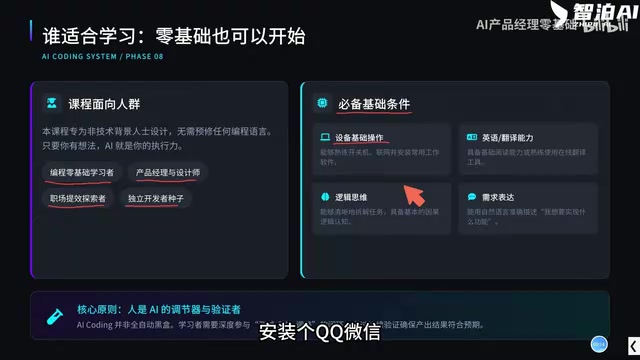
There are only four prerequisites: basic computer operation (powering on/off, installing software), basic English and translation ability, and logical thinking and requirement expression skills. The creator emphasizes that Vibe Coding is mainly done on a computer; pure mobile operation will be more difficult. After completing the course, you'll gain: a deep understanding of Vibe Coding, comprehension of Agent engine capabilities, model selection ability, and the ability to independently complete a zero-to-one web project loop.
Course Structure: A Complete Loop from Environment Setup to Project Launch
The course unfolds in five stages: environment preparation (getting familiar with the command-line terminal PowerShell), core concepts (mainstream AI programming tools and models, Token, context), tool mastery (how to use Codex), SKILL construction, and project practice (from requirement definition to launch and deployment).
The design logic is a closed loop of "theoretical understanding → tool mastery → experience packaging → practical delivery." A statement the creator made at the end is worth remembering: you don't need to become a programmer in the traditional sense — instead, first learn to state your goals clearly, break down problems, and validate results well.
This may be the most core capability transfer of Vibe Coding — from writing code to defining problems.
One-line Summary
Vibe Coding transforms developers from code-writing builders into homeowners who organize AI iteration, and AI Coding has nearly reached autonomous driving L3.
Paragraph Summary
The article introduces the paradigm shift of Vibe Coding. The author calls traditional development "traditional coding" or "builder mode," requiring mastery of syntax, algorithms, and multi-role collaboration; Vibe Coding represents "homeowner mode," where developers define goals and boundaries in natural language, AI handles technical implementation, and humans only evaluate and provide feedback. The article notes that AI has evolved from a conversational tool into an agent with closed-loop capabilities for autonomous planning, tool invocation, and result validation, with AI Coding basically reaching autonomous driving L3. In tool selection, the course recommends Codex over Claude Code and follows the principle of matching models to task complexity. Additionally, SKILL packages senior developers' experience into reusable collaboration methods, reducing the friction for beginners describing requirements. The course targets zero-base learners and is designed as a closed loop of "theoretical understanding → tool mastery → experience packaging → practical delivery."
Related articles
world2vec: Building Mechanistic World Models with Latent Dynamics Learning
world2vec proposes a reward-free method for learning mechanistic world models via latent dynamics, faithfully reproducing systems over long horizons with at least an order of magnitude fewer parameters than DreamerV3, TD-MPC2, and LeWM, and achieving accurate system identification on 71 attractor benchmarks.

A New KL-DRO Paradigm: Adaptive Scenario Generation Around a Learned Density Model
KL-DRO research proposes centering the KL ball on a learned density model instead of the empirical distribution, with adaptive scenario generation guiding sampling toward the worst case. Experiments show lower cost under distribution shift when records are scarce and the model can extrapolate, with comparable in-distribution cost.

ODE Samplers for Discrete Diffusion Models: Exponential Residual Flows Accelerate Generation
Discrete diffusion models lack deterministic ODE sampling? This article introduces Exponential Residual Flows (ERFs), which introduce continuous residual variables per token to construct piecewise ODEs for deterministic sampling and support consistency distillation acceleration. Superior to prior methods on code and text generation tasks.