Vibe Coding in 3 Hours: Building a Content Creator Competitor Radar That Auto-Analyzes Viral Videos

3-hour vibe coding project that auto-tracks, transcribes, and analyzes viral videos from competitor creators.
Using vibe coding, a Bilibili creator built a fully automated competitor radar in just 3 hours. The system scrapes new videos from a curated watchlist, transcribes them locally with FunASR, applies a structured five-dimension prompting framework to analyze viral logic, and syncs everything to a Feishu dashboard — turning hours of manual research into a hands-free daily intelligence feed.
In the worlds of content creation and AI learning, "tracking competitors and reverse-engineering viral content" is a near-universal daily ritual. But manually following a dozen creators, watching videos one by one, and summarizing patterns is both time-consuming and hard to sustain. Bilibili UP creator Linke spent roughly 3 hours using vibe coding to build a "Content Creator Competitor Radar" that fully automates this entire workflow.
What is Vibe Coding? Vibe coding is a new programming paradigm coined by OpenAI co-founder Andrej Karpathy in early 2025. The core idea: instead of writing code line by line, developers describe what they want in natural language, and an AI (like Claude, GPT-4o, etc.) generates the code in real time. The developer's role shifts to reviewing, debugging, and iterating. This "chat-as-you-build" approach dramatically lowers the barrier to entry, enabling people without formal programming training to build working tools in just a few hours — especially well-suited for automation scripts where the goal is clear but the implementation path is flexible.
This tool isn't just for content creators. For anyone trying to learn AI by following tutorials, it's equally powerful — spot someone using AI to build something cool, feed the transcript to an AI, and have it replicate the project for you. The author calls this "the most efficient way to learn AI right now." Here's a full breakdown of how it works.
Step 1: Build a Watchlist, Auto-Collect and Deduplicate
The system starts with something surprisingly simple — a watchlist. The author picked out a dozen high-quality creators in the AI space that he follows long-term and added them all to the list.
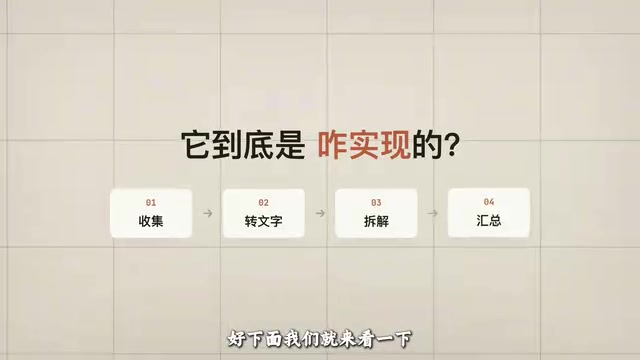
With the list in place, the tool automatically fetches new videos from these creators, then handles collection, deduplication, and organization. This step seems basic, but it determines the quality of the information source for all downstream analysis. Rather than letting AI crawl the entire internet aimlessly, the human first defines a high-signal "intelligence network" — which is exactly what allows the system to consistently produce useful insights.
Step 2: Local Transcription — Turning Video into Text
Initially, the author wanted AI to "watch the videos" directly, but quickly realized that approach was slow and expensive — AI processes video by breaking it into individual frames, which drives costs sky-high. The pivot: convert audio to text first, because AI reads text far faster and cheaper than it processes images.
Technical Choice: Local Deployment with FunASR
The author chose FunASR, an open-source speech recognition model from Alibaba, running entirely on a local machine. No money spent, no data sent to external servers — balancing both cost and privacy.
What is FunASR? FunASR (Fundamental Speech Recognition) is an open-source speech recognition framework released by Alibaba DAMO Academy in 2022. It supports high-accuracy transcription in Chinese, English, and multiple other languages. Its core model, Paraformer, achieves commercial-grade recognition accuracy on academic benchmarks. Compared to calling online services like OpenAI Whisper API or iFlytek Cloud, the biggest advantage of deploying FunASR locally is zero marginal cost — no API fees regardless of how much audio you process — while keeping data local, which matters for creators who want to protect account information and competitive research data.
Hundreds of videos were batch-converted into transcripts.

But there was a catch: FunASR's raw output is a wall of text with no punctuation and no paragraph breaks — hard for humans to read and hard for AI to parse. To fix this, the author stacked two additional open-source models from Alibaba that pair naturally with FunASR:
- FSMN-VAD (Voice Activity Detection): Identifies speech start/end boundaries to handle sentence segmentation
- CT-Transformer (City Transformer): Uses contextual semantics to automatically add punctuation to raw text
Together, the three form a complete "audio → readable transcript" pipeline. The output is clean and well-structured, providing a solid data foundation for downstream analysis.
Step 3: Structured Prompting Framework — Make AI "Fill in the Blanks" Instead of "Free Styling"
This is the part the author considers the most valuable piece of the entire system. At first, he dumped all the transcripts into AI and asked it to summarize "why this went viral." The results were generic platitudes like "high-quality content" and "resonates with the audience" — technically true but completely useless.
The key insight: don't let AI free-style. Define a framework first, then have it fill in the boxes.
Why does structured prompting work? There's solid theory behind this approach. When faced with open-ended questions, large language models (LLMs) tend to output the "safe expressions" most common in their training data — generic conclusions that sound correct but carry almost no information. By pre-defining an output format and specific dimensions, the prompt effectively narrows the model's "search space," forcing it to generate concrete, verifiable content within each slot rather than hovering at a high level of abstraction. This is also the underlying logic of Chain-of-Thought (CoT) prompting — have the AI fill in intermediate reasoning steps before reaching a conclusion. In the field of Prompt Engineering, this is called Structured Prompting, and it's widely recognized as best practice for business analysis, competitive research, content strategy, and similar use cases.
The author defined five fixed dimensions:
- Topic Angle
- Opening Hook
- Content Structure
- Viral Moment
- Engagement Trigger

For each transcript, AI fills in each of these five slots. Using a video titled From Beginner to 10K AI Followers (100K+ likes) as an example, the breakdown came through clearly: the topic angle was "a replicable path for ordinary beginners learning AI"; the hook was the counterintuitive line "daring to imagine matters more than daring to act"; the structure was "show results first, then argue the point, then do a retrospective"; and the viral moment landed on the sense of hope in "ordinary people can catch up too."
The methodology here is worth more than the tool itself. Define the framework first, then have AI fill it in — this is more valuable than mastering any particular tool. Whatever type of analysis you're doing, the principle of structured prompting applies universally.
Step 4: Feishu Multidimensional Table — Building a Visual Dashboard
The final step pushes all transcription and analysis data into a Feishu (Lark) multidimensional table and sets up a visual dashboard — "who's blowing up lately and why" becomes instantly visible at a glance.

Why Feishu Multidimensional Table? Feishu Multidimensional Table is ByteDance's Airtable-like product, combining the structured storage of a relational database with the ease of use of a spreadsheet, and natively supporting kanban views, chart views, and other visualizations. For automation workflows, it provides an open API that allows data to be written, queried, and updated via HTTP requests directly — making it a popular "data endpoint" for AI automation projects in China. After AI processes the data, results are pushed to the table, where team members can browse and collaborate without any technical knowledge. This "backend automation + frontend readability" separation is the standard architectural pattern for modern No-Code/Low-Code workflows.
To control costs, the author set one rule for AI: don't analyze every video — only analyze the ones that actually went viral, avoiding unnecessary token spend. So each morning, the latest viral content intelligence is already organized and waiting in the table.
Viral Patterns That Emerged from the Data
As hundreds of data points accumulated, patterns naturally surfaced. The author distilled several findings worth noting:
- The first three seconds decide everything — Among the AI creators he follows, nearly every viral video either opens with a big number or drops a counterintuitive statement in the first three seconds to grab attention immediately.
- More technical = fewer views — The deeper a video goes into deployments, code, and hard technical content, the steeper the view drop; content that's emotionally driven and broadly accessible regularly pulls tens of thousands of likes.
- One shareable sentence is crucial — Whenever a script contains a single line that makes people want to repost it, the metrics don't disappoint.
These conclusions weren't guesswork — they were extracted one by one from hundreds of real data points. That's the advantage of data-driven competitive analysis over gut instinct.
Conclusion: The Tool Is the Surface; the Methodology Is the Core
The real lesson from this "Content Creator Competitor Radar" isn't how much time it saves — it's the transferable AI workflow it demonstrates: use local open-source models to cut costs, use structured frameworks to constrain AI output, use automated pipelines to hand off repetitive work to machines.
The author has packaged the entire toolset into a skill and encourages everyone to replicate it with AI assistance — which is itself a live demonstration of the "replicate whatever you see" learning method he advocates. For content creators, it's a tireless competitor radar. For AI learners, it's the shortest path from "watching someone else build" to "building it yourself."
Related articles
PGP-Clinical-TimeKAN: A Detailed Guide to the Multivariate Physiological Indicator Joint Prediction Framework
An in-depth analysis of the PGP-Clinical-TimeKAN framework for joint probabilistic prediction of multivariate physiological indicators, covering trajectory-first paradigm, KAN message passing, MIMIC-IV validation, and ablation studies.
CriticGen: A New Framework That Transforms AI Evaluation into Actionable Improvement Feedback
CriticGen proposes a generation-aware evaluation framework that transforms AI assessment from passive scoring to an active optimization loop, achieving 73.17% answer improvement and 93.28% non-degradation rate.

Vercel AI SDK workflow-harness Update Analysis
Deep analysis of Vercel AI SDK workflow-harness 1.0.107 update: architecture design, engineering practices, and developer value for building reliable AI apps.