Vibe Coding in Action: Building a Tetris Hardware Project in 15 Minutes with Natural Language
Natural language programming turns hardware development from a specialist skill into a conversational creative tool for everyone.
Vibe Coding is breaking into hardware development: developers describe their intent in natural language, and AI automatically generates and deploys hardware control code. Participants completed projects like Tetris in just 15 minutes — far faster than traditional methods. This paradigm is reshaping STEM education by shifting the focus from "teaching code" to "teaching thinking," while driving the democratization of hardware making.
From Code to Conversation: A Paradigm Shift in Hardware Development
While debates about AI-generated code reliability are still ongoing, a deeper transformation has quietly taken hold — controlling hardware directly through natural language. No more learning programming syntax, no more wrestling with complex logic bugs. Just describe what you want, as if chatting with a friend, and your hardware project takes shape.
This is the latest breakthrough of Vibe Coding in the hardware space. The concept was formally introduced by OpenAI co-founder Andrej Karpathy in early 2025. Its core idea: developers describe their intent in natural language, and an AI model automatically generates, debugs, and deploys the code — removing humans from the traditional line-by-line writing loop. In the hardware domain, this paradigm requires an additional hardware abstraction layer — the AI must understand physical interface concepts like GPIO pins, PWM signals, and serial communication, then map natural language instructions to concrete embedded control code. Real-world results speak for themselves: participants using only natural language interaction have completed multiple hardware projects — including a joystick-controlled mini game, Tetris, a music wall, and an animated electronic pig — quickly, intuitively, and with a strong sense of accomplishment.
Building Tetris in 15 Minutes: A Real-World Vibe Coding Efficiency Test
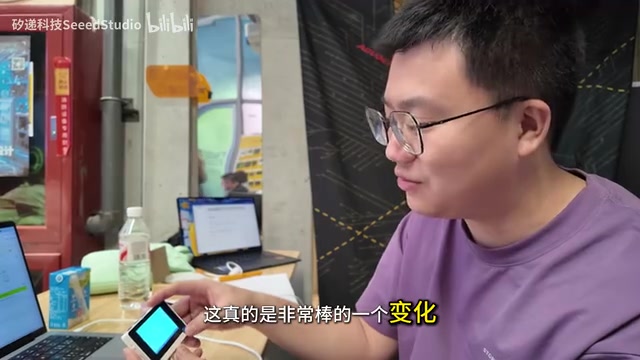
Multiple participants shared their firsthand experiences with natural language programming. One built a dog mini-game controlled by a joystick, with different buttons switching between colors — results were impressive. Another completed a Tetris project in just 15 minutes — something that would take even an experienced developer several hours using traditional methods.
The key to this efficiency gain: developers no longer need to think about "how to implement" something — they focus entirely on "what they want." The underlying technical architecture is an AI Agent's three-layer "Perception–Planning–Execution" loop: the perception layer parses the user's natural language input and extracts functional intent and hardware constraints; the planning layer uses a large language model to decompose intent into executable sub-task sequences (e.g., initialize the display driver, configure input pins, write the main game loop); the execution layer calls code generation tools, compilers, and flashing toolchains to actually deploy code to the target hardware, with automatic debugging via serial logs — forming a complete closed loop. You simply describe what you need, and the AI Agent automatically generates the corresponding hardware control code and deploys it.

From Drag-and-Drop Blocks to Natural Language: The Programming Barrier Drops Again
Before this, programming education for beginners had already gone through one major simplification — from text-based code to graphical drag-and-drop blocks. Scratch, developed by MIT Media Lab in 2003, replaced written code with visual building blocks, lowering the barrier from "syntactically correct" to "logically correct." It now has over 100 million registered users worldwide.
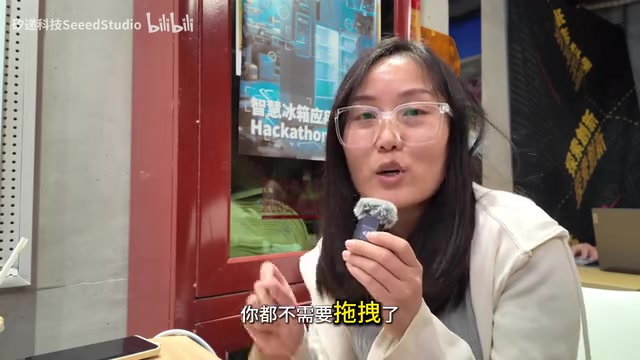
Looking back at this progression of lowering barriers: machine code → assembly → high-level languages → graphical blocks → natural language — each leap in abstraction level brought an order-of-magnitude expansion in who could participate. Natural language programming is the latest jump on this path, and its revolutionary quality lies in eliminating the final barrier of "learning how to express yourself" — humans are born knowing how to speak. Now, even dragging and dropping is unnecessary. As one participant put it: "You can communicate with it entirely in natural language, just like using a chatbot, and tell it what you want to generate."
Take the music wall project as an example: you simply say "I want to make a music wall," then specify whether the display effect should be dots, stripes, or something else — and the system handles the rest automatically. This interaction model brings the barrier to hardware development to an unprecedented low.
The Far-Reaching Impact of Natural Language Programming on STEM Education
Solving the Core Pain Points of Traditional Hardware Teaching
Multiple educators have spoken highly of this technology. Traditional hardware programming education faces several core challenges:
- Steep learning curve: Students must first master programming syntax, compilation principles, and logical thinking
- Frequent errors: Debugging consumes enormous time and dampens motivation
- Wide skill gaps: Students with different backgrounds progress at very different rates, making it hard to teach effectively
Natural language programming addresses all of these at once. Students are no longer stuck on syntax details — they can directly express ideas and see results. Students at any skill level can quickly bring their concepts to life.
From "Teaching Code" to "Teaching Thinking": The Transformation of Maker Education
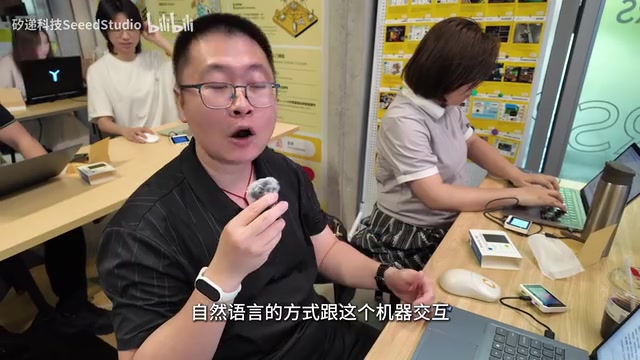
One educator noted a fundamental shift in teaching approach: "Before, we had to teach students how code compiles, how to write it, and the logic behind it. Now we've changed our teaching method — students can interact with machines using natural language."
This shift is grounded in solid educational theory. Computational Thinking was systematically defined by Carnegie Mellon University professor Jeannette Wing in 2006, encompassing four core dimensions: decomposition, pattern recognition, abstraction, and algorithm design. Traditional programming education used "learning to write code" as the primary vehicle for developing computational thinking — but this approach suffers from a clear tool-goal confusion: enormous teaching time is spent on memorizing syntax and debugging techniques rather than on thinking skills themselves. Natural language programming decouples the two — students can directly train computational thinking within the high-level loop of "describe requirements → decompose the system → verify results," while AI acts as a dynamic scaffold, enabling learners to achieve success on complex tasks beyond their current skill level, thereby sustaining motivation.
This doesn't mean programming thinking has become unimportant — rather, the educational focus shifts from "how to write code" to "how to clearly articulate requirements" and "how to think systematically." This is actually a higher-order capability — and precisely the skill that is genuinely scarce in the age of AI.
The Future of Vibe Coding: Democratizing Hardware Making
Empowering Everyone to Become a Maker
"Being able to let people who have absolutely no coding background implement hardware functions in the future — that's a truly remarkable change." This statement captures the core value of Vibe Coding: technology democratization.
Technology democratization refers to the process of opening up capabilities — once accessible only to a small group of specialists — to a much broader population through tool innovation. Historically, desktop publishing software in the 1980s gave ordinary people professional typesetting capabilities; smartphones brought mobile internet to billions of users. The democratization of hardware has lagged behind — Arduino's emergence in 2005 expanded microcontroller development from professional engineers to the maker community, and natural language-driven hardware programming has the potential to expand that community by another order of magnitude. When programming is no longer the domain of a select few, when anyone can realize hardware ideas through conversation, we can expect:
- A creativity explosion: More people from non-technical backgrounds participating in hardware innovation
- Rapid prototyping: Time from idea to prototype shrinking from days to minutes
- Broader education: Hardware programming education starting as early as elementary school or even kindergarten
From Domestic to International: Exporting China's AI Education Solutions
Notably, participants have already expressed genuine interest in "bringing this into classrooms in Singapore," signaling the potential for Chinese AI education solutions to reach an international audience.
Related articles
Deep Dive into AI Agent Skill Design: …
Deep Dive into AI Agent Skill Design: Engineering Practices from Anthropic and Perplexity
A deep dive into Skill design philosophy from Anthropic's Claude Code team and Perplexity's Agent team, covering the Tax Test, Gotchas Flywheel, progressive disclosure, and Eval-First practices for building high-quality AI Agent skill systems.
Deep Dive into OpenAI's Official GPT-5…
Deep Dive into OpenAI's Official GPT-5.6 Prompting Guide: The Shift from Manual to Automatic
A deep dive into OpenAI's official GPT-5.6 Sol prompting guide: conciseness-first, outcome-oriented design, autonomy boundaries, tool routing, and reasoning intensity tuning.
 Deep Dives
Deep Dive into How OpenClaw (Open-Source Crayfish) AI Agent Works
Deep analysis of OpenClaw AI Agent internals: System Prompt, tool calling, SubAgents, Skill system, memory, and Context Engineering explained.