Vibe Coding in Practice: A Complete Guide to Building Profitable Apps with AI — No Coding Background Required

Vibe Coding lets non-programmers build and monetize full apps using nothing but natural language.
Vibe Coding is a human-AI programming paradigm coined by Andrej Karpathy in 2025, where developers describe intent in natural language and AI generates the full codebase. Riley Brown — with no deep coding background — raised $9M using this approach. His methodology covers identifying user pain points, validating workflows in ChatGPT, rapid prototyping with tools like V0.dev, and achieving professional design through screenshot-based imitation. The core belief: critical thinking beats technical skill in the AI era.
What Is Vibe Coding?
Vibe Coding is rapidly becoming one of the hottest tech entrepreneurship trends of 2025. The term was formally coined in early 2025 by AI researcher Andrej Karpathy — former Director of AI at Tesla and co-founder of OpenAI — to describe a new human-AI collaborative programming paradigm. Instead of writing code line by line, developers describe their intent in natural language and let large language models (LLMs) generate, debug, and iterate entire codebases. This shift became possible thanks to a qualitative leap in code generation capabilities from models like GPT-4 and Claude 3 — models that not only understand natural language requirements but can produce fully functional applications and self-correct based on error messages.
Unlike traditional programming, vibe coding doesn't require you to write code by hand, debug files, or understand complex technical architectures. You simply describe what you want in plain language, and AI generates the complete application for you.
This episode's guest, Riley Brown, is a standout example of this movement. He doesn't have a deep programming background and isn't a software engineer — yet he just raised $9 million for his AI application, Vibe Code. His core belief: in the age of AI, critical thinking and the ability to move fast matter more than technical skills.
As Riley puts it: "If you're a great critical thinker — someone who can identify problems and then solve them through prompts — you're going to be one of the most dangerous people in the world over the next few decades."
The Core Vibe Coding Methodology: A Complete Path from Problem to Product
Step 1: Identify User Pain Points
Riley emphasizes that everything starts with finding a real problem. He likes to use visual tools like Whimsical or Excalidraw to map out a "problem → ideal state" diagram. In the episode, he uses YouTube creators as an example: the biggest pain point for new creators is "not knowing what questions to ask themselves" — they lack experience and don't know how to organize their thinking to write a compelling video script.
This leads to a product idea: what if you could turn YouTube growth strategist Patty Galloway's methodology into an AI coaching app that dynamically asks users questions and then generates a professional script based on their answers? That's something people would pay for.
Step 2: Validate and Build Your Workflow in ChatGPT
Before writing a single line of code, Riley builds out a complete prompt workflow inside ChatGPT. He has the AI research Patty Galloway's methodology, generate a series of questions for users, and then narrow them down to the 5 most valuable ones.
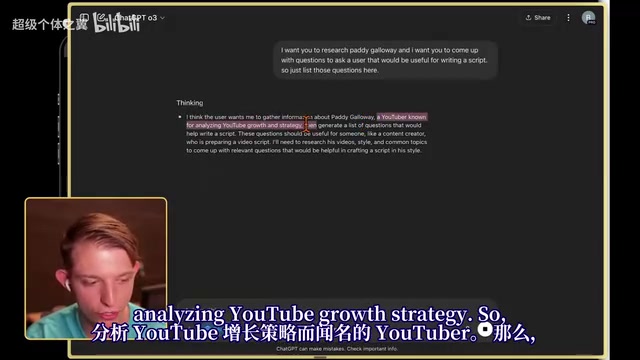
There's a key insight here: prompts are programming. From a technical standpoint, prompt engineering is the core skill for interacting effectively with large language models. LLMs are fundamentally probabilistic models built on the Transformer architecture — they predict the most likely output sequence based on the input context. Research shows that structured prompts (with role definitions, task descriptions, output format requirements, and constraints) can improve output quality by 30–50% compared to vague instructions. Chain-of-Thought (CoT) techniques — asking the model to "think step by step" — significantly boost accuracy on complex reasoning tasks. When Riley says "prompts are programming," he means it technically: prompts define the behavioral logic of an AI system, making them a form of declarative programming.
Riley believes most people underestimate the importance of prompts. At its core, it's the ability to "effectively communicate your ideas to a PhD-level system and get useful answers back." Once you've refined a workflow in ChatGPT that works for you, you can turn it into a software product.
Step 3: Rapidly Prototype with AI Coding Tools
Riley demonstrates how multiple tools work together:
Claude Artifacts — the tool that first made him realize AI could generate runnable code. You can watch code render into a real application interface directly within the chat window.
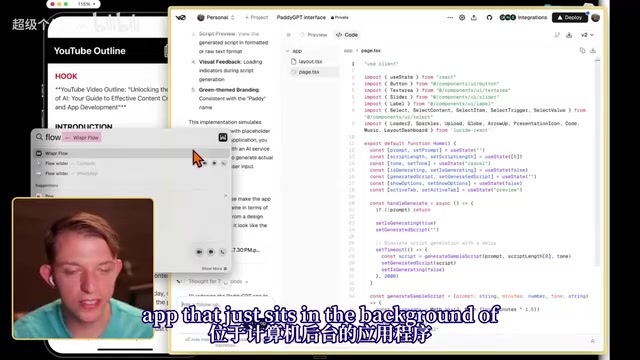
Vibe Code App — Riley's own product, which lets you describe requirements by voice and generates a mobile app. In the episode, he creates a "voice-to-YouTube outline" mobile app with a single voice prompt — the entire process takes just one instruction.
V0.dev — Riley's favorite tool for building web apps. V0.dev is an AI-driven UI generation tool launched by Vercel (a leading global frontend cloud platform) in 2023. Built on the Next.js framework and the shadcn/ui component library, it converts natural language descriptions directly into production-ready React component code. Next.js is currently the most popular full-stack React framework, supporting server-side rendering (SSR), static site generation (SSG), and API routes — an industry standard for building modern web applications. V0's technical advantage is that it doesn't generate throwaway prototype code; it produces engineering-grade code that can be deployed directly to Vercel's platform. This compresses the path from "AI-generated UI" to "live application" down to minutes — which is exactly why Riley can demo a complete product build in real time on the show. He creates a "Patty GPT" script-writing interface in just a few minutes.
Step 4: Steal Like an Artist, Iterate Fast
This is one of Riley's most practical tips: screenshot a website design you like, upload it directly to V0, and ask it to re-render your app in that style. He grabbed a screenshot of Lovable.dev, uploaded it to V0, and said "keep the functionality the same, but redesign it to match the screenshot" — and got a professional-grade interface in seconds.
He even used ChatGPT 4o's image generation feature to create a custom gradient background image, then uploaded it to V0 as the app's background. The whole process showcases the power of multi-tool collaboration.
One important prompt tip: always add "change nothing else" at the end of your instructions. AI sometimes "over-delivers" when executing your request, drifting away from your original design.
From Prototype to Profit: The Vibe Coding Path to Monetization
Testing and User Feedback
Riley recommends the following before officially launching:
- Use it yourself for a week — treat yourself as the user, repeatedly test the quality of the AI's output, and keep refining your prompts
- Deploy it to the internet — tools like V0 let you deploy with one click and generate a shareable link
- Send it to trusted friends — not your mom (she'll just say "it's amazing!"), but people who will honestly tell you "this is rough, you can do better"
Related articles
 Tutorials
ChatGPT Plus Subscription Guide: Are GPT-5.5, image-2, and Codex Worth the Upgrade?
A detailed look at ChatGPT Plus features — GPT-5.5, image-2, and Codex — with a Plus vs Pro comparison and a complete step-by-step subscription guide for users outside the US.
 Tutorials
Harness AI Engineering in Practice: Using Claude Code to Master Enterprise-Level E-Commerce Development
Deep dive into Harness AI Engineering: master enterprise e-commerce development with Claude Code using the Rules, Skills, Wiki, and Changes framework.
 Tutorials
Cursor + Codex Dual-IDE Collaboration: A Practical Methodology for Open-Source Project Customization
A complete methodology for open-source project customization based on real-world experience, detailing the Cursor+Codex dual-IDE workflow, seven-stage process, MVP validation, and AI source code reading techniques.