Vibe Coding in Practice: A Comprehensive Review and Selection Guide for 6 AI Coding Tools

A practical head-to-head review of 6 AI coding tools to help you choose the best Vibe Coding solution.
Vibe Coding, coined by Andrej Karpathy, lets developers build software by describing requirements in natural language instead of writing code line by line. This article reviews 6 major tools — Claude Code, Trae, Zhipu, Cursor, Baidu Miaoda, and Tongyi Lingma — comparing cost, Chinese language support, free tiers, and code quality to help you pick the right one.
What Is Vibe Coding?
In recent years, a concept has taken the global developer community by storm — Vibe Coding. This term was coined in early 2025 by Andrej Karpathy, co-founder of OpenAI and a top researcher in deep learning. Karpathy, who previously served as Tesla's AI Director and later contributed to the GPT model series, described a brand-new development experience on social media: fully immersed in an AI-assisted development flow, barely reading code himself, and instead continuously describing intent in natural language, accepting AI output, and validating results. This effortless, flow-like state is what he called Vibe Coding — where "vibe" captures that sense of ambient, immersive atmosphere. The core idea is using AI to drive the entire development process.
This paradigm is made possible by a major breakthrough in code generation capabilities of large language models (LLMs). Modern code generation models, pre-trained on massive code corpora, equipped with ultra-long context windows (capable of processing an entire codebase in one pass), and refined through instruction fine-tuning and RLHF, now achieve over 90% one-pass success rates on authoritative benchmarks like HumanEval — the technical basis behind the claim that "roughly 80% of AI-generated code can be used directly in production."
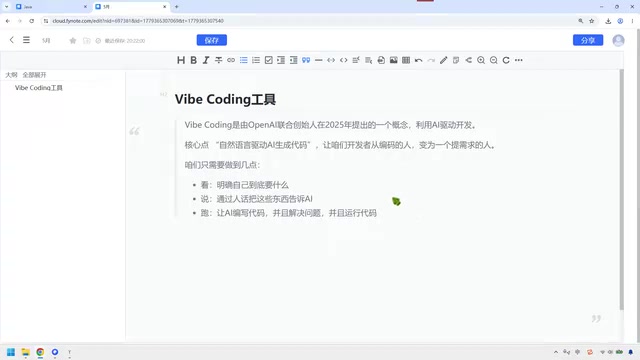
In short, Vibe Coding fundamentally overturns traditional programming: instead of writing code line by line from scratch, you describe in plain language what product you want and what the details are, and the AI tool generates runnable code directly. Your job is simply to state requirements, review results, and ask the AI to iterate.
This shifts developers from "people who write code" to "people who define requirements" — more like technically-savvy product managers. For moderately complex projects, about 80% of AI-generated code can go straight into use.
Traditional Programming vs. Vibe Coding: A Kitchen Analogy
-
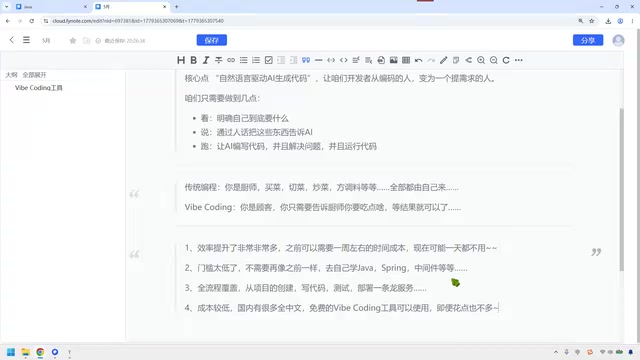
Traditional programming is like being your own chef — buying ingredients, chopping, cooking, and seasoning all by yourself. In practice, that means handling requirements analysis, design documents, architecture, API specifications, coding, compilation, local debugging, frontend integration, and deployment — all on your own shoulders.
-
Vibe Coding turns you into a customer — just tell the chef (the AI) what you want to eat and wait for the result. If it's too salty, ask for sugar; not spicy enough, ask for chili. You provide feedback; the AI executes.
Why Has Vibe Coding Gone Viral?
This programming paradigm offers several obvious advantages:
Massive efficiency gains: A requirement that used to take a team a week can now often be handled in less than a day with Vibe Coding tools.
Extremely low barrier to entry: Even if you can't read code at all, you can get things done by repeatedly telling the AI "change this part, adjust that part." You no longer need to master programming languages, frameworks, ecosystems, or middleware — the ability to articulate requirements clearly is the only core skill you need.
End-to-end coverage: From project creation and coding to testing and deployment, the whole pipeline is handled in one place. This trend is even spawning new career paths.
Affordable cost: There are plenty of fully Chinese-language, free tools available domestically. Even for paid options, the main cost is just model token consumption. A token is the basic unit LLMs use to process text — roughly 0.5 to 1 Chinese character per token. As AI inference costs have dropped sharply over the past two years, leading domestic models (like DeepSeek and Doubao) now price their APIs as low as 0.1–1 RMB per million tokens. For a mid-complexity graduation project built entirely with AI assistance, the total token cost typically amounts to just a few to a few dozen yuan — that's the economics behind "what used to cost 800–900 yuan in outsourcing now costs a few yuan in tokens," and the fundamental reason Vibe Coding has become truly accessible to everyone.
Of course, every coin has two sides. This also means that market demand for programmers may continue to contract — a reality every practitioner needs to face squarely.
A Head-to-Head Review of 6 Mainstream Vibe Coding Tools
Claude Code (Anthropic): Best Overall Experience
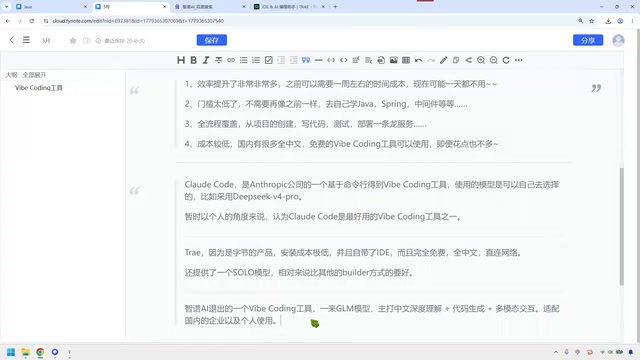
Claude Code is currently one of the best all-around Vibe Coding tools available. It's a command-line tool from Anthropic — think of it as a souped-up terminal window where you describe what you need and it generates all kinds of code.
Claude Code's command-line interface is no accident; it reflects the philosophy of "Agentic programming." Unlike traditional IDE plugin-style AI assistants, Claude Code runs in Agent mode: it doesn't just generate code — it can autonomously execute terminal commands, read and write the filesystem, invoke compilers, and run test scripts, forming a complete "perceive–plan–execute–feedback" loop. This makes it capable of handling complex engineering tasks across files and modules. The command-line form also provides environment agnosticism — whether on macOS, Linux, or a remote server, it runs wherever there's a terminal.
Key strengths: Models can be freely swapped (there are now setups pairing it with DeepSeek series models, offering a practical workaround for domestic users dealing with network restrictions), code generation is precise and debugging is strong, it handles complex backend business logic with ease, and all code is stored locally — addressing enterprise concerns about code security and intellectual property.
Main drawbacks: It's not a domestic product, so installation requires a VPN and carries some risk of failure — while it's just one command, some users get it working on the first try while others may need multiple attempts. It also only supports command-line operation, making multimedia input like images cumbersome, and its Chinese language comprehension is relatively weaker.
ByteDance Trae: Ready Out of the Box, Completely Free for Domestic Users
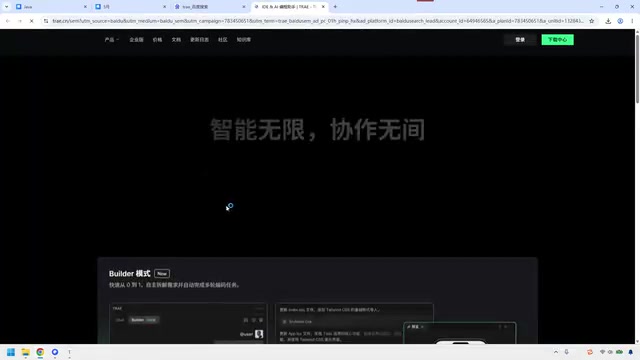
Trae is ByteDance's AI coding product and one of the first tools many domestic developers pick up.
Key strengths: As a product from a major domestic tech company, the installation friction is minimal — just search for the official website and download. It comes with a full IDE (no command-line environment setup needed), a built-in communication panel ready to use right away. Most importantly — the domestic version is completely free, with built-in access to Doubao and several other free models, a fully Chinese interface, direct network access, and zero barrier to entry.
Trae also offers a more capable Solo mode, which outperforms the standard Builder mode overall. It's largely usable now, though you may need to wait briefly during peak hours.
If Claude Code scores 90 points, Trae comes in at just above 80 — the real-world gap is not as wide as you might expect.
Zhipu AI: One of the Top Domestic AI Coding Tools
Zhipu AI's Vibe Coding tool is built on its proprietary GLM model and is one of the strongest players in domestic Chinese code generation. GLM (General Language Model) originated from Tsinghua University's KEG Lab and is one of China's most academically grounded LLMs, with deep technical expertise in Chinese semantic understanding. With the GLM-4 series, Zhipu now fully supports multimodal capabilities.
Standout features: Excels at deep Chinese comprehension and supports multimodal interaction — unlike Claude Code which only accepts text input, Zhipu lets you hand it documents and screenshots directly, so it can analyze the content and start building the product (essentially "code from images," which dramatically reduces ambiguity in requirement descriptions). It also caters to domestic enterprise and individual needs, supports local private deployment (using the open-weight GLM version, enterprises can run it entirely on an intranet to meet data compliance requirements in sectors like finance and healthcare), and the personal version is free (with paid token top-ups available once the free quota is exceeded).
Cursor: AI-Native IDE Pioneer, but Pricey
Cursor is one of the earliest AI-native IDEs, launched by Anysphere in 2023. Its core innovation was upgrading AI capabilities from "autocomplete plugin" to "native editor feature." Built on the VSCode codebase with AI-native features like Composer (multi-file simultaneous editing) and Codebase indexing (full-repository semantic search), Cursor was once the world's largest Vibe Coding tool by user base, with the most mature ecosystem — many companies bought team subscriptions in bulk for their employees.
However, in today's crowded landscape, its disadvantages have become increasingly apparent: the Pro subscription at around $20/month is not cheap, domestic use requires a VPN with inconsistent stability, and its Chinese comprehension lags behind domestic-first tools like Zhipu and Trae. Cursor's rise and relative decline also illustrates the "shallow moat, fast iteration" dynamic of the AI tools market — first-mover advantages can be eroded by a competitor's cost advantages within just a few months.
Baidu Miaoda & Alibaba Tongyi Lingma: The Big Platforms Join the Race
Baidu Miaoda is Baidu's no-code AI programming tool — free for individuals and paid for teams, best suited for users already deep in the Baidu ecosystem.
Alibaba's Tongyi Lingma is deeply integrated with the Alibaba Cloud ecosystem, offers rich plugin support, and also delivers solid Chinese language comprehension.
Interestingly, several major domestic products have converged on similar interface styles and feature positioning. When making your choice, consider your own tech stack and usage habits.
Selection Guide: How to Find the Right Tool for You
Based on this comprehensive review, here are practical recommendations:
- If you have VPN access: Start with Claude Code — it delivers the best overall code quality;
- For purely domestic environments: Zhipu and Trae are recommended — strong Chinese support, low barrier, and free to use;
- For enterprise needs or local deployment: Zhipu is the safer choice.
All the other tools are worth trying too, since each has its own strengths — in certain scenarios, a different tool might simply work better for you.
Conclusion: The Paradigm Shift from "Writing Code" to "Defining Requirements"
Vibe Coding isn't really about replacing programmers — it's about freeing developers from large volumes of repetitive, low-creativity code writing. A lot of developer burnout stems from "staring at code until it all blurs together" — and now, that part of the work can be handed off to AI.
The core skill developers truly need to cultivate going forward is how to deeply understand product requirements and how to communicate effectively with AI tools. This capability is known academically as Prompt Engineering — effective prompts typically include a clear task objective, sufficient contextual information, the expected output format, and representative examples. Research shows that for the same task, the code quality difference between a high-quality and a low-quality prompt can be several times over. At its core, this is about transferring the requirements analysis mindset from software engineering into the context of human-AI dialogue: decompose requirements → describe technical choices → clarify boundary conditions → define acceptance criteria. Learning to articulate requirements precisely may well be the most durable competitive edge for programmers in the AI era.
Key Takeaways
Related articles

WebMCP in Practice: How MakeMyTrip Is Reshaping the Travel Booking Experience
India's largest OTA platform MakeMyTrip uses WebMCP to standardize AI Agent interactions with web apps, replacing fragile DOM scraping with natural language-driven test automation and simplified complex booking scenarios.

Deep Dive into the EYG Programming Language: A New Portable Programming Paradigm Designed for Humans
Deep analysis of the EYG programming language's core design, including algebraic effects, program state persistence, and cross-platform portability, exploring how it addresses modern software fragmentation.

WebMCP in Practice: How MakeMyTrip Is Reshaping the Travel Booking Experience
India's largest OTA platform MakeMyTrip uses WebMCP to standardize AI Agent interaction with web apps, solving DOM scraping fragility, enabling natural language test automation, and simplifying complex international flight bookings.