Vibe Coding Interview Tips for Campus AI Product Manager Recruitment: Key Assessment Areas & Response Strategies

Systematic breakdown of Vibe Coding interview strategies for campus AI PM recruitment
This article approaches from the interviewer's perspective to systematically outline core assessment areas in the Vibe Coding segment of campus AI product manager interviews. It identifies three key dimensions: what you specifically built with AI programming, how you corrected AI errors (including Few-shot and other Prompt Engineering techniques), and what technical concepts you learned (such as APIs and JSON). It also provides response strategies for advanced follow-up questions, including rule documentation and data validation mechanisms, emphasizing the integration of product thinking with quality awareness.
Introduction
With the widespread adoption of AI programming tools like Cursor and Copilot, Vibe Coding—a programming paradigm coined by OpenAI co-founder Andrej Karpathy in early 2025—has become a high-frequency topic in product manager campus recruitment interviews. The core idea of Vibe Coding is that developers describe their intent in natural language and rely entirely on AI to generate code, barely writing any code themselves. This paradigm quickly sparked extensive discussion in both tech and product circles because it significantly lowers the barrier for non-technical people to participate in software development, enabling product managers to rapidly build prototypes and tools.
For fresh graduates, demonstrating hands-on experience with AI programming while showcasing product thinking and quality awareness in interviews directly determines whether you'll land an offer. Unlike traditional programming, the essence of Vibe Coding isn't about mastering syntax—it's about whether you can precisely articulate requirements, identify the quality boundaries of AI output, and establish reproducible workflows. These are exactly the capabilities interviewers truly want to assess.
This article approaches the topic from the interviewer's perspective, systematically outlining the core assessment areas and response strategies for the Vibe Coding segment in campus AI product manager interviews, helping you build a comprehensive interview preparation framework.
Three Core Dimensions of Vibe Coding Interview Assessment
Dimension 1: What Exactly Did You Build with Vibe Coding?
The first thing interviewers want to understand is how you specifically used AI programming tools in your projects. This isn't simply saying "I wrote code with Cursor"—you need to clearly describe:
- Which stage you used AI for: Was it writing web scrapers, regular expressions, building interfaces, or data processing?
- What code AI produced: What was the specific functionality of the code?
- What role this code played in the project: What business problem did it solve?
Using a legal document project as an example, you could answer: "I had AI write regular expressions to extract dispute focal points, compensation amounts, and legal statute names from court judgments, ultimately generating structured tables."
Technical Background: Regular Expression (Regex) is a formalized language for describing string patterns. In legal document processing, it can precisely match fields with fixed formats like "Compensation amount: RMB XX million." Compared to AI semantic understanding, its advantages are speed, deterministic results, and immunity to contextual interference. However, regular expressions are extremely sensitive to format variations—once document formats become inconsistent, they easily fail. This is precisely why combining AI for semantic fallback is necessary. A product manager who understands the capability boundaries of regex can make sound judgments between "rule engine vs. AI model" during technical solution selection.
This type of answer includes both technical details and business value, demonstrating your judgment in tool selection.
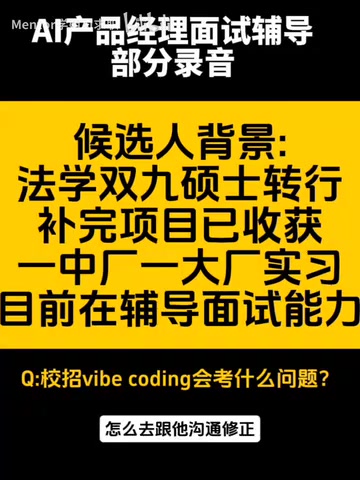
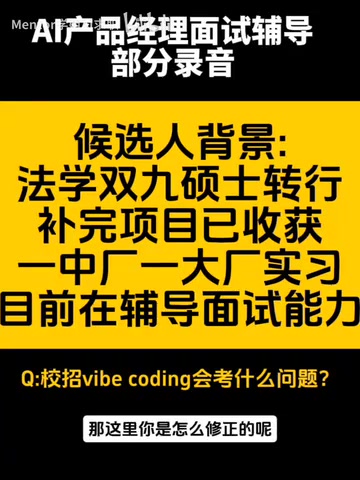
Dimension 2: How Did You Correct AI When It Made Mistakes?
This is one of the areas interviewers value most. They want to hear the complete loop: identifying AI errors, communicating corrections to AI, and consolidating rules to prevent recurrence.
Practical Case Demonstration:
For example, in legal document extraction, AI mistakenly treated content from "the plaintiff alleges" as dispute focal points. Your correction strategy could be:
- Provide AI with a sample text along with the correct output format
- Explicitly tell AI which fields qualify as dispute focal points and which don't
- Use a Few-shot approach to teach AI the distinction
Technical Background: Few-shot Prompting is one of the core techniques in large language model inference, originating from a key finding in the GPT-3 paper. The principle is to provide a small number of input-output examples (typically 2-5) alongside the instruction when sending commands to AI, allowing the model to understand task patterns through analogy learning without retraining model weights. Compared to Zero-shot (giving only instructions without examples), Few-shot can significantly improve accuracy on complex tasks, especially for information extraction scenarios with strict formatting and ambiguous boundaries. In the legal document extraction case, providing AI with annotated judgment excerpts as examples is essentially applying Few-shot technique to guide the model in establishing correct field identification boundaries.
This answer demonstrates your problem diagnosis ability and Prompt Engineering skills. Prompt Engineering refers to the methodology of systematically designing and optimizing input text for interacting with AI models. Its essence is highly similar to writing requirements documents—both require eliminating ambiguity, clarifying boundaries, and defining acceptance criteria. Core techniques include: role setting, task decomposition, constraint conditions, and output format specification. Product managers who master these techniques can dramatically reduce the number of iterations when collaborating with AI—far more insightful than saying "I just had AI regenerate it."
Dimension 3: What Technical Concepts Did You Learn?
Campus recruitment doesn't require technical mastery, but you need to demonstrate a spirit of exploration. Interviewers will look for whether you understand:
- Basic concepts of frontend and backend
- How to call APIs
- JSON data format
- Database fundamentals
The key is being able to articulate: which model's API you called, and what the input/output looks like.
Technical Background: API (Application Programming Interface) is a standardized protocol for communication between software systems. In AI programming scenarios, calling a large model API means sending an HTTP request, passing the user's Prompt as input to a cloud-based model, and receiving the model-generated text as output. A typical AI API call contains three key elements: Endpoint (interface address, such as OpenAI's chat/completions), Request Body (containing model name, message content, temperature parameters, etc.), and Response (typically in JSON format, containing generated text content and token consumption). Understanding this process enables product managers to evaluate the latency, cost, and reliability of AI features, leading to more informed product decisions.
This reflects a product manager's cognitive ability regarding technical boundaries—you don't need to write APIs yourself, but you need to know what an API call entails, as this directly impacts your judgment on product feasibility and cost.
Advanced Follow-up: Can Vibe Coding Output Go to Production?
When interviewers ask "Can the code from your Vibe Coding go directly to production?", don't force a claim that you wrote unit tests. An honest and professional answer should cover these three levels:
Rule Documentation — The PM's SOP Mindset
Document key rules (such as extraction field definitions for legal documents) in MD files, and have AI read this document before generating code each time to ensure output consistency. This essentially transforms tacit knowledge into explicit knowledge, allowing AI to work within the same "contextual framework" every time, avoiding output instability caused by variations in Prompt phrasing.
Data Validation Mechanism — Quality Control Awareness
Manually annotate 5-10 real data entries as a validation set. If AI's results deviate from expectations by more than 10%, adjust the Prompt and retry. This method draws from the "test set evaluation" approach in machine learning.
Related articles
 Tutorials
ChatGPT Plus Subscription Guide: Are GPT-5.5, image-2, and Codex Worth the Upgrade?
A detailed look at ChatGPT Plus features — GPT-5.5, image-2, and Codex — with a Plus vs Pro comparison and a complete step-by-step subscription guide for users outside the US.
 Tutorials
Harness AI Engineering in Practice: Using Claude Code to Master Enterprise-Level E-Commerce Development
Deep dive into Harness AI Engineering: master enterprise e-commerce development with Claude Code using the Rules, Skills, Wiki, and Changes framework.
 Tutorials
Cursor + Codex Dual-IDE Collaboration: A Practical Methodology for Open-Source Project Customization
A complete methodology for open-source project customization based on real-world experience, detailing the Cursor+Codex dual-IDE workflow, seven-stage process, MVP validation, and AI source code reading techniques.