Vibe Coding Practical Guide: SDD Methodology Explained with 4 Enterprise-Level AI Programming Projects

SDD specification-driven development is the core framework for AI programming in the Vibe Coding era.
This article introduces SDD (Specification-Driven Development), a systematic methodology for the Vibe Coding (AI programming) era that emphasizes driving AI programming through specification documents rather than random instructions. The course teaches the full AI programming lifecycle through four progressive enterprise-level projects (Chat BI, open-source secondary development, multimodal knowledge base, and intelligent document compliance review platform), with the core argument that methodology far outweighs tools, and that Prompt Engineering and SDD thinking are foundational developer capabilities in the AI era.
Introduction: The Vibe Coding Era Has Fully Arrived
In the second half of 2025, Vibe Coding (AI programming) is rapidly transitioning from concept to mainstream development practice. The term "Vibe Coding" was coined by Andrej Karpathy (former Tesla AI Director and OpenAI co-founder) in early 2025, referring to a paradigm where developers no longer write code line by line but instead describe their intent in natural language, letting AI generate the code while developers review, adjust, and guide. This concept quickly resonated across the industry because it precisely describes the fundamental shift in programming brought about by the leap in large language model capabilities—from "writing code" to "steering AI to write code."
Anthropic's CEO has publicly stated that their internal studios barely write code by hand anymore, and an increasing number of development teams are fully embracing AI programming tools. A technical lead with four years of AI large model development experience—Teacher Xigua—has launched a systematic Vibe Coding full-stack development bootcamp based on practical experience accumulated from over 70 AI programming projects.
What's most noteworthy about this course isn't the tools themselves, but the underlying SDD (Specification-Driven Development) methodology and Prompt Engineering mindset. This article provides an in-depth analysis of the course's core philosophy, project design logic, and practical value for developers in different roles.
Why Traditional Programmers Are Facing Obsolescence Risk
Teacher Xigua raises a controversial yet thought-provoking point: Traditional programmers who still rely on hand-writing code will face obsolescence within six months.
This isn't alarmist rhetoric. His team mandated that all R&D personnel stop hand-writing code in the second half of 2025, fully transitioning to AI programming. In just six months, the team consumed hundreds of billions of tokens on AI programming, accumulating extensive practical experience. Tokens are the basic unit of measurement for large language model text processing—one Chinese character corresponds to approximately 1.5-2 tokens. The consumption of hundreds of billions of tokens means the team engaged in massive interactions with AI models—including code generation, debugging, refactoring, documentation, and the entire development lifecycle. This data reflects the real-world intensity of AI programming in industrial-grade scenarios, far beyond what individual developers experience when occasionally using Copilot to autocomplete a few lines of code. More critically, this experience doesn't come from simple demo exercises but from industrial-grade projects delivered to enterprise clients.
Typical challenges developers currently face include:
- Obsessing over framework version differences and syntax details while ignoring the efficiency revolution brought by AI programming
- Being able to install AI programming tools like Cursor and Claude Code but unable to independently complete enterprise-level projects
- AI tools throwing frequent errors when handling complex features, with debugging taking longer than hand-writing code
- Product managers and project managers needing rapid prototyping but lacking systematic technical implementation capabilities
The root cause of these problems lies in the lack of a systematic AI programming methodology, not deficiencies in the tools themselves.
SDD Specification-Driven Development Methodology: The Core Framework for AI Programming
What Is SDD Specification-Driven Development
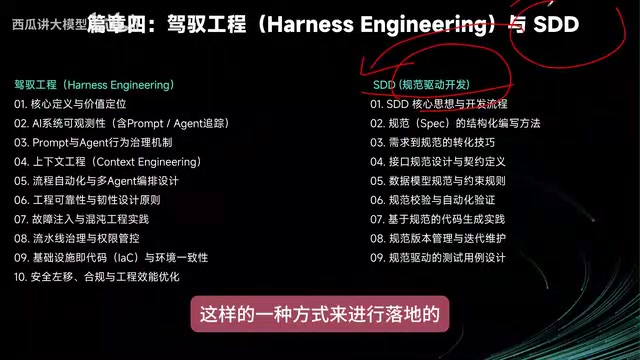
SDD (Specification-Driven Development) is currently a widely recognized and efficient development paradigm in the Vibe Coding space. Its core principle is: driving AI programming based on specification documents, rather than issuing scattered instructions to AI randomly.
Simply put, SDD requires developers to complete the definition of requirement specifications, architecture specifications, interface specifications, and other documents before having AI write code. AI programming tools generate code based on these specification documents, significantly improving code quality and project controllability.
It's worth noting that software engineering already has multiple mature development paradigms, such as TDD (Test-Driven Development), BDD (Behavior-Driven Development), and DDD (Domain-Driven Design). TDD emphasizes writing test cases before implementation code, BDD focuses on business behavior descriptions, and DDD centers on business domain modeling. SDD can be seen as the natural evolution of these paradigms in the AI programming era—it shifts the human's core work forward to the specification definition phase, delegating code implementation to AI. Specification documents serve as both the precise expression of human intent and the critical input for AI to generate high-quality code. This paradigm shift means the developer's core value transitions from "coding ability" to "specification definition ability" and "architecture design ability."
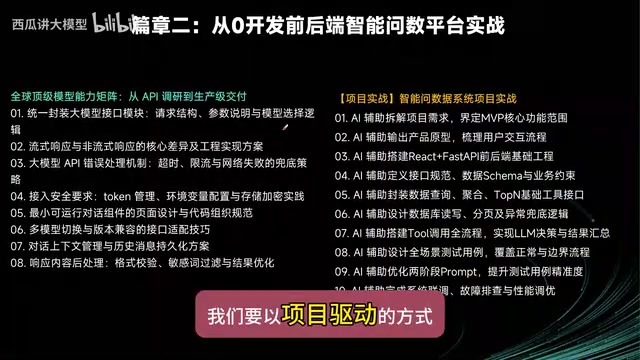
However, SDD is easy to talk about but another matter entirely to implement. Teacher Xigua emphasizes that all four projects in the course are developed using SDD, with every step strictly following the specification process—from requirement research, business modeling, and architecture design to code generation, integration testing, and deployment operations.
Why Prompt Engineering Is the Foundational Skill for AI Programming
The course positions Prompt Engineering as a core chapter for two reasons:
-
Deep understanding of tool principles: Only by mastering Prompt Engineering can you truly understand the working mechanisms behind AI programming tools like Cursor and Claude Code, rather than staying at the surface level of button operations. Cursor is an AI-native IDE deeply modified from VS Code, integrating code completion, conversational programming, and codebase indexing, excelling at interactive development within a graphical interface. Claude Code is Anthropic's command-line AI programming tool, using the terminal as its primary interaction interface, excelling at understanding and modifying large-scale codebases with support for longer context windows. These two represent the two main forms of AI programming tools: IDE-integrated and command-line native, each with suitable use cases. Understanding their underlying Prompt processing mechanisms is essential to maximizing tool effectiveness.
-
Building enterprise-level complex agents: Enterprise-level complex AI Agent development requires systematic Prompt Engineering thinking to design Prompt chains and interaction logic. An AI Agent refers to an AI system capable of autonomously perceiving its environment, making plans, invoking tools, and executing tasks. In enterprise development, complex agents typically require designing multi-step reasoning chains, tool invocation orchestration, memory management, and error recovery mechanisms. This is fundamentally different from simple single-turn Prompt interactions—it requires developers to possess systematic Prompt chain design capabilities and understand how to decompose complex business processes into sub-task sequences executable by AI.
These two points establish that Prompt Engineering is not just a practical skill but a foundational capability that developers must possess in the AI programming era.
Breakdown of Four Progressive Enterprise-Level Vibe Coding Projects
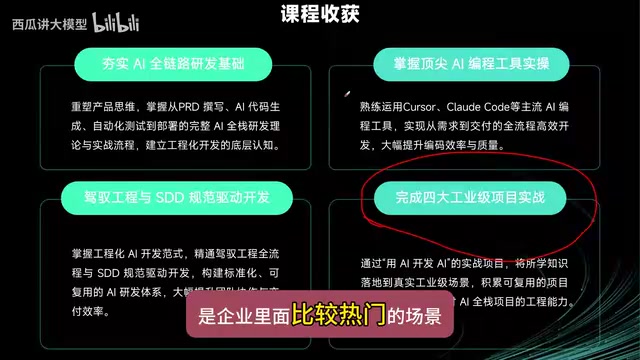
The course designs four enterprise-level projects with increasing complexity, each carrying different AI programming teaching objectives, forming a complete capability progression path.
Project 1: Chat BI Intelligent Data Query Platform
This is the entry-level project with the core goal of helping students find their groove with AI programming. Starting from scratch, it includes complete front-end and back-end development, demonstrating step by step how to use AI programming tools like Cursor to build a complete project.
Chat BI (intelligent data querying) is a very popular application scenario in enterprises today—users query databases through natural language, and AI automatically generates SQL and returns visual reports. The technical core is Text-to-SQL, which converts users' natural language questions into structured SQL query statements. This technical pipeline typically includes: natural language understanding, database schema mapping, SQL generation, query execution, and result visualization. In recent years, as large language models' reasoning capabilities have improved, Text-to-SQL accuracy has significantly increased, enabling non-technical users to directly "converse" with databases for insights, greatly lowering the barrier to data analysis. This project helps students quickly build intuitive understanding of the entire AI programming workflow through hands-on practice.
Project 2: Secondary Development Based on the OPCFlow Open-Source Project
This project switches to another extremely common development scenario: secondary development based on an existing open-source project. The chosen project is OPCFlow (Xiaolongxia), which has a large codebase and high complexity.
The core challenge of this scenario is that developers need to first leverage AI to understand the architecture and logic of an existing codebase, then perform feature extensions and custom development on top of it. In actual enterprise development, opportunities to build projects from scratch are far fewer than iterating and extending existing systems. When facing an open-source project with tens or even hundreds of thousands of lines of code, knowing how to use AI to quickly build global understanding, locate key modules, and comprehend data flows is an extremely practical skill. The course systematically outlines a methodology for AI programming secondary development, which has extremely high application frequency in real work.
Project 3: Multimodal Knowledge Base System
This is a project developed using Claude Code, introducing a critical challenge: using new technology stacks that AI is unfamiliar with.
When a project requires technologies that aren't as popular as React, Vue, or Python—technologies with less coverage in the model's training data—AI programming tools' performance noticeably degrades. Large language models' code generation capabilities are highly dependent on training data distribution—for mainstream tech stacks, models have learned massive amounts of high-quality code from platforms like GitHub, resulting in excellent generation quality. But for niche frameworks, internal enterprise SDKs, newly released libraries, or industry-specific tech stacks, the model's training data coverage is insufficient, easily producing "hallucinations"—generating seemingly reasonable but actually non-existent API calls or incorrect usage.
How should the SDD approach be adjusted in these cases? How can specification documents and contextual supplements compensate for AI's knowledge blind spots? For example, developers can inject official documentation and API reference manuals as context, or write detailed technical specification documents to constrain AI's generation scope. This is an extremely common problem in real development and a key pain point the course aims to resolve.
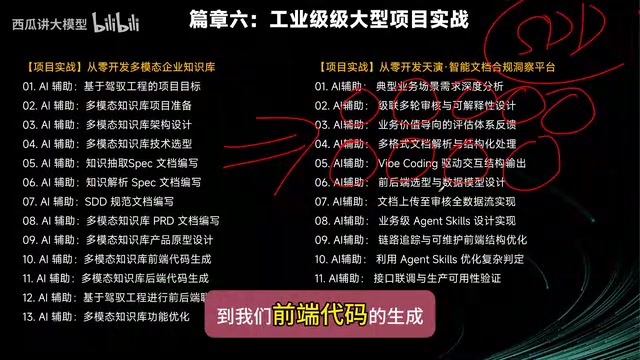
Project 4: Intelligent Document Compliance Review Agent Platform
This is the course's capstone project, covering the complete enterprise-level development lifecycle:
- Requirement research and business analysis
- Business modeling and system architecture design
- Technology selection and PRD document generation
- Front-end UI design and back-end code generation
- Front-end and back-end integration and API interfacing
- Code management, automated deployment, testing, and operations
All stages are completed through SDD specification-driven development, ultimately producing a validated, replicable AI programming methodology system. This project also has strong business value in itself—intelligent document compliance review is a critical use case in heavily regulated industries like finance, law, and healthcare, involving the comprehensive application of multiple technologies including document parsing, rule engines, and multimodal understanding, fully demonstrating the complexity of enterprise-level AI applications.
What You Can Do After Mastering the Full AI Programming Pipeline
Independently Deliver Enterprise-Level Projects
From architecture design and technology selection to front-end and back-end development, testing, and deployment, students can independently complete the full development lifecycle of enterprise-level projects. This isn't simply "knowing how to use AI tools" but possessing the practical ability to deliver industrial-grade products using the Vibe Coding approach.
Deep Mastery of Cursor and Claude Code
The course focuses on Cursor and the globally leading Claude Code as the two primary AI programming tools, but more importantly, it teaches the underlying methodology. After mastering SDD and Prompt Engineering thinking, regardless of which AI programming tool you switch to in the future—whether GitHub Copilot Workspace, Windsurf, or tools that haven't been created yet—you can quickly get up to speed and produce efficiently. This is the core value of "teaching someone to fish."
Gaining a Replicable Methodology System
Teacher Xigua particularly emphasizes that the AI programming methodology summarized by the team has been validated through over 70 real projects and is replicable and transferable. This means students aren't learning scattered tricks for specific scenarios but mastering a universal AI programming paradigm applicable to any type of software development project.
The Future Direction of AI Programming and Developer Response Strategies
From this course's design, we can identify several important trends in the Vibe Coding space:
First, the value of methodology far exceeds the tools themselves. AI programming tools will continuously iterate and update, but development paradigms like SDD will remain effective long-term. Just as design patterns in software engineering have remained applicable for decades, the "specification first, AI executes" thinking that SDD represents will become the foundational paradigm of the AI programming era. Developers' core competitiveness in the future won't lie in which tool they can use, but in whether they've mastered systematic AI programming thinking and standardized development processes.
Second, Prompt Engineering is becoming a core developer skill. It's not just about writing good prompts—it's the foundational capability for understanding how AI systems work and designing complex agent architectures. As AI Agent frameworks (such as LangChain, CrewAI, AutoGen, etc.) rapidly evolve, developers who can design multi-agent collaboration systems and orchestrate complex tool invocation chains will gain enormous competitive advantages. Prompt Engineering will foreseeably become a standard skill for future technical positions.
Third, the barrier to full-stack development capabilities is dropping significantly. With AI programming tools and SDD methodology, non-traditional technical roles like product managers and project managers also have the opportunity to independently complete prototype development or even product delivery. This will profoundly change collaboration models and talent structures in the software industry. The traditional linear process of "product manager writes requirements → designer creates prototypes → developers write code → QA engineers verify" is being challenged by the new model of "one person completing the entire pipeline with AI assistance."
For developers, the most important thing right now isn't worrying about being replaced by AI, but proactively embracing change, arming yourself with systematic methodology, and becoming a pioneer in the AI programming era. Mastering SDD specification-driven development and Prompt Engineering thinking is the best starting point for taking that step.
Key Takeaways
- SDD (Specification-Driven Development) is the widely recognized core methodology in AI programming, emphasizing development based on specifications rather than random instructions
- The course includes 4 progressive enterprise-level projects: Chat BI intelligent data query, OPCFlow secondary development, multimodal knowledge base, and intelligent document compliance review platform
- Prompt Engineering has dual value: understanding AI programming tool principles and building enterprise-level complex agents
- The methodology summarized from 70+ industrial-grade projects and hundreds of billions of tokens consumed has been validated as replicable
- In the AI programming era, methodology matters more than tools—mastering SDD thinking enables rapid adaptation to any AI programming tool
Related articles
 Tutorials
ChatGPT Plus Subscription Guide: Are GPT-5.5, image-2, and Codex Worth the Upgrade?
A detailed look at ChatGPT Plus features — GPT-5.5, image-2, and Codex — with a Plus vs Pro comparison and a complete step-by-step subscription guide for users outside the US.
 Tutorials
Harness AI Engineering in Practice: Using Claude Code to Master Enterprise-Level E-Commerce Development
Deep dive into Harness AI Engineering: master enterprise e-commerce development with Claude Code using the Rules, Skills, Wiki, and Changes framework.
 Tutorials
Cursor + Codex Dual-IDE Collaboration: A Practical Methodology for Open-Source Project Customization
A complete methodology for open-source project customization based on real-world experience, detailing the Cursor+Codex dual-IDE workflow, seven-stage process, MVP validation, and AI source code reading techniques.