Vibe Coding vs AI Engineering: A Practical Enterprise-Level Comparison Guide

Vibe Coding suits small demos; enterprise AI development demands engineering workflows, Skills, and structured processes.
This guide breaks down the fundamental difference between Vibe Coding and AI Engineering, comparing Claude Code and Codex through two real projects — an e-commerce site and an OpenRouter-style model aggregation platform. The key insight: enterprise-grade AI programming requires encapsulating software engineering best practices into reusable Skills, enabling team collaboration and quality control at scale.
From Vibe Coding to AI Engineering
The most widely circulated claim about AI programming is: "Even without being a developer, you can build complete projects with AI tools." This statement gets amplified endlessly, but reality is far more nuanced. Bilibili content creator "Zhugou" offers a more grounded take in his 2-hour hands-on course: Vibe Coding works well for small zero-to-one projects, but enterprise-level development still requires engineering discipline and professional expertise.
Vibe Coding refers to non-technical users directing AI coding tools via natural language to rapidly generate demo-level products like websites, mini-programs, or small games. The concept was formally introduced by OpenAI co-founder Andrej Karpathy in early 2025, quickly sparking widespread discussion in the developer community. Its fundamental limitation: LLMs generating code lack continuous awareness of the overall system architecture. As projects scale up, problems accumulate rapidly — context window overflow, chaotic inter-module coupling, missing test coverage — ultimately rendering the project unmaintainable. For simple, low-traffic applications with limited data, AI can genuinely handle the load. But when a project enters the enterprise tier — complex business logic, complex technology, large user bases, large data volumes — relying purely on natural language instructions makes delivery nearly impossible.
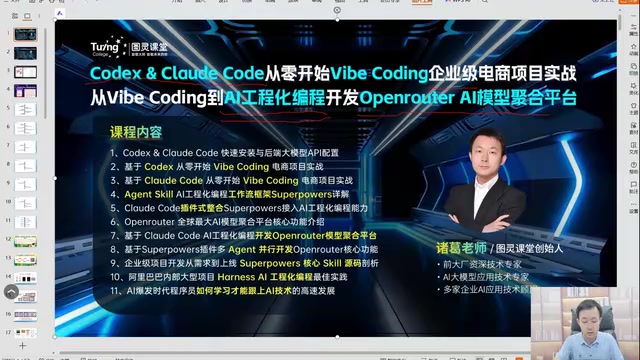
This is the core value of this course. Rather than staying at the "show-off" level, it breaks AI programming into two distinct paths: Vibe Coding for beginners, and AI Engineering for real enterprise team collaboration.
Tool Comparison: Codex vs Claude Code
The course uses two mainstream AI coding tools for a hands-on comparison: OpenAI's Codex and Anthropic's Claude Code.
Positioning Differences
OpenAI Codex originated as a code-specialized fine-tuned version of GPT-3, later evolving into Codex CLI and its cloud-based agent form. Its core capability is mapping natural language to executable code snippets — well-suited for single-file, single-task rapid generation. The barrier to entry is low, making it broadly accessible. Anthropic's Claude Code is a terminal-native coding agent built on the Claude 3 model series. Its design philosophy emphasizes deep understanding of entire code repositories — it can read and write across files, execute shell commands, run tests, and iteratively fix issues. It more closely resembles an "AI collaborative developer" with engineering context awareness, making it better suited for professional developers handling complex tasks. The root of this positioning difference lies in the underlying models' context-handling capabilities and the depth of their tool-call design. The instructor's verdict is direct:
"Claude Code paired with the Claude model is currently the strongest combination in AI coding tools; followed by Codex paired with GPT."
It's worth noting a pragmatic adjustment made during the course demos. Since Claude has strict network environment checks and poses account-ban risks for users in China, the instructor didn't connect to Claude's official model as the Claude Code backend. Instead, he integrated one of China's leading coding LLMs — Zhipu's GLM series.
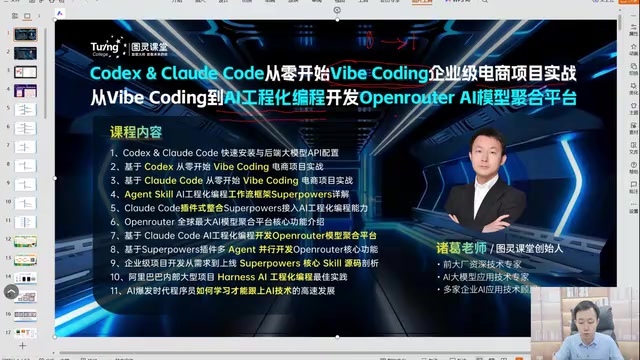
Domestic LLMs in Code Generation
The course specifically notes that beyond Zhipu GLM, domestic models like Tongyi Qianwen, Xiaomi MiMo, and MiniMax also perform strongly in code generation scenarios. Zhipu AI's GLM series (especially the CodeGeeX dedicated coding branch) has reached near GPT-4o levels on mainstream code benchmarks like HumanEval and MBPP. Alibaba Cloud's open-source Qwen2.5-Coder series shows balanced performance in code completion and multilingual support. MiniMax's MoE architecture offers cost advantages for long-context code understanding, while Xiaomi MiMo focuses on math-reasoning-enhanced code generation, excelling at algorithmic tasks. The instructor's view: Zhipu is "slightly better" for the specific task of writing code, with minimal gaps elsewhere. The maturity of this ecosystem means that under network compliance constraints, developers in China can fully build production-grade AI coding workflows — a reliable backend alternative to Claude Code.
Two Full Project Walkthroughs
The course is built around two real projects from start to finish, with all theory serving only as supplementary explanation.
Project 1: E-commerce Website (Vibe Coding Mode)
The first project is an e-commerce website — chosen because everyone understands e-commerce, requiring no extra business context, making it ideal as an introductory case. In the demo, the instructor sets up a project directory named CC-Shop using VS Code + the Claude Code plugin, then kicks off development with a single natural language instruction:
"Please help me develop an e-commerce website that includes user, product, shopping cart, and order functionality. Please do not use any local Skill capabilities."
There's a detail here worth noting — the Skill mechanism. Skills are essentially the conversion of software engineering "process standards" and "domain knowledge" into structured prompt templates or tool functions that AI can invoke. This design philosophy closely mirrors the "separation of concerns" principle in software engineering. The instructor's working environment has dozens or even hundreds of Skills installed — capability modules covering the entire software development lifecycle, from requirements analysis and architecture design to coding, testing, and deployment, each encapsulated as an independent Skill. Their deeper value: transforming tacit engineering experience into shareable, version-controlled, continuously iterable explicit assets — upgrading AI programming from a personalized "one-shot generation" to a team-level "repeatable engineering process." This is precisely what distinguishes AI Engineering from Vibe Coding.

Project 2: OpenRouter-Style Model Aggregation Platform
The second project is considerably more challenging — replicating an AI model aggregation platform like OpenRouter. OpenRouter is currently the world's largest AI model routing aggregation platform. Its core business model: a unified API interface connecting hundreds of models from OpenAI, Anthropic, Google, Meta, and others, charging users slightly above official pricing, pocketing the margin while providing value-added services like routing, fallback, and load balancing. The course notes that OpenRouter is one of the most profitable "AI wrapper" sites globally, with annual revenue in the hundreds of millions. This model is highly profitable because it solves the fragmentation pain of multi-model management for developers, while leveraging scale to secure bulk discounts. The core tech stack for such a platform is an API proxy layer, billing system, user management, and model registry. Building this type of platform through AI Engineering provides a complete demonstration of team-collaborative complex project development — making it exceptionally valuable as a teaching case.
The Core of AI Engineering: Skills and Process Encapsulation
If Vibe Coding is "generate with one sentence," then AI Engineering is embedding software engineering best practices into AI workflows.
The core methodology the course reveals: develop each phase of software development — requirements analysis, architecture design, coding, testing, deployment — as an independent Skill. For example, a requirements analysis Skill has built-in user story decomposition templates specifically for handling product manager requirement documents; an architecture design Skill codifies a layered architecture decision framework; a code standards Skill injects the team's lint rules and naming conventions into the generation context. This is also one of the mainstream paths for AI agents to take root in enterprise software development.

The core advantages of this engineering approach:
- Reusability: Develop a Skill once, reuse it continuously across multiple projects
- Team collaboration: Multiple people collaborate under unified skill standards, reducing friction
- Quality assurance: Engineering standards are baked into AI workflows, avoiding the uncontrolled output of "random generation"
This also explains why enterprise projects can't be completed with Vibe Coding — it fundamentally lacks engineering constraints, collaboration mechanisms, and quality control, and those three elements are precisely the foundation of large, complex projects.
Learning Paths for Developers at Different Levels
Based on the course content, learners from different backgrounds can reference the following roadmaps:
Complete beginners: Start with Vibe Coding, use Codex or Claude Code to quickly build demo-level small projects, and develop intuitive understanding of AI programming. But stay clear-eyed: there's still a significant gap between this and being capable of enterprise-level project delivery.
Experienced developers: Focus on mastering AI Engineering — learn to combine Skills with team collaboration workflows, and genuinely integrate AI into enterprise development practices. This is also the core capability that current roles in AI programming, LLM development, and AI agent application development actually assess.
Tool selection recommendations: For professional depth and coding capability, prioritize Claude Code; in China's network environment, use domestic models like Zhipu GLM as the backend. For ease of use and broad applicability, the Codex + GPT combination works well.
Conclusion
The most valuable part of this hands-on course is not teaching you to generate a website with one sentence — it's that it punctures the inflated narrative of "AI replacing programmers" while pointing developers toward the right way to embrace AI: moving from the toy-grade applications of Vibe Coding toward the production-grade practice of AI Engineering. AI won't replace programmers. But programmers who know how to harness AI with an engineering mindset are already replacing those who are still sitting on the fence.
Related articles

Alibaba Launches Happy Shrimp: AI-Powered One-Click Complete Song Generation
Alibaba launches Happy Shrimp, an AI music generation tool that creates complete songs with lyrics, melody, arrangement, and vocals from natural language descriptions. In-depth analysis of its core features, differentiation from competitors like Suno, and industry impact.
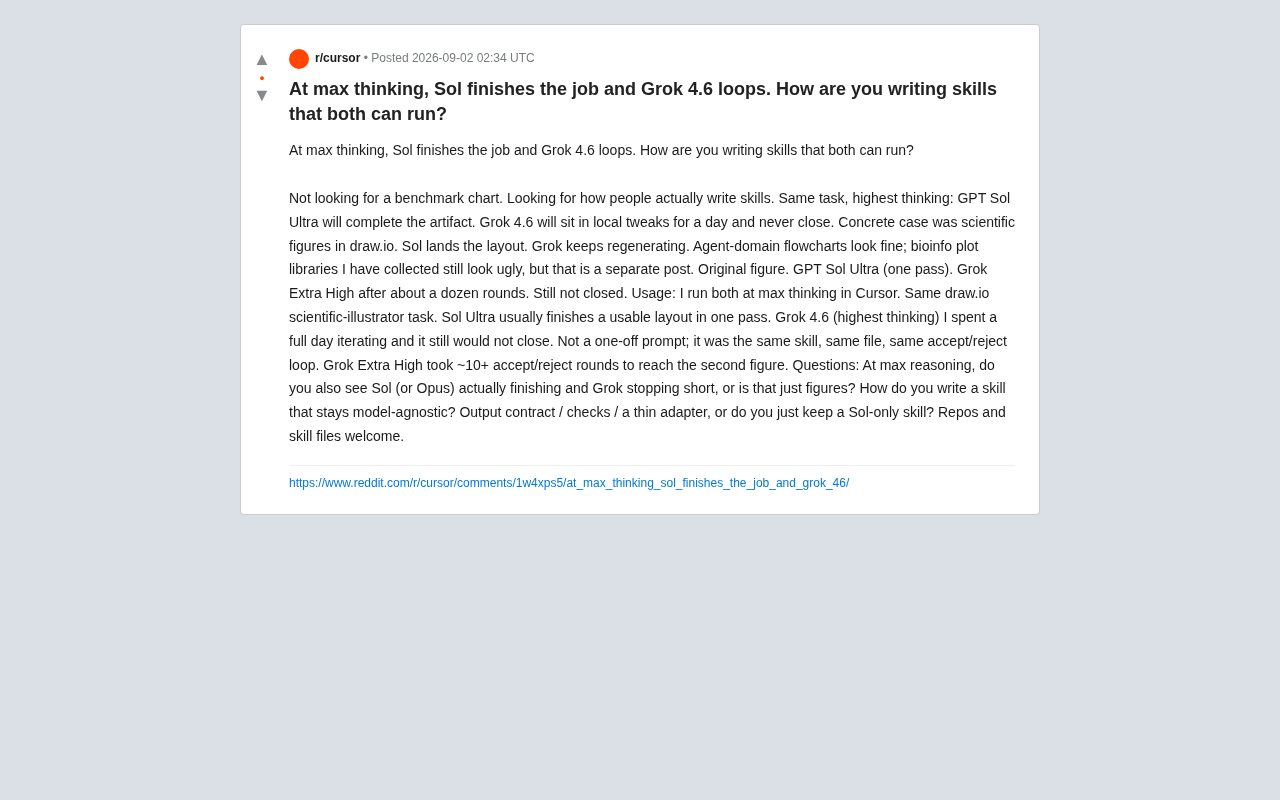
GPT Sol Ultra vs Grok 4.6: Real-World Task Completion Benchmark in Reasoning Mode
Developer benchmark reveals GPT Sol Ultra completes draw.io scientific diagrams in one iteration while Grok 4.6 fails to converge despite maximum reasoning mode, exposing that reasoning depth ≠ task delivery capability.
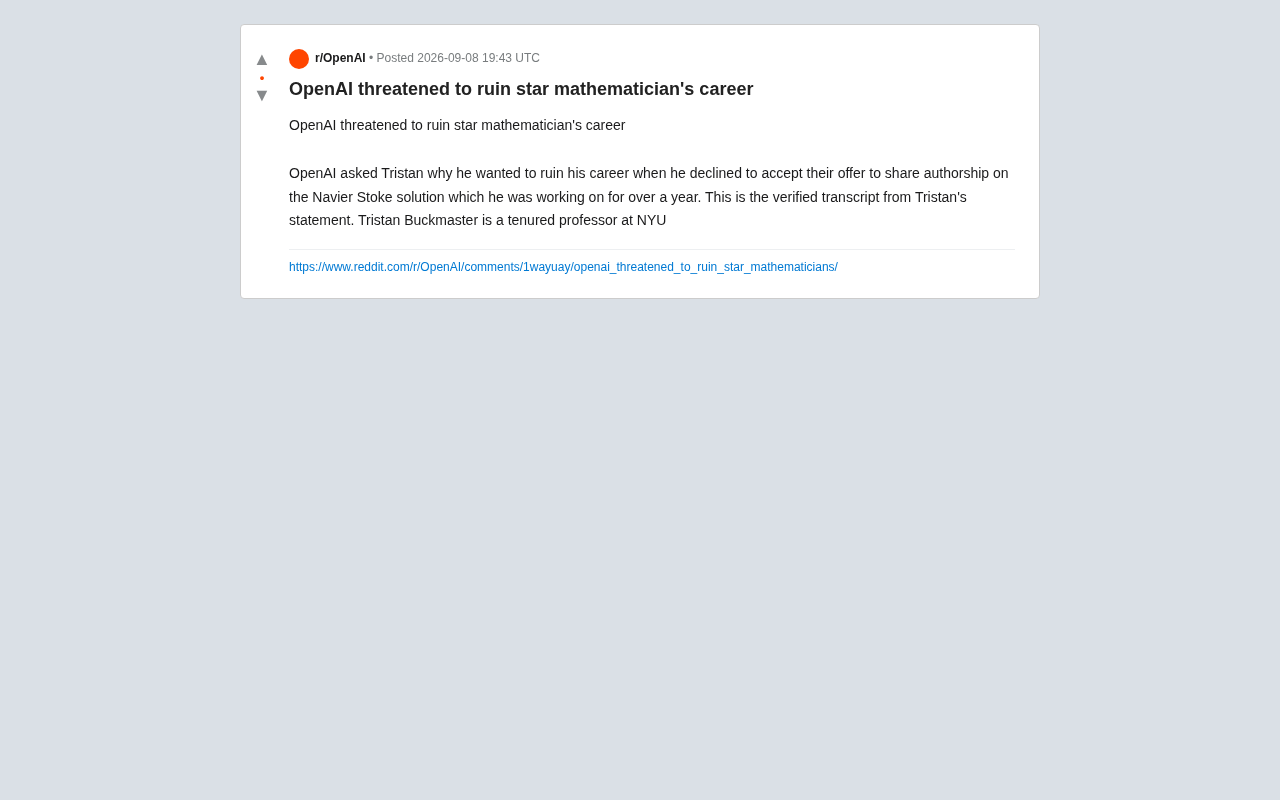
OpenAI Authorship Dispute: The Battle Over Academic Boundaries in the AI Era
OpenAI disputes authorship with mathematician Tristan Buckmaster over Navier-Stokes research, raising ethical questions about AI involvement in science.