Vibe Coding vs Real Software Development: What's the Actual Difference?

Vibe coding covers only coding; real software development needs seven phases of engineering collaboration.
The article distinguishes "vibe coding" from "real software development." Software development has seven phases — planning, analysis, design, coding, testing, deployment, and maintenance — with coding being only one part, though the part AI excels at. Vibe coding skips planning, design, and testing, relying on AI to blindly generate code; typical outcomes include accumulated architectural flaws, no test cases, project abandonment after six months, and production crashes. AI-assisted programming is different: experienced engineers lead architectural decisions, technology choices, and testing strategies, with AI as an accelerator. Vibe coding may suit simple apps, but medium-to-complex projects still require professional engineering teams.
When "Vibe Coding" Meets Real Software Development
When I started learning to code in 2020, ChatGPT didn't exist yet. Writing code was a grind, but every time I fixed a bug or solved an algorithm problem, that "flash of genius" feeling was addictive. By 2022, ChatGPT had arrived — capable of solving coding problems, though still not quite mature. Then products like Lovable promised to "deliver complete apps with AI," and now AI agents are embedded directly in code editors — all we need to do is type a prompt, and AI produces something that "works."
But wait.
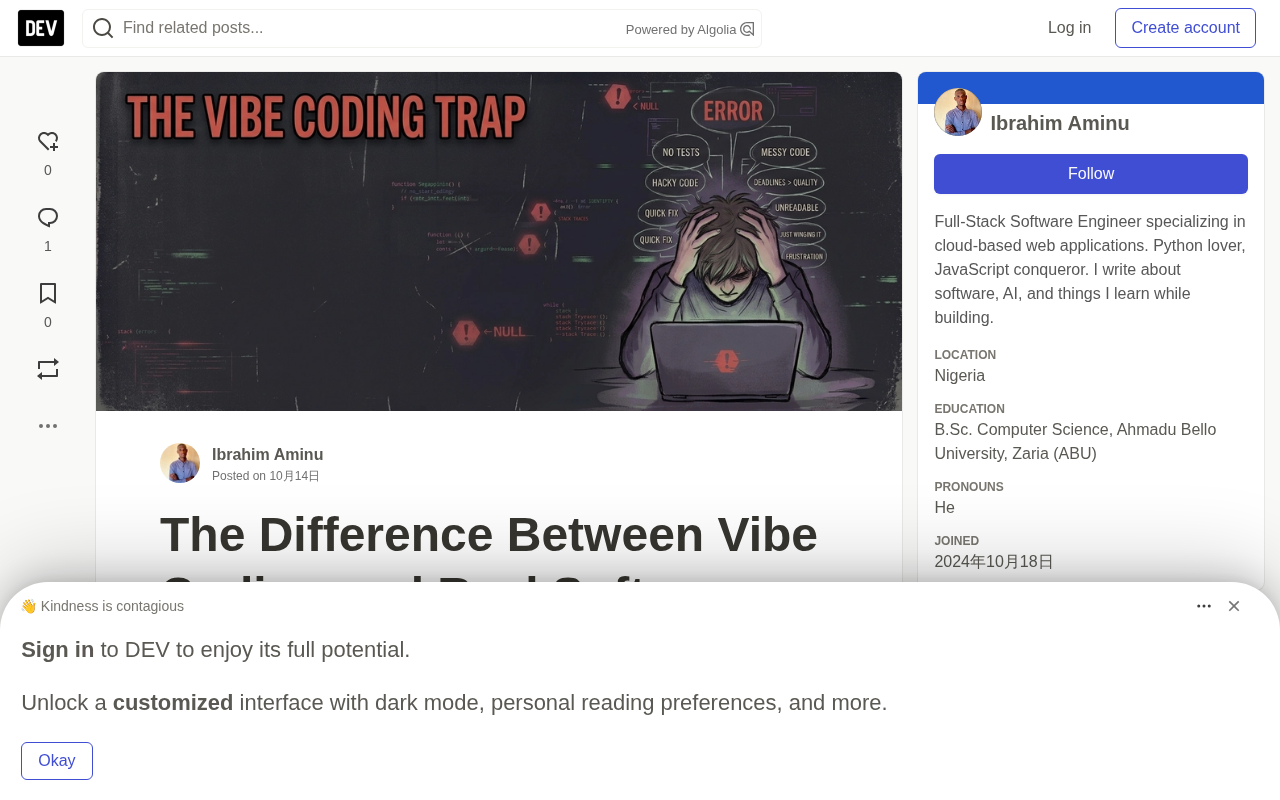
Ask yourself: Am I actually doing software development, or am I just vibe coding? These two things are fundamentally different. One produces reliable products; the other is just beautifully packaged garbage.
What Does Real Software Development Actually Involve?
According to IBM's definition, the Software Development Life Cycle (SDLC) has 7 phases. Let's walk through each one.
1. Planning
Define the project scope, goals, and requirements. In plain terms, figure out what you're actually building. Draw boundaries, list the features you want and the ones you're deliberately leaving out — otherwise you'll fall into "scope creep," where project goals and features spiral out of control.
Scope Creep is a classic project management risk: after a project kicks off, requirements keep getting added or modified without planning, causing time, cost, and quality to spiral. It usually stems from vague initial requirements, stakeholders continually proposing new ideas, or a lack of clear change control processes. In software development, typical symptoms include: constantly adding features during prototyping, repeatedly redesigning the UI, and delaying launch dates over and over. The key to fighting it is to clearly define "what we're building" and "what we're not building" during the planning phase, write requirements as verifiable checklists, and ensure any additions go through evaluation and resource reallocation. Vibe coding is especially prone to triggering scope creep — because adding a requirement to AI only takes one prompt, the perceived cost is extremely low, and project boundaries collapse.
2. Analysis
The data collection phase. Organize user stories, assess market potential, evaluate technical feasibility. This step determines "whether this project is worth doing."
3. Design
Define the project architecture, plan the user interface, database schema, software navigation, and technology choices — monolith or microservices. This step is the heart of the development process and the key differentiator between junior and senior engineers.
4. Coding
Yes, this is the most exciting part. Coding is just one part of development, and AI is genuinely great at it. Pick a language — Java, C#, Python, or JavaScript — and write the application code. This is the part where I won't argue with AI.
5. Testing
Another critical step that separates real engineers from "pseudo-engineers." Testing frameworks are endless: Cypress, Jest, Vite Test, Playwright, Pytest. Testing methods are just as varied: unit tests, integration tests, end-to-end tests. An untested application should not be released to users. Of course, you can't test every scenario, but the higher the coverage, the better.
Unit tests, integration tests, and end-to-end tests are three different levels of verification granularity. Unit tests focus on individual functions or modules, verifying whether the smallest logic unit is correct — they run fast and pinpoint issues precisely. Integration tests focus on whether multiple modules work correctly together, such as whether database connections and API calls interact as expected. End-to-end tests simulate real user flows, walking through the entire system from the interface to the backend, verifying overall system behavior. Together they form the "testing pyramid": the most unit tests at the bottom, the fewest — but most expensive — end-to-end tests at the top. Vibe coding often skips these levels entirely, resulting in code that appears to run fine but, once user volume increases or edge cases appear, failures erupt en masse with no way to pinpoint them.
6. Deployment
Good apps need users. Deployment can be on a third-party PaaS platform (Render, Railway, Fly.io), self-built cloud infrastructure (AWS, Azure, Huawei Cloud, DigitalOcean), or even local deployment. Mobile apps go to the App Store or Play Store. This step can be simple, or it can be a real headache.
7. Maintenance
Application maintenance is an ongoing process: updates, patches, fixes, security checks, monitoring. Software evolves, technology becomes outdated, and you have to keep up. Imagine if Facebook were still stuck at its 2006 version — refreshing to see new messages, who would still use it? Software needs continuous maintenance and improvement.
You might ask: How can one person possibly do all of this? The answer is: one person genuinely can't. Most software is built by teams with different specialties working together — project managers handle planning, systems analysts handle analysis, UI/UX designers and software architects handle design, programmers handle coding, QA engineers handle testing, DevOps engineers handle deployment, and maintenance engineers handle operations. Software engineers must understand and follow all of these processes, collaborate with cross-functional teams, and write clean, maintainable code.
What Vibe Coding Actually Looks Like
Now I sit down with a lollipop in my mouth and tell an AI agent: "Build me a dating app." The AI doesn't even ask for clarification — it just stirs something up and says "here you go." You see a pretty interface but have no idea about the architectural flaws and security vulnerabilities underneath. Until you get 10 users and start noticing the app lagging. You keep prompting AI to fix it, but because you don't understand what works and what's usable, AI fixes one thing while creating new bugs. No test cases. You keep struggling for six months, then confusedly abandon the whole project.
This is the reality of vibe coding. Someone spent six months getting frustrated prompting AI, then gave up on the mess they created. The lucky ones who made it to production start experiencing outages, API failures, and crashes — with no proper monitoring and no way to trace root causes. Money and trust are lost in the process — the two most valuable things for any business.
Not to mention using vibe coding for mission-critical software — systems where lives are at stake — the consequences would be unthinkable.
The famous programmer Brian Kernighan once said:
Everyone knows that debugging is twice as hard as writing a program in the first place. So if you're as clever as you can be when you write it, how will you ever debug it?
Technical Debt is a metaphor introduced by Ward Cunningham: shortcuts taken to deliver quickly will be "repaid" in the future through higher maintenance costs. Vibe coding is essentially taking on massive debt unconsciously — AI-generated code may be redundant, chaotically coupled, poorly documented, and lacking tests as a safety net. When the application scales up and requirements change, these hidden problems surface en masse, and fixing one bug often introduces two more. In contrast, trained engineers consciously manage technical debt: they know when shortcuts are acceptable, when refactoring is mandatory, and how to leave room for evolution at the architectural level. This is precisely the gap between "being able to generate code" and "being able to deliver a reliable product."
AI-Assisted Programming ≠ Vibe Coding
So does this mean you can't use AI in development? Of course not. AI-assisted development means: an experienced, well-grounded engineer uses AI to write code quickly, implement features, or build applications, while providing guidance to the AI — what tools to use, what approach to take, what architectural decisions to make, what tests to write. They pour years of experience into directing AI to build a masterpiece. This is viable and commendable. It also proves one thing: to use AI well, you still need to learn programming and practice problem-solving.
Seriously, vibe coding might work for simple apps, but any medium-to-complex application needs trained professionals.
What pains me most is seeing vibe coders flock to LinkedIn calling themselves "full-stack developers" — someone who can't tell JSON from XML, doesn't know what GitHub is, and still lands clients. The best tools are useless in the hands of fools. This isn't negativity — it's reality.
We will still need excellent engineers in the future to build secure, reliable applications. Those who understand the tech stack won't be replaced. So grab your coffee and write that first line of code — it's going to be a wild ride.
One-line Summary
Vibe coding covers only coding; real software development requires seven phases of engineering collaboration.
Paragraph Summary
The article distinguishes "vibe coding" from "real software development." Software development includes seven phases: planning, analysis, design, coding, testing, deployment, and maintenance — coding is just one part, and it happens to be the part AI excels at. Vibe coding skips planning, design, and testing, relying on AI to blindly generate code. The typical failure path: architectural flaws accumulate, no test cases exist, the project is abandoned after six months, and even production environments suffer outages and crashes. AI-assisted programming is different: experienced engineers lead architectural decisions, technology choices, and testing strategies, with AI serving only as a speed tool. The author emphasizes that vibe coding may suit simple apps, but projects of medium complexity or above still require professional engineering teams working together — those who understand the tech stack won't be replaced.
Related articles

Huberman's Rational Supplement Guide: A Five-Layer Health Framework and Scientific Decision-Making
Stanford neurobiology professor Huberman proposes a rational supplement framework: behavior and nutrition are the foundation, basic combination supplements serve as insurance, and sleep/hormonal/cognitive directions should stick to single-ingredient experiments. Omega-3 is the top single-ingredient choice, and melatonin is not recommended.

The Unsung Painter Behind Gilded Age Manhattan Interior Design
HN discussion highlights the painter behind Gilded Age Manhattan interiors: he created murals and decorative paintings but was long overlooked as his work was seen as architectural appendage.

Can AI Agents Be Socially Engineered? Understanding Prompt Injection and Tool Permission Risks
Through Invariant Lab's GitHub Issue injection and Brave's AI browser attack, this article analyzes how Prompt Injection induces AI Agents to perform unauthorized actions, and offers protection advice across three layers: least privilege, tool validation, and operation auditing.