Vibesmonitor: The One-Stop Ops Center for Monitoring All Your Projects

Vibesmonitor unifies multi-project traffic, errors, feedback, and cookie compliance on one screen with MCP agent queries.
Vibesmonitor is an ops center tool for indie developers and small teams that aggregates traffic, errors, user feedback, and cookie consent across multiple projects into one interface. Its standout features are a smart priority inbox and deep MCP protocol integration, letting AI agents like Claude and Cursor query project health via natural language. With lightweight one-script-per-site setup, it earned 90 votes and ranked 12th on Product Hunt.
Introduction
In today's fast-paced development environment, developers often maintain multiple projects simultaneously, each requiring monitoring of traffic, errors, user feedback, and cookie consent status. Fragmented dashboards and tools significantly undermine operational efficiency. The newly launched vibesmonitor.com on Product Hunt attempts to solve this pain point, positioning itself as "The ops center for everything you ship" — designed to unify multi-project monitoring into a single screen and use an intelligent inbox to prioritize what needs your attention most.
Core Features: One Screen, Comprehensive Monitoring
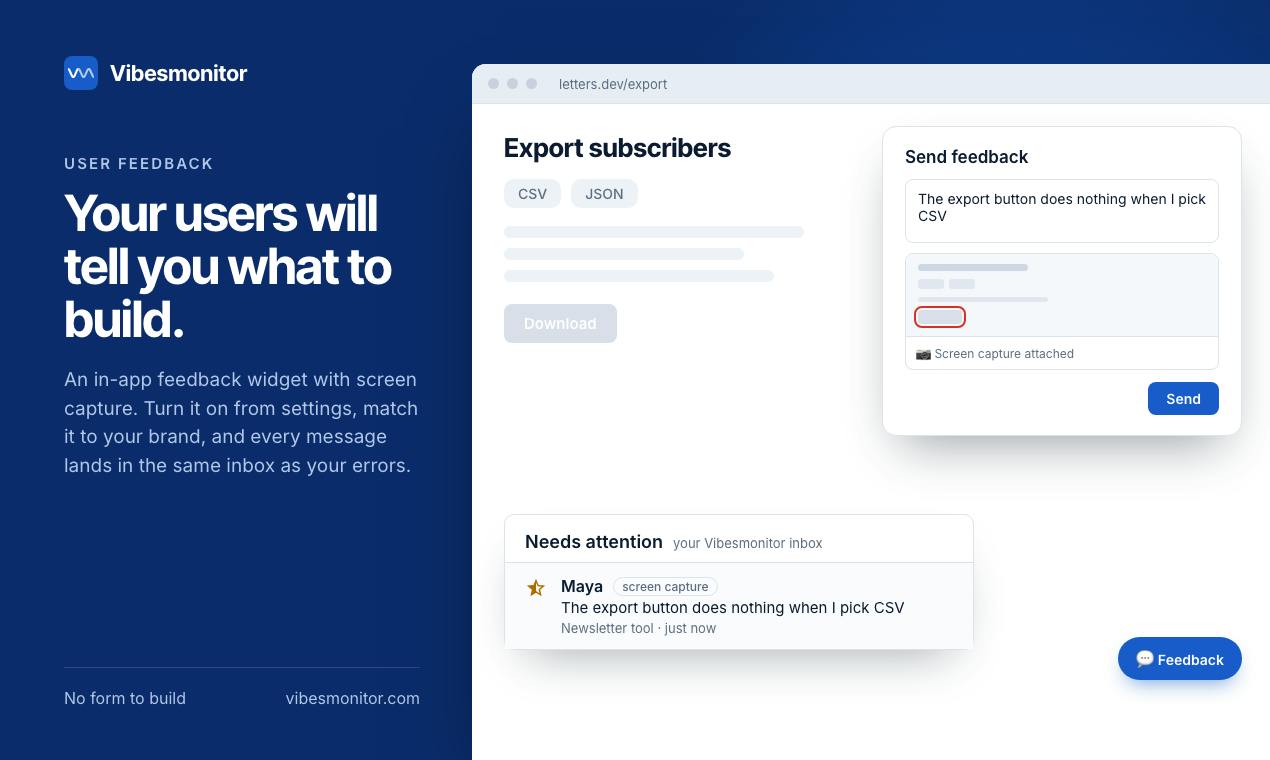
Vibesmonitor's core selling point is aggregating traffic, errors, user feedback, and cookie consent status for each project into a single interface. This means developers no longer need to constantly switch between multiple analytics tools, error tracking services, and feedback collection platforms. According to the Product Hunt description, it achieves lightweight integration through "one script per site," reducing deployment complexity.
For indie developers managing multiple small projects or side products simultaneously, this unified view can significantly reduce the cognitive burden caused by context switching.
Context Switching Costs: In cognitive psychology, task switching leads to significant efficiency losses — research shows that re-entering a state of deep focus takes an average of about 23 minutes. For developers, frequently jumping between analytics platforms, error tracking, user feedback, and compliance tools not only wastes time but also interrupts debugging and coding flow. The value of a unified ops center is precisely in compressing this "switching" into "glancing" — presenting key metrics together so that status assessment becomes a single visual action rather than multiple logins and navigations.
Technical Trade-offs of Lightweight Script Integration: The so-called "one script" typically refers to a piece of frontend JavaScript that collects page views, JS exceptions, and user behavior events and reports them to a backend. It's simple to deploy, but compared to building your own SDK or server-side instrumentation, it has limitations in data sampling accuracy, cross-domain restrictions, and being blocked by ad blockers. For lower-traffic side projects, this lightweight approach is sufficient for basic monitoring; but for products with strict compliance or high-precision requirements, data integrity and privacy policies still need to be evaluated.
Smart Inbox: Telling You What to Focus On Today
The "Vibes" in the product name hints at its focus on overall status, while "Monitor" points to its monitoring function. Vibesmonitor introduces an "inbox of what needs you first." This is similar to prioritizing alerts and to-dos, helping developers quickly identify issues rather than drowning in massive amounts of data.
According to the official description, you can even "ask Claude, Cursor, or any MCP agent which project needs you today," reflecting deep integration with the AI agent ecosystem. MCP (Model Context Protocol) is an open protocol introduced by Anthropic that allows AI models to interact with external tools and data sources. Vibesmonitor clearly embraces this trend, enabling AI agents to directly query project status.
Integration with AI Agents: MCP Protocol Support
Vibesmonitor explicitly supports MCP agents, meaning developers can query project health status through natural language. For example, you can ask an AI assistant: "Which project has the most errors today?" or "Which project's user feedback is most urgent?" The agent will access Vibesmonitor's data through the MCP protocol and provide answers.
This integration approach transforms monitoring from passively viewing dashboards into proactive conversational operations, especially suited for developers accustomed to using AI coding assistants. Based on its Product Hunt categories, it's classified under Analytics, Developer Tools, and Artificial Intelligence simultaneously, indicating its positioning spans both traditional monitoring tools and AI-native tools.
MCP vs. Function Calling: Traditional LLM function calling requires each application to define its own JSON Schema and parse model output on the client side, whereas MCP standardizes "tool exposure" as a protocol between client and server. An MCP server only needs to declare which Resources, Prompts, and Tools it provides, and any MCP-compatible client — including Claude Desktop, Cursor, Cline, etc. — can automatically discover and invoke them. This decoupling means Vibesmonitor doesn't need to write separate adapter code for each AI assistant; implementing an MCP server once makes it accessible to the entire ecosystem.
MCP Transport and Security Considerations: MCP supports two transport methods: stdio (local process) and HTTP+SSE (remote service). Remote deployments typically require OAuth or API Key authentication and rely on TLS encryption. For a service like Vibesmonitor that carries sensitive metrics across multiple projects, how to balance "convenient access for AI agents" with "avoiding data leakage to third-party models" is a key consideration users must evaluate.
Target Users and Use Cases
Vibesmonitor clearly targets indie developers, small teams, and product owners — especially those maintaining multiple websites or applications simultaneously. Typical scenarios include:
- Indie developers managing multiple side projects who need to quickly identify which project has an issue.
- Small teams wanting to reduce switching costs between multiple monitoring tools.
- Developers who habitually use Claude or Cursor and want to get project status directly through AI agents.
The lightweight "one script per site" integration lowers the barrier to entry, enabling even static sites or simple applications to quickly gain monitoring capabilities.
Market Positioning and Competition
On Product Hunt, Vibesmonitor received 90 votes and 7 comments, ranking 12th for the day. This shows a certain level of community interest, though it's not a breakout hit. The monitoring space already has many established players like Datadog, Sentry, and Plausible, but Vibesmonitor's differentiation lies in:
- Multi-project unified view: Not deep single-project monitoring, but cross-project aggregation.
- AI agent native: Seamless integration with AI assistants through the MCP protocol.
- Lightweight: One script does it all, no complex configuration needed.
However, it also faces challenges: how to convince developers to entrust multiple critical monitoring data streams to a new product? Integration depth with existing tools and data export capabilities will be key.
Summary
Vibesmonitor offers an attractive ops center concept for multi-project developers, integrating traffic, errors, feedback, and compliance status in one place while embracing the AI agent ecosystem through the MCP protocol. Its lightweight design and smart inbox concept are worth watching. For developers tired of switching between multiple tabs, this could be a tool worth trying. However, as a new product, its long-term stability and feature depth still need market validation.
One-line Summary
Vibesmonitor aggregates multi-project traffic, errors, feedback, and cookie compliance into one screen, with MCP agent query support.
Paragraph Summary
Vibesmonitor is an ops center tool for indie developers and small teams that aggregates traffic, errors, user feedback, and cookie consent status across multiple projects into a single interface, reducing switching between monitoring tools. Its key highlights include a smart inbox that prioritizes items needing attention and deep MCP protocol integration, allowing AI agents like Claude and Cursor to query project health via natural language. The product uses a lightweight "one script per site" integration approach, lowering deployment barriers. It received 90 votes and 7 comments on Product Hunt, ranking 12th, with positioning spanning Analytics, Developer Tools, and AI. Its differentiation lies in cross-project aggregation, AI agent nativity, and lightweight design, but as a new product, long-term stability, integration depth with existing tools, and data security still need market validation.
Related articles

Should U.S. College Fraternities Be Banned? A Researcher's Incisive Observations
Why not just ban U.S. college fraternities? A researcher finds the key resistance comes from decision-makers' own fraternity identities and schools' "willful ignorance."

Microsoft Discovery: Accelerating Scientific Discovery with AI Agents
Microsoft's Discovery platform runs specialized AI agents to help researchers screen and prioritize the most promising compounds and experimental paths, reducing experiments and accelerating scientific discovery.

Cambridge Heavy Industries Secretly Develops Desktop-Scale Nuclear Fusion Device
Cambridge Heavy Industries is secretly developing a desktop-scale laser-driven nuclear fusion device, targeting the equipment supply market for fusion power plants. This article analyzes its miniaturization technology path, commercialization logic, and unique positioning in the fusion startup wave.