video-use: The Open-Source Tool That Lets AI Coding Agents Auto-Edit Videos

Open-source video-use enables AI coding Agents to automatically edit videos through natural language instructions.
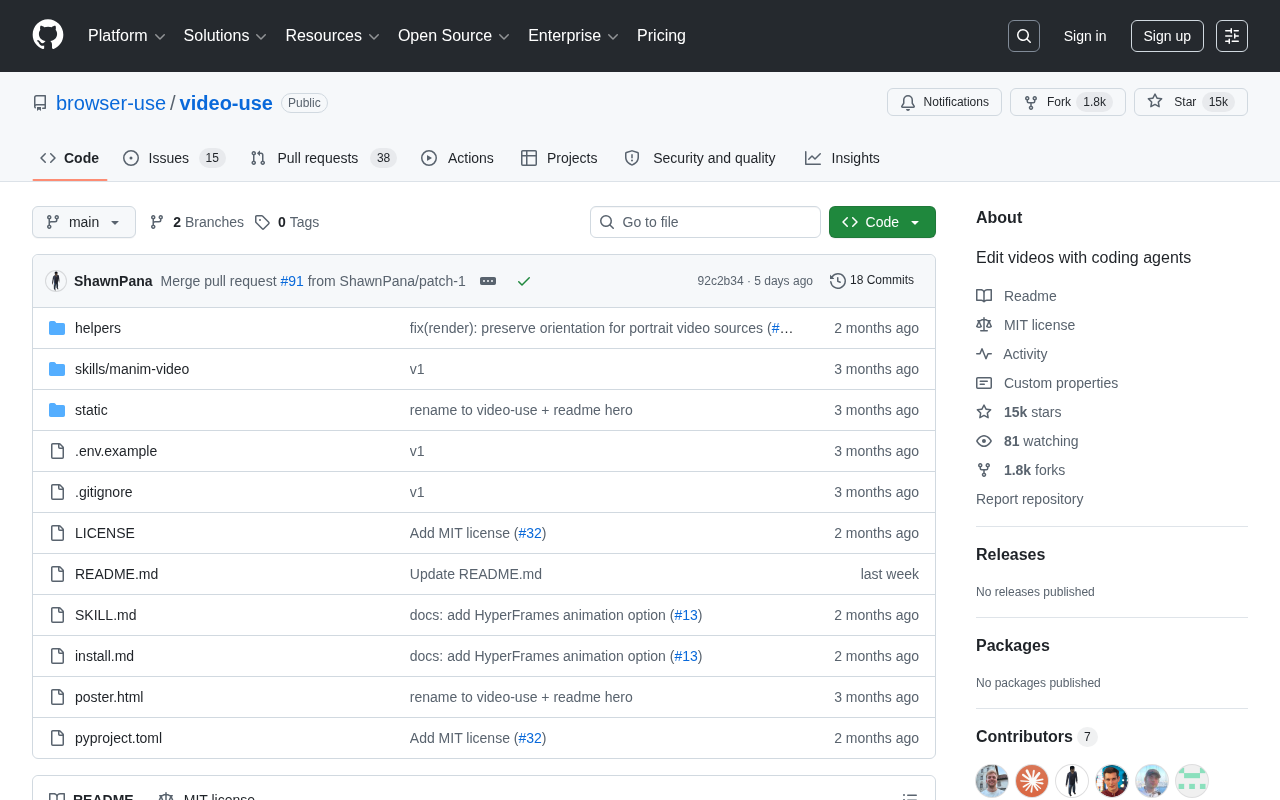
video-use, an open-source project from the browser-use team, lets AI coding Agents understand and execute video editing tasks via natural language commands. With 13,000+ GitHub stars and nearly 1,700 forks, the Python-based tool integrates with FFmpeg and MoviePy, supports batch processing and automated silence removal, and represents a paradigm shift from imperative manual editing to intent-driven video production.
When Video Editing Becomes Coding
Video editing has long been a heavily manual process—importing footage, dragging timelines, trimming clips, adding transitions, and exporting final cuts. Even skilled editors spend enormous amounts of time processing ordinary videos. The open-source project video-use from the browser-use team is trying to change this: it lets AI coding Agents directly understand and edit video.
Notably, video editing itself has undergone a profound evolution from linear to non-linear editing (NLE). From physical film cutting and tape-based linear editing to non-linear digital editing software like Premiere Pro and Final Cut Pro, each paradigm shift has dramatically lowered the barrier to creation.
The Technical Roots of Linear vs. Non-Linear Editing: The technical differences between linear and non-linear editing go beyond workflow—they're rooted in underlying storage and processing architectures. In the linear editing era, the physical sequential read/write nature of magnetic tape dictated that editing had to proceed in chronological order. Modifying a middle segment meant re-recording everything that followed—this wasn't a software design limitation but a direct mapping of hardware physics. The essence of the non-linear editing revolution was Random Access: once hard drives replaced tape, material at any point in time could be located and read in milliseconds, liberating the timeline from physical constraints into pure logical construction. The "timeline" managed by software like Premiere Pro is essentially a metadata mapping table recording "at what time point, play which segment of which file." Original source files always remain intact, and all editing operations are lossless—this architecture is also called "non-destructive editing" and forms the cornerstone of modern professional video production. The "intent-driven" model represented by video-use can be seen as the third paradigm leap along this evolutionary trajectory—creators no longer need to master any software operations, only describe their goals in language.
The Historical Evolution and Competitive Landscape of Video Codec Standards: The evolution of video codec technology is important context for understanding modern video toolchains. H.264 (AVC) has dominated the industry for nearly two decades since its standardization in 2003, owing its success to an elegant balance between compression efficiency and computational complexity. Its successor H.265 (HEVC) compresses file sizes by approximately 50% at equivalent quality, but its exorbitant patent licensing fees gave rise to AV1—an open, royalty-free codec standard jointly promoted by tech giants including Google, Mozilla, and Netflix. AV1's compression efficiency exceeds H.264 by roughly 30-50% and is rapidly becoming the new streaming industry standard—YouTube already defaults to AV1 encoding for a large portion of its content. This codec standards battle directly influences the functional evolution of foundational tools like FFmpeg, as well as the boundaries of underlying processing capabilities that video-use can leverage.
The project went viral upon release and has already garnered over 13,000 stars on GitHub, with a single-day peak of 554 new stars and nearly 1,700 forks. These numbers carry clear signals in the open-source community: 13,000 stars typically means a project has crossed the "early adopter" phase into broader developer awareness; a daily rate of 554 stars suggests the project is in a viral growth phase, usually driven by high-traffic discussions on Hacker News, Reddit, or social media; and 1,700 forks indicate developers aren't just watching but actively participating in secondary development, which is more indicative of actual ecosystem vitality.
The "Critical Mass" Effect in Open-Source Communities: video-use's rapid accumulation of 13,000 stars reflects the "critical mass" mechanism of open-source community propagation. GitHub project growth curves typically exhibit a distinct bimodal pattern: a brief burst at initial release, followed by sustained self-reinforcing propagation once a certain star threshold is reached. When a project enters the GitHub Trending list (usually requiring several hundred stars per day), it triggers secondary propagation through Hacker News, tech blogs, and social media; projects above 1,000 stars begin appearing in various "Awesome List" curated repositories; 10,000 stars often means a project has become the reference implementation in its niche, frequently cited in technical articles and course materials. The fork-to-star ratio (approximately 1:7.6 for video-use) is an important metric for gauging practical utility—the higher the ratio, the more developers are not just bookmarking but actively building upon it, which typically signals an emerging ecosystem around the project.
As a pure Python project, it continues the browser-use team's consistent approach: delegating complex human-computer interaction tasks to Agents for automated, code-driven execution.
browser-use Background: browser-use is an open-source framework that allows large language models to directly control web browsers. Its core idea is to abstract web interactions into structured action sequences, enabling AI Agents to complete complex tasks like form filling, page navigation, and data scraping just as human users would. The project has accumulated over 50,000 stars on GitHub and is one of the landmark projects in the AI Agent automation space. video-use can be seen as an extension of the same methodology into the video domain—what works for browsers works for video editing too.
Core Philosophy: Making Agents Think Like Editors
video-use's name echoes its sister project browser-use—the latter lets Agents operate browsers, while the former lets Agents take over video editing workflows. The core approach abstracts video editing into a series of operations that can be invoked and reasoned about through code, then has coding Agents automatically generate and execute them based on natural language instructions.
How Coding Agents Work: A coding Agent is an AI system that combines large language models with code execution capabilities. It can understand natural language instructions, decompose them into executable code steps, call external tools or APIs, and self-correct based on execution results. Unlike simple prompt engineering, coding Agents possess a "plan-execute-feedback" closed-loop capability, making them suitable for complex tasks requiring multi-step reasoning—such as video editing, which demands understanding content semantics, judging time points, and coordinating multiple processing steps. This architecture is commonly called the ReAct (Reasoning + Acting) pattern, where the model observes results after each action and adjusts subsequent plans, forming an adaptive task execution loop.
The Inflection Point in LLM Code Generation Capabilities: video-use relies on AI Agents generating executable video processing code, and the practicality of this capability rests on historic breakthroughs in LLM code generation quality. The launch of GitHub Copilot in 2021 marked the leap from "lexical-level association" to "semantic-level reasoning" in code completion; GPT-4's arrival in 2023 enabled models to understand complex multi-step engineering problems and generate complete runnable functions; models like Claude 3.5 Sonnet in 2024 achieved engineering-practical levels of "pass@1" (the probability of first-generation code running correctly without modification). This qualitative change is the core technical prerequisite enabling coding Agent projects like video-use to emerge en masse in 2024-2025—language models from two years earlier simply couldn't reliably automate complex video processing scripts.
ReAct Architecture's Special Fit for Video Editing: The ReAct framework's advantages are particularly pronounced in video editing scenarios. Video editing is inherently an iterative process requiring continuous evaluation and correction: whether cuts are accurate, transitions natural, or pacing meets expectations—these judgments can often only be verified after execution. ReAct's "reason-act-observe" cycle precisely fits this workflow, allowing Agents to reassess the current state after each operation and dynamically adjust subsequent strategies, rather than blindly executing a complete plan generated all at once. For example, when an Agent receives the instruction "remove all silent segments," it first locates silent intervals through audio analysis tools (reasoning + action), observes whether detection results contain false positives (observation), then fine-tunes threshold parameters and re-executes (correction), ultimately producing editing results that match expectations—this self-correcting capability is beyond the reach of static script generation approaches.
From "Manual Dragging" to "Intent-Driven"
Traditional editing software operates in an "imperative" manner: you must tell the software step by step exactly which frame to cut and where to place each clip. video-use adopts an "intent-driven" model—users simply describe their goals in natural language, such as "remove all silent segments longer than two seconds" or "cut these interview segments into a three-minute highlight reel," and the Agent understands the intent, plans the steps, and invokes underlying video processing capabilities to complete the task.
This shift corresponds to the classic opposition between "imperative" and "declarative" programming paradigms. Imperative programming requires developers to precisely describe every detail of each step; declarative/intent-driven paradigms only require describing the desired end result, leaving the system to plan the implementation path—SQL query language is a classic example of the declarative paradigm, where users describe "what data I want" rather than "how to find the data."
The Technical Evolutionary Lineage of Declarative Paradigms: The rise of declarative programming is essentially a systematic transfer of "cognitive load"—from the human brain to the computer. SQL, born in the 1970s, elevated database queries from procedural "iterate through records row by row" operations to declarative "describe the desired result set" expressions, and is widely considered one of the most successful abstractions in computer science history. The same paradigm leap replayed in UI development: React's declarative component model replaced the imperative DOM manipulation of the jQuery era; Terraform and Kubernetes in the infrastructure domain shifted operations engineers from "executing a series of configuration commands" to "describing the desired system state." Each instance of declarative-ization has been accompanied by dramatically lower barriers and significantly higher productivity in the corresponding domain. video-use brings this concept to video editing, representing a deep migration of human-computer interaction from the "operation layer" to the "intent layer," highly aligned with the evolutionary direction of software engineering history as a whole.
This paradigm shift is significant: it lowers the barrier to video editing from "mastering complex software" to "describing requirements in language." For content creators, social media professionals, and enterprise marketing teams, this means lower learning costs and higher output efficiency.
Why a Coding Agent
video-use emphasizes "editing video with a coding Agent" rather than being a simple one-click AI video generation tool—the two are fundamentally different.
Controllability and Reproducibility
One-click generation tools are often black boxes, making it difficult to fine-tune results. The output of a coding Agent is inherently readable, modifiable code or operation sequences, delivering two core advantages:
- Controllability: If a processing step doesn't meet expectations, you can directly intervene in the corresponding code logic without starting over.
- Reproducibility: Processing workflows can be saved, reused, and applied in batch. Uniformly adding intros and outros to an entire video series, or batch color grading, is exactly where coding Agents excel.
"Auditability": The Overlooked Third Dimension: Beyond controllability and reproducibility, code-based output brings another characteristic crucial in enterprise scenarios—auditability. When video content involves brand compliance, copyright declarations, or regulatory requirements, being able to precisely reconstruct "what each processing step was, why it was executed, and what the result was" is critical. Content generated by black-box AI tools often cannot be retrospectively traced for decision paths, while the operation sequences generated by coding Agents naturally constitute an auditable operations log. This characteristic gives video-use a differentiated advantage over consumer-grade AI video tools in scenarios with higher compliance requirements, such as media organizations and enterprise content teams.
The Computational Economics of Video Processing: Video processing is a computationally intensive task, and its cost structure directly affects the feasibility boundaries of AI automation solutions. Traditional cloud-based video transcoding services (such as AWS Elemental MediaConvert) charge per minute, making the cost of batch-processing high-resolution content non-trivial. The proliferation of GPU-accelerated NVENC/NVDEC hardware codecs (NVIDIA) and VideoToolbox (Apple Silicon) has increased local video processing speeds by several to dozens of times while dramatically reducing CPU load. As a locally-running Python tool, video-use can directly leverage these hardware acceleration capabilities, offering natural advantages over cloud solutions in cost control and data privacy protection—particularly important for processing enterprise video content involving copyright or trade secrets.
Seamless Integration with Existing Toolchains
As a Python project, video-use naturally integrates with mature video processing ecosystems like FFmpeg and MoviePy. It can also be embedded into CI/CD pipelines, automation scripts, or larger content production pipelines, becoming a critical component in automated workflows rather than an isolated tool.
The Industry Standing of FFmpeg and MoviePy: FFmpeg is the de facto standard in open-source video processing, supporting encoding/decoding, conversion, and streaming for virtually all mainstream video formats. It's used by YouTube, VLC, and numerous other major platforms and tools. Its core advantage lies in high-performance low-level processing implemented in C, along with broad format compatibility covering hundreds of codecs. FFmpeg's architectural design strictly decouples "container formats" (such as MP4, MKV) from "codecs" (such as H.264, AV1), enabling it to flexibly handle conversion needs for virtually any format combination—this is precisely why it has become industry infrastructure rather than an ordinary tool. MoviePy is a Python wrapper built on top of FFmpeg, providing a more developer-friendly object-oriented programming interface suitable for rapid video processing script development—developers can accomplish in a dozen lines of Python what would otherwise require complex FFmpeg command-line parameters. video-use's integration with these mature toolchains means it can directly reuse stable underlying capabilities proven in production environments, without needing to build video codec infrastructure from scratch.
CI/CD and Content Production Pipelines: CI/CD (Continuous Integration/Continuous Delivery) originally emerged as an automated deployment concept in software engineering. As content production scaled, this concept was adopted by the media industry to form "content production pipelines"—connecting material collection, editing, review, and publishing into automated assembly lines. Platforms like Netflix and YouTube run massive video transcoding and processing pipelines behind the scenes, automatically processing millions of video files daily. Netflix has publicly disclosed that its "media pipeline" can automatically transcode a single piece of original content into over 1,200 different bitrate, resolution, and format combinations to accommodate varying network conditions and devices worldwide. As a Python library, video-use can be embedded into such pipelines through scheduling tools like GitHub Actions or Airflow, enabling full automation of video post-processing and making previously manual steps programmable and schedulable.
The browser-use Team's Consistent Approach
video-use comes from the browser-use team, which itself is noteworthy. browser-use is a highly influential open-source project in the AI Agent space, enabling large language models to operate web pages like humans—clicking, typing, and navigating. video-use can be seen as an extension of the same methodology into the video domain.
The core insight behind this approach is: a vast number of repetitive manual operations that depend on graphical interfaces can be taken over by Agents in a code-driven manner. This applies to browsers, and equally to video editing. As multimodal large models continue to strengthen their ability to understand video content, Agents can now "see" video footage, identify key moments, and understand narrative structure, laying a solid foundation for automated editing.
Multimodal Large Models and Video Understanding: Multimodal large models are AI models capable of simultaneously processing multiple data types including text, images, audio, and video. New-generation models represented by GPT-4o and Gemini 1.5 Pro can directly analyze video frame sequences, identifying scene transitions, character actions, speech content, and other key information. One core technical bottleneck in video processing is context window length—a one-hour video sampled at one frame per second at 1080p resolution requires processing over 3,600 images, an enormous amount of information. Gemini 1.5 Pro supports an ultra-long context window of up to 1 million tokens, breaking through this limitation and enabling the model to understand complete long-video narrative structures in a single inference pass, rather than relying on sliding window segmented processing—the latter tends to cause cross-segment semantic coherence loss.
The Spatiotemporal Semantic Challenge of Video Understanding: The core challenge of video understanding is the compound nature of spatiotemporal semantics—unlike static images, meaning in video often spans multiple frames to fully manifest. Early video AI models commonly adopted keyframe extraction strategies, sampling one frame at fixed intervals to feed into image models, an approach that performs poorly with rapid action, gradual scene changes, or narratives that depend on temporal logic. Current mainstream approaches have shifted to temporal-aware visual encoders combined with large-capacity context windows, enabling models to process complete videos while preserving inter-frame temporal relationships. Notably, audio tracks are often crucial auxiliary signals for video semantic understanding—speech content, emotional shifts in background music, and even silent passages all provide editing cues that cannot be obtained from visuals alone. This cross-modal fusion (visual + audio + text subtitles) of comprehensive understanding capability is the underlying technical support enabling video-use to achieve precise intent-driven editing.
Typical Use Cases
video-use has a broad range of potential applications:
- Batch content creation for social media: Automatically splitting long videos into highlight clips suitable for short-video platforms.
- Meeting and tutorial organization: Automatically removing redundant content to generate clearly structured condensed versions.
- Localization and repurposing: Batch subtitle replacement, pacing adjustments, and adapting to different platform specifications.
- Enterprise content pipelines: Integrating video post-processing into automated workflows for scaled production.
The Hidden Complexity of Platform Specification Adaptation: "Adapting to different platform specifications" sounds simple but encompasses a massive amount of technical detail. Douyin/TikTok requires 9:16 vertical format, duration under 15 minutes, with recommended bitrate around 2Mbps; YouTube supports 16:9 horizontal format, up to 4K resolution, with no strict length limit but an algorithmic recommendation preference for 8-15 minute content; WeChat Channels has strict file size limits at 1GB per video. Additionally, subtitle burn-in standards and Safe Zone dimensions (content areas that avoid being obscured by UI elements) vary across platforms. Manually processing the same video separately for each platform is a major efficiency bottleneck for content operations teams.
The Scaling Challenge of Multi-Platform Content Operations: One of the core efficiency bottlenecks facing today's content creators is the exponential workload growth from multi-platform differentiated operations. A professional content team typically needs to simultaneously maintain six to eight platforms—Douyin, Bilibili, YouTube, WeChat Channels, Xiaohongshu, Instagram Reels—each with different requirements for video duration, aspect ratio, bitrate, subtitle styles, and cover specifications. Platform algorithms also show significantly different preferences for content pacing and information density—for example, the importance of a hook in the first three seconds on Douyin far exceeds that on YouTube. Under traditional workflows, producing one piece of content often requires editors to perform six to eight platform-specific re-edits, with labor and time costs becoming the key barrier limiting small creative teams from scaling. The programmable processing capability offered by video-use can theoretically compress this multi-platform adaptation process into a one-time rule configuration with subsequent automated batch execution, fundamentally restructuring the efficiency ratio of content production.
Conclusion
The popularity of video-use reflects a larger trend: AI Agents are moving from "conversation" to "action," expanding from operating browsers to handling professional creative tasks, gradually penetrating into various production processes that require human intervention.
The Capability Boundaries and "Action Layer" Evolution of AI Agents: The leap of AI Agents from "conversation" to "action" is essentially the result of both model capabilities and tool-calling infrastructure maturing simultaneously. Early AI assistants were limited to pure text output, able only to provide suggestions without direct execution; around 2023, the proliferation of standardized tool-calling interfaces like OpenAI's Function Calling and Anthropic's Tool Use enabled large language models to invoke external APIs and local programs in a structured manner, achieving the critical transition from "saying" to "doing." The video editing automation represented by video-use is a concrete manifestation of this capability boundary expanding into professional creative domains, and a microcosm of the macro trend of AI Agents penetrating "high-cognitive-load repetitive work." From a longer historical perspective, each generation of automation technology follows a similar penetration path: first breaking through in highly structured, rule-explicit domains (such as data processing and code writing), then expanding into semi-structured domains requiring contextual judgment and creative assessment (such as video editing and content creation). The emergence of video-use marks this expansion accelerating into the latter category.
For developers, it provides an open-source starting point for encapsulating video processing capabilities into Agent workflows; for content creators, it heralds an accelerating future where "describing requirements yields finished products."
As a project still in rapid iteration, video-use has room for improvement in areas like precision for complex edits and accuracy in understanding creative intent. But the direction it points to—making coding Agents serve as automated assistants for creators—is undoubtedly worth continued attention.
Related articles

Greek Fire: The Ultimate Military Secret Guarded by the Byzantine Empire for a Millennium
Greek Fire was the Byzantine Empire's most closely guarded state secret — an ancient flamethrower that burned on water. Learn how it helped repel Arabs and Vikings and ensured the empire's survival.

7 Vibe Coding Agents Tested & Ranked: Which AI Coding Tool Should Beginners Choose?
Hands-on comparison of 7 Vibe Coding agents including Trae, Cursor, Claude Code, Codex, WorkBuddy & CoderWork, ranked by beginner-friendliness and performance.

AI-Generated Series 'Nido de Villanas': How AI Tells a Soap Opera Story
Deep analysis of AI-generated telenovela Nido de Villanas Episode 2: examining dialogue design, narrative tension, and AI's potential in dramatic storytelling.