vLLM Releases proto-v0.4.0: Signature Verification and Protocol Layer Upgrade Explained

vLLM releases proto-v0.4.0, updating its distributed inference protocol layer with verified signature support.
vLLM maintainer Bugen Zhao officially released proto-v0.4.0 on September 30th — a standalone version update for the `vllm-proto` component. Built on Protocol Buffers, this component defines data exchange structures between the scheduler, execution engine, and GPU workers, serving as a critical low-level module for vLLM's distributed inference. The release features a verified SSH signature to ensure trusted provenance. Since no detailed changelog was included, teams doing secondary development or system integration with vLLM should review the asset files and evaluate interface compatibility before upgrading.
vLLM Gets Another Version Update
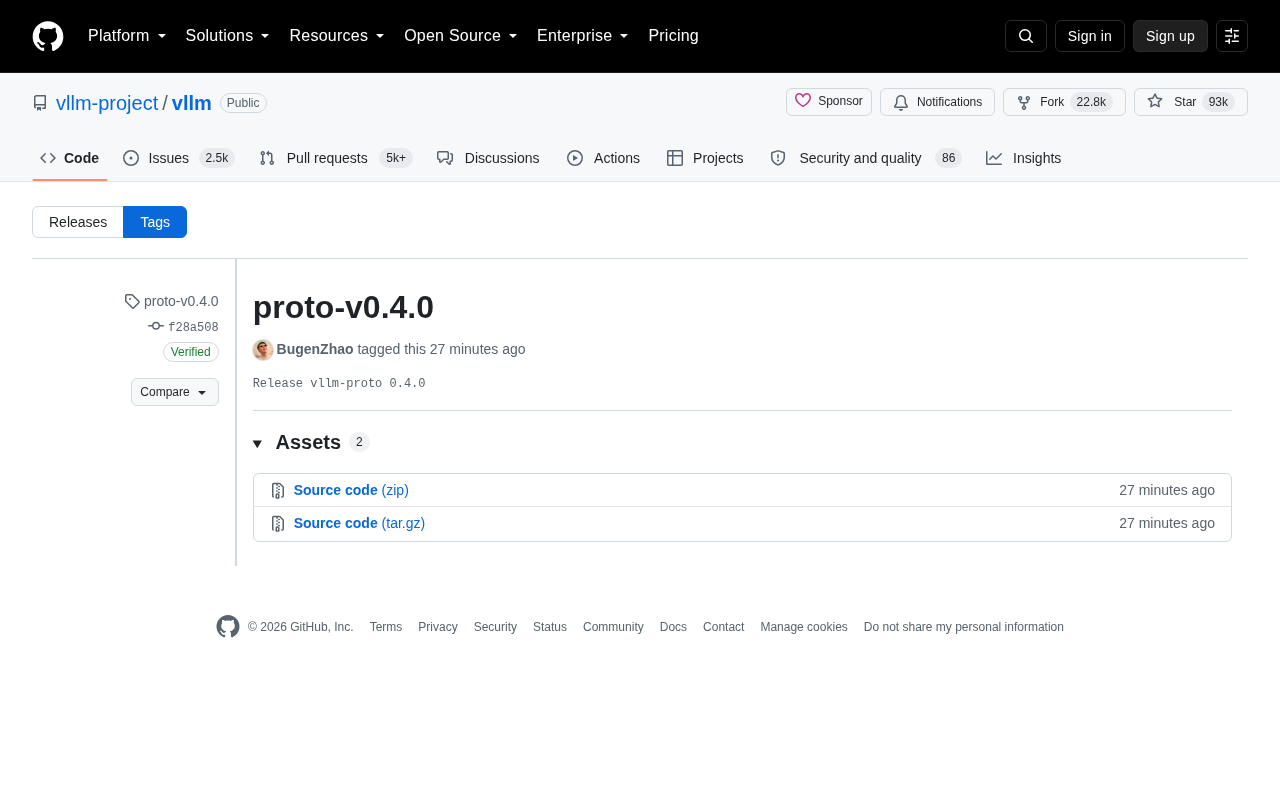
vLLM is one of the most closely watched open-source projects in the LLM inference space, having accumulated over 93,000 GitHub stars and 22,800 forks. Recently, project maintainer Bugen Zhao officially tagged the vllm-proto component with proto-v0.4.0, corresponding to commit hash f28a508.
Based on publicly available information, this is a standalone release targeting vLLM's protocol layer (proto) component. Unlike major updates to the main project, proto-related tags typically focus on internal communication protocols, serialization formats, or service interface definitions — making them a critical low-level module underpinning vLLM's distributed inference capabilities.
Key Details of This Release
The proto-v0.4.0 tag was created by the maintainer on September 30th. The release notes are labeled "Release vllm-proto 0.4.0" and include 2 asset files.
One notable aspect is how security was handled: the tag carries a verified signature from the committer, with an SSH key fingerprint of qvcijXBgmowIgiJzhZfmEfeJAj3PPJVDfG0xRh+Rspc. For an inference framework widely deployed in production environments, signature verification means users can confirm that the version they're pulling genuinely comes from a trusted maintainer — not a tampered third-party distribution. This is a sound practice at a time when software supply chain security is receiving increased scrutiny.
What Is vllm-proto?
Within vLLM's overall architecture, proto refers to data structures and interface protocols defined using Protocol Buffers or a similar mechanism. It handles data exchange between the scheduler, execution engine, and individual inference workers. Version iterations of the protocol layer typically involve:
- Adding or adjusting message structures
- Optimizing serialization/deserialization efficiency
- Handling backward compatibility
- Ensuring interface stability in distributed deployments
Since this component is aimed at framework internals and integration developers, everyday end users may not notice it directly — but it has a real impact on overall inference performance and stability.
Protocol Buffers (protobuf) is a language-agnostic, platform-agnostic structured data serialization mechanism open-sourced by Google. Compared to JSON or XML, protobuf uses binary encoding, resulting in smaller payloads and faster parsing — making it well-suited for high-frequency, low-latency inter-service communication. Developers define message structures and RPC service interfaces in .proto files, and a compiler automatically generates target-language code (Python, C++, etc.). In a distributed inference framework like vLLM, operations such as the scheduler dispatching inference tasks to multiple GPU workers, or workers reporting KV Cache states back to the scheduler, all rely on protobuf-defined message formats to ensure efficient and consistent data exchange. Once a message structure undergoes field additions, removals, or type changes, components that haven't been updated in sync may experience deserialization failures or data misalignment — which is precisely why protocol layer versions need to be managed independently and locked down rigorously.
Software supply chain security has become a major topic in the open-source ecosystem in recent years. The 2020 SolarWinds incident and the 2021 Log4Shell vulnerability made the industry realize that attackers can compromise large numbers of downstream users by poisoning upstream dependency packages or tampering with release artifacts. To address this threat, Git signed tags provide a public-key cryptography-based verification mechanism: maintainers sign tag objects with their private key, and users can verify — using the corresponding public key or GitHub's SSH key binding mechanism — that the tag was genuinely created by the claimed author and has not been modified. For an inference framework like vLLM that is deployed in production environments by numerous enterprises, signature-verified releases effectively guard against man-in-the-middle attacks or mirror repository poisoning, providing a trust anchor for version locking in CI/CD pipelines.
What This Means for Developers
For teams building inference services on top of vLLM, independent version management of the protocol layer reflects mature engineering practices. Separating proto from the main version and tagging it independently makes it easier for downstream projects to lock onto specific protocol versions as needed, reducing compatibility risks during upgrades.
If you're doing secondary development on vLLM or integrating with it at the system level, it's recommended to review the corresponding change content and asset files before upgrading the proto component — specifically to confirm whether there are any breaking changes in the interfaces. Additionally, using the verified signature mechanism to check the version's origin is a necessary step for ensuring deployment security.
Summary
Due to the limited information provided on the official release page, proto-v0.4.0 has not yet disclosed a detailed changelog. What can be confirmed includes: the version was signed and released by a trusted maintainer, it comes with two asset files, and it focuses on vLLM's protocol layer component. For developers following the vLLM ecosystem, it's recommended to keep an eye on the project repository's Releases page for more complete technical details and migration guidance.
Related articles

Gemini 4 Argon Hands-On: AI Builds Board Games, Constructs Temples, and Trains Robots Autonomously
Gemini 4 Argon hands-on roundup: AI autonomously builds a desk racetrack and temple in Blender, writes a ray tracing engine, trains a humanoid robot to sink 7 shots, plus API pricing and developer access.

The Magic Octagonal Coin: Why Only 9% of People Can Predict Its Flip?
Only 9% of people can correctly predict the Magic Octagon coin flip. This article explains its spatial rotation mechanism, common cognitive pitfalls, and a new hypothesis based on Relevance Theory, exploring the limits of human spatial reasoning.

Sam Altman: AI Is Entering the Era of Scientific Discovery — Math Breakthroughs Will Replicate in Biology and Energy
Sam Altman says AI is entering the era of scientific discovery — math breakthroughs will replicate in biology, materials science, and energy to help develop new drugs and energy sources.