vLLM Releases v0.29.1rc0: Speculative Decoding Gains Dual-Key Watermarking
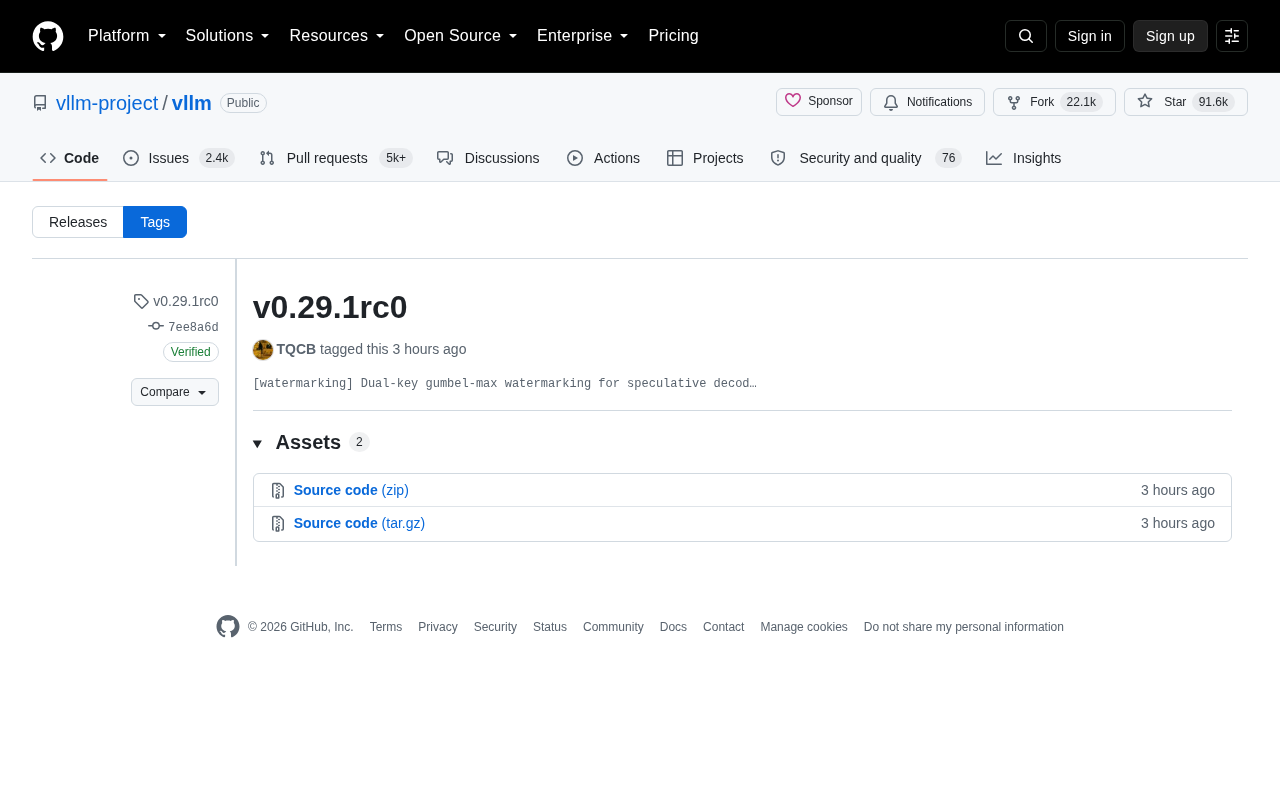
vLLM v0.29.1rc0 adds dual-key Gumbel-Max watermarking to speculative decoding for traceable AI inference.
vLLM has released v0.29.1rc0, a release candidate whose core change introduces dual-key Gumbel-Max watermarking into speculative decoding. Speculative decoding boosts throughput via a draft model and batch verification, while Gumbel-Max watermarking embeds key-controlled statistical signals during sampling for AI content attribution. Previously, enabling both simultaneously was impractical, as speculative decoding's rejection-resampling process disrupted watermark integrity. This update brings watermarking directly into the inference engine layer, resolving the "acceleration breaks watermarks" pain point and enabling enterprise deployments to meet compliance requirements at lower engineering cost. As an rc0 build, production use should be evaluated carefully.
vLLM Previews Another New Release
vLLM, the high-performance LLM inference engine, has recently released v0.29.1rc0. As a standout open-source project on GitHub with over 91,000 stars and 22,000 forks, every new vLLM release draws close attention from the inference and deployment community. This version is published as a release candidate (rc0), meaning it's in a pre-stable testing phase intended for early community validation and feedback.
Based on the version number v0.29.1rc0, this is a patch-level iteration. The release was tagged by maintainer TQCB and carries a verified GitHub signature with GPG key ID B5690EEEBB952194, ensuring the integrity and authenticity of the release.
Core Update: Dual-Key Watermarking for Speculative Decoding
The most noteworthy change in this release is the introduction of Dual-key Gumbel-Max watermarking for speculative decoding.
Speculative decoding has become one of the key techniques for accelerating LLM inference in recent years. It works by using a small, fast "draft model" to predict multiple candidate tokens, which are then verified in a single pass by the main model — significantly improving throughput without sacrificing generation quality. vLLM has been a major driver of bringing this technique to production.
Watermarking, on the other hand, aims to embed invisible statistical signatures into model-generated text for later attribution and AI-content detection. Traditional Gumbel-Max watermarking injects specific pseudo-random signals during the sampling stage. Extending this to a "dual-key" form and adapting it to the speculative decoding pipeline means vLLM is now attempting to preserve traceable generation watermarks while still accelerating inference — two goals that have historically been difficult to achieve simultaneously.
Why This Change Matters
As AI-generated content continues to proliferate, reliably and cost-effectively identifying AI-written text has become an industry necessity. Embedding watermarking capabilities at the inference engine layer — rather than relying on individual applications to implement it separately — allows deployers to gain content attribution with far less engineering overhead.
More importantly, bridging watermarking with the speculative decoding acceleration path directly addresses the real-world pain point of "enabling acceleration breaks the watermark." For enterprise deployments that need to simultaneously meet compliance traceability requirements and serve high-concurrency workloads, this kind of low-level support has genuine practical value.
About the rc Release Status
It's worth noting that rc0 is a release candidate, not a stable production release. These versions are typically used to let the community test new features in real environments and surface potential regressions. Production users are advised to proceed with caution — validating in an isolated environment first before deciding whether to upgrade, and waiting for the official stable release before switching, is the safer approach.
For developers who want to try out the new watermarking capabilities or participate in community testing and feedback, pulling this version early for evaluation is a great option.
Summary
Although vLLM v0.29.1rc0 is a patch-level preview release, its introduction of dual-key watermarking for speculative decoding reflects a broader evolution in inference engines — from simply being "faster" to being "faster, more controllable, and more traceable." This direction aligns well with the growing trend toward AI content governance and compliance. Since the official full changelog has not yet been published, further details on additional changes will become clearer when the stable release lands.
Related articles
Geopolitical Bias Compared Across Three AI Models: GPT-5.2, Claude, and Qwen Tested
An open-source project compares GPT-5.2, Claude Opus 4.6, and Qwen 3.5 Plus on sensitive Greek geopolitical topics. We break down its methodology, limitations, and why LLM neutrality audits matter.
Sam Altman: An IPO in the Near Term Would Be 'Ill-Advised' for OpenAI
OpenAI CEO Sam Altman tells Fortune that an IPO in the near term would be "ill-advised," while also addressing recursive self-improvement risks and the Hugging Face hack.
AI Coding Model Benchmark Tool: GPT-5.3 Codex vs. Claude Opus 4.6 — Which One Wins?
The open-source project ai-coding-benchmark-zyt benchmarks GPT-5.3 Codex vs. Claude Opus 4.6. This article explores its methodology, value, and developer guidance.