vLLM Releases v0.32.1rc0: Adds Weight-Transfer HTTP Protocol Documentation for Trainers

vLLM releases v0.32.1rc0 candidate, primarily adding documentation for the weight-transfer HTTP protocol.
vLLM released the v0.32.1rc0 release candidate on GitHub, submitted by contributor aoshen02, with the core change being documentation of the weight-transfer HTTP protocol for trainers. The protocol targets scenarios such as RLHF and online preference optimization where training and inference are separated, using HTTP interfaces to push and pull weights instead of disk reload or direct NCCL transfer, reducing deployment constraints and improving cross-node flexibility. The article argues that documenting the interface means the capability is treated as a stable external contract, allowing external teams to implement their own trainer side. Due to missing full diff and asset manifest in the source, protocol endpoints, message formats, and authentication details cannot be confirmed. The author recommends production users wait for the official release, RL developers evaluate adaptation costs, and contributors start with documentation PRs.
Version at a Glance: A Documentation-Focused Release Candidate
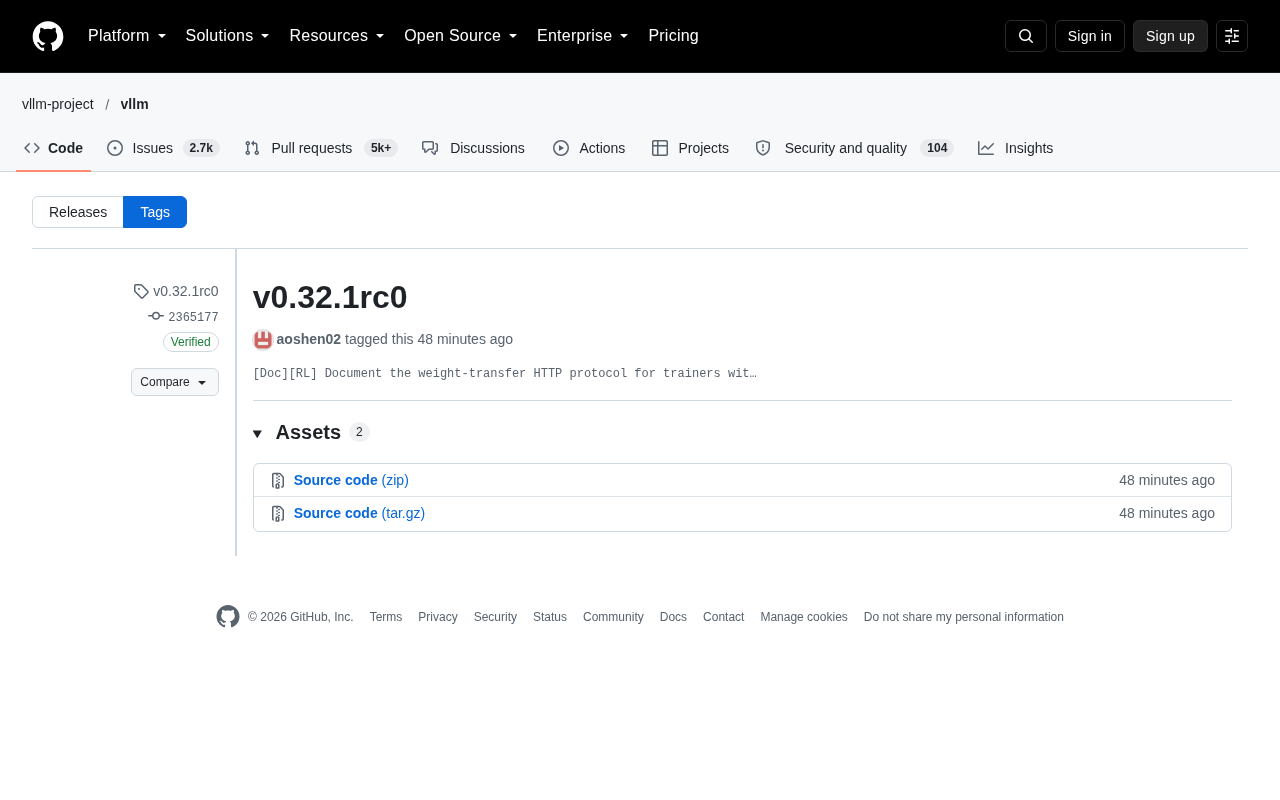
Recently, the large-model inference framework vLLM released the v0.32.1rc0 release candidate on GitHub. The tag was applied by contributor aoshen02 on the 18th, and the commit message points to a fairly specific change: documenting the weight-transfer HTTP protocol for trainers ([Doc][RL] Document the weight-transfer HTTP protocol for trainers).
Based on the naming convention, rc0 represents the 0th release candidate, meaning it is intended for pre-release validation rather than as a stable version. Production users are generally advised to wait for the official tag, while developers who want to adapt interfaces early get a preview window with this candidate.
This commit carries a verified signature on GitHub (GPG key ID B5690EEEBB952194), meaning the commit's authenticity has been validated by the platform. However, you may not have noticed that the tag comparison and asset list on the page failed to load during capture, so the full diff and binary wheel asset manifest for this change are not reflected in the source material—this is something that needs to be confirmed later.
The Weight-Transfer HTTP Protocol: Why It Deserves Its Own Documentation
The Parameter Synchronization Challenge in Reinforcement Learning
In training pipelines such as RLHF and online preference optimization, inference and training are two separate systems: the trainer is responsible for updating parameters, while the inference engine (such as vLLM) handles high-throughput generation. After each training step, the new weights need to be transferred from the training side to the inference side, and the efficiency of this step directly determines overall throughput.
The traditional approach is to write weights to disk and reload them, or to rely on collective communication libraries like NCCL for direct GPU-to-GPU transfer. The former incurs high IO overhead and slow switching, while the latter places high demands on topology and deployment environment. The weight-transfer HTTP protocol takes a different path—using HTTP interfaces to push and pull weights, decoupling the trainer from the inference service for more flexible deployment and easier implementation across nodes and clusters.
RLHF (Reinforcement Learning from Human Feedback) is currently the mainstream paradigm for aligning large models, and its typical pipeline consists of three stages: supervised fine-tuning (SFT), training a reward model, and optimizing the policy model with reinforcement learning algorithms (such as PPO). During the PPO stage, the system repeatedly executes a "generate—score—update" loop: the inference engine uses the current policy model to batch-generate responses, the reward model scores the responses, and the trainer computes gradients and updates parameters accordingly. Each iteration requires strict consistency between the model weights on the inference side and the training side, so the latency and reliability of weight synchronization directly become one of the pipeline's bottlenecks.
Online preference optimization (such as Online DPO) further alternates between preference data generation and training, and likewise depends on high-frequency weight transfer. These scenarios require not only "fast transfer" but also version consistency, retry on failure, and compatibility across heterogeneous clusters—exactly the requirements the HTTP protocol approach attempts to cover.
The Significance of Documentation
If an interface capability has only code and no documentation, external integrators can only reverse-engineer the protocol details by reading the source code, which is costly and error-prone. This commit documents the protocol separately, indicating that the capability is being treated as a stable interface with external commitments—at least a formal contract for the internal trainer team. For teams building custom RL pipelines, this means they can implement their own trainer side based on the documentation without being bound to the official implementation.
Note that since the original source material does not include the documentation body, this article cannot provide the protocol's specific endpoints, message formats, or authentication methods. These details should be based on the actual documentation in the repository.
GPG signatures and the verified badge: If a commit on GitHub carries a verified badge, it means the commit's GPG (or SSH, S/MIME) signature matches the public key bound to the committer's account, proving that the commit was indeed created by the account holder and that the content has not been tampered with. The key ID B5690EEEBB952194 appearing in the article identifies the public key used for signing. For open-source projects, signature verification is part of supply chain security, especially when releasing candidates and binary assets, allowing users to confirm the source is trustworthy.
Release candidate (rc) version semantics: Following semantic versioning conventions, X.Y.ZrcN indicates the Nth release candidate where features are frozen and pre-release validation is underway; during this period only bug fixes are accepted and no new features are introduced. Projects typically collect regression test feedback at this stage and promote to the official version if there are no blocking issues. Therefore, rc versions are not suitable for direct production use, but are suitable for integrators to perform interface compatibility validation in advance.
What This Commit Reveals About vLLM's Engineering Direction
In recent releases, vLLM has continued to strengthen training-side collaboration capabilities beyond the inference side. Documenting the weight-transfer protocol appears to be documentation work, but in essence it clarifies the system boundary: the inference engine is no longer just a black box passively receiving weights, but provides a programmable interface for trainers to call.
This approach aligns with the industry trend of "inference-training integration"—training and inference no longer operate in isolation but cooperate on parameter synchronization, memory scheduling, and batching strategies. The choice of HTTP also reflects pragmatism: compared with proprietary RPC, HTTP is easier to debug and easier to integrate across language stacks, at the cost of potentially being inferior to shared memory or RDMA solutions in ultra-low-latency scenarios. The specific trade-off depends on whether the protocol implementation supports batching and streaming.
NCCL and collective communication: NCCL (NVIDIA Collective Communications Library) provides high-speed GPU-to-GPU communication primitives such as all-reduce and broadcast, and is the de facto standard for gradient synchronization in distributed training. Using it for direct weight transfer can bypass host memory and disk with extremely low latency, but it requires both communicating parties to be within the same NCCL communication domain, placing strong constraints on network topology (such as NVLink and InfiniBand) and startup methods, making it difficult to maintain across clusters or with dynamic scaling of inference services. In contrast, the HTTP protocol trades some latency for deployment decoupling and language-stack independence; the two are complementary rather than substitutes.
Inference-training integration: This trend refers to training and inference sharing model definitions, parallelism strategies, and scheduling infrastructure to reduce duplicate construction of two systems. Capabilities accumulated by vLLM on the inference side, such as PagedAttention and continuous batching, are gradually extending into the post-training stage, and the weight-transfer interface is the infrastructure layer for this direction.
Recommendations for Different Users
Production users: rc0 is a release candidate; unless there is a clear need, it is advisable to wait for the official v0.32.1. Check the release notes for behavioral changes before upgrading.
RL pipeline developers: Pay attention to this protocol documentation and evaluate the cost of adapting it to your existing trainer. If you already have a custom weight synchronization solution, compare the latency performance of the HTTP approach under your cluster topology.
Framework contributors: Documentation PRs have a relatively low barrier to entry and are a good starting point for becoming familiar with vLLM's code structure and RL workflow.
Given the limited source information, the above judgments are based on version naming conventions and commit titles; for specific API details, please refer to the repository documentation.
Frequently Asked Questions
Is v0.32.1rc0 a stable version? No. The rc suffix indicates a release candidate used for testing and validation before the official release.
What problem does the weight-transfer HTTP protocol solve? In RL pipelines where the trainer and inference engine are separated, it completes weight synchronization through HTTP interfaces, reducing dependence on disk-reload or direct GPU communication.
Does this update bring performance changes? Based on the commit message, it is primarily documentation, and the source material does not mention runtime changes, so performance impact cannot be confirmed.
One-line Summary
vLLM releases the v0.32.1rc0 candidate, primarily adding documentation for the weight-transfer HTTP protocol.
Related articles

Amphibious Transforming Drone: Beyond 100x Power Savings, What Are the Real Needs?
Is the amphibious transforming drone just a gimmick? Starting from the 100x power difference of the M4 Morphobot, explore real application scenarios and thesis topic ideas, analyzing boundary conditions where pure drones and pure ground robots both fail.

Warhound Raises $200 Million: Genetically Engineered "War Dogs" Paired with Anduril Gear
Warhound raises $200M, backed by Ben Lamm and Palmer Luckey, to genetically engineer dogs for military and law enforcement use and equip them with Anduril gear. This article analyzes its technology direction, funding logic, and ethical controversy.

Claude API Comes to Google Cloud: IAM Integration and SDK Access Guide
Anthropic hosts the full Claude API on Google Cloud with IAM-controlled permissions and unified billing. This guide covers the Vertex AI and Anthropic-hosted entry points, IAM role configuration, and SDK access.