vLLM v0.29.0rc4 Released: Fixing the TRT-LLM Inference Synchronization Bottleneck Explained
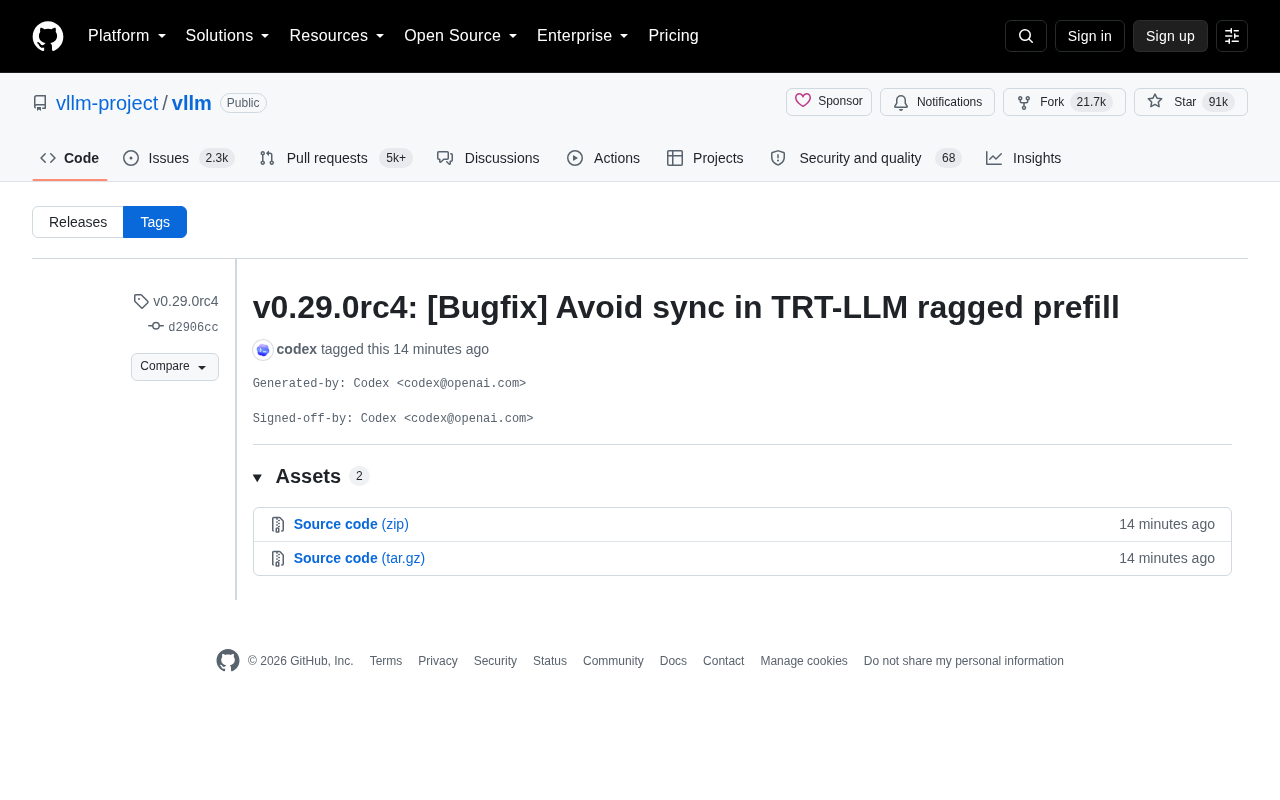
vLLM v0.29.0rc4 fixes a TRT-LLM ragged prefill sync bottleneck to boost GPU inference performance.
vLLM v0.29.0rc4 release candidate addresses a critical performance issue: unnecessary GPU-CPU synchronization in TRT-LLM's ragged prefill path. This fix eliminates implicit sync overhead that breaks CUDA's async execution pipeline, improving throughput, reducing tail latency, and maximizing GPU utilization for variable-length batch inference in production LLM serving.
Introduction
As one of the most popular large language model inference engines today, every version iteration of vLLM captures the attention of countless production deployment teams. Recently, the vLLM project released v0.29.0rc4 as a release candidate on GitHub. The core update in this release is a critical bug fix for TensorRT-LLM (TRT-LLM) ragged prefill scenarios — avoiding unnecessary synchronization (Avoid sync).
This change may seem minor, but it strikes at the heart of high-performance inference engine optimization: the synchronization overhead between GPU and CPU. This article will dive deep into the technical logic behind this fix and its practical implications for inference performance.
vLLM Project Background and Version Evolution
vLLM was initiated by the UC Berkeley team and has become a widely recognized high-throughput, low-latency LLM inference framework, thanks to innovations like PagedAttention. As of now, the project has accumulated over 91,000 Stars and 21,700 Forks on GitHub, reflecting an extremely active community.
PagedAttention is vLLM's most iconic innovation, inspired by the virtual memory paging mechanism in operating systems. In traditional LLM inference, KV cache (Key-Value Cache) pre-allocates contiguous GPU memory for each request. Since sequence lengths are unpredictable, this approach leads to severe memory fragmentation and waste, with actual utilization often below 50%. PagedAttention divides KV cache into fixed-size "pages" (blocks) and uses page tables for non-contiguous logical-to-physical mapping, allowing multiple requests to share physical memory blocks and boosting memory utilization to nearly 100%. This mechanism also naturally supports copy-on-write semantics, providing additional memory savings for scenarios like beam search and parallel sampling.
The v0.29.0rc4 release is a Release Candidate, meaning the official v0.29.0 version is in its final stabilization phase. Notably, this version was tagged and authored by OpenAI's Codex automation tool (Generated-by: Codex), reflecting how AI-assisted engineering practices are gradually permeating the day-to-day maintenance workflows of mainstream open-source projects. OpenAI Codex is an AI programming agent system that goes beyond traditional code completion tools, capable of taking on more autonomous roles in software engineering workflows — including understanding issue descriptions, writing code fixes, running tests, and submitting PRs as part of a complete development workflow. This recursive progress of "AI for AI infrastructure" is becoming an important paradigm for improving development efficiency in the open-source ecosystem.
Core Fix Analysis: Why "Avoid Sync" Matters
What Is Ragged Prefill
In LLM inference, the prefill phase refers to the process where the model performs a one-time parallel computation on the input prompt to generate the initial KV cache. When multiple requests in a batch have inconsistent input lengths, this creates so-called ragged sequences. TRT-LLM, as NVIDIA's official high-performance inference backend, has dedicated optimization paths for these variable-length sequences.
To understand the importance of ragged prefill, you first need to understand the continuous batching scheduling strategy widely adopted by modern LLM inference engines. Unlike traditional static batching, continuous batching allows new requests to be dynamically added or completed requests to be removed at the end of each decoding iteration, without waiting for the longest sequence in the entire batch to finish. This dramatically improves GPU utilization and system throughput. However, this dynamic scheduling naturally produces ragged batches — the same batch contains both long sequences in the prefill phase (processing complete prompts) and short sequences in the decode phase (generating only one token at a time). To efficiently handle such irregular inputs, variable-length sequence indices and masks must be used in attention computation rather than simple fixed-shape tensor operations — and this is exactly the problem that the ragged prefill optimization path aims to solve.
TensorRT-LLM (TRT-LLM) is NVIDIA's high-performance inference library built specifically for large language models on top of its TensorRT inference optimization engine. It deeply leverages NVIDIA GPU hardware features, including Tensor Core matrix operation acceleration, FP8/INT8 quantization support, Flash Attention fused operators, and multi-GPU tensor parallelism. TRT-LLM compiles model computation graphs into highly optimized CUDA kernels, eliminating Python runtime overhead and framework-level redundant operations. vLLM supports TRT-LLM as its backend execution engine, and this combination allows vLLM's advanced scheduling capabilities to complement TRT-LLM's low-level operator optimizations, achieving near-hardware-limit inference performance on NVIDIA GPUs.
The Hidden Cost of GPU-CPU Synchronization Overhead
The keyword of this fix is Avoid sync. In GPU computing, synchronization operations between CPU and GPU (such as cudaStreamSynchronize or implicit device-to-host data copies) force the CPU to wait for the GPU to complete all current tasks, thereby breaking the asynchronous execution pipeline.
To deeply understand this issue, you need to understand CUDA's asynchronous execution model. CUDA operates on the concept of Streams: the CPU submits operations like kernel launches and memory copies to a GPU stream and can immediately return to continue executing subsequent code, while the GPU asynchronously executes the operations in the stream in order. This design allows the CPU and GPU to work simultaneously, forming an efficient pipeline. Synchronization operations break this pipeline: cudaStreamSynchronize blocks the CPU thread until all operations in the specified stream are completed; cudaDeviceSynchronize waits for all streams on the device to complete; additionally, data copies from GPU memory to CPU memory (cudaMemcpy D2H) implicitly trigger synchronization in the default mode. In inference engines, even a seemingly harmless .item() or .cpu() call on a tensor can trigger implicit synchronization, causing GPU pipeline bubbles that force otherwise overlapping computation, data transfer, and scheduling decisions to be serialized.
This synchronization is especially detrimental in ragged prefill scenarios:
- Breaking the overlap between computation and scheduling: Ideally, the CPU should prepare the next batch of data while the GPU is computing. Synchronization operations force this process to become serial.
- Introducing unpredictable latency jitter: In high-concurrency services, every unnecessary synchronization can accumulate into significant tail latency.
- Reducing GPU utilization: The GPU sits idle while waiting for CPU instructions, wasting expensive compute resources.
By eliminating redundant synchronization in the TRT-LLM ragged prefill path, vLLM enables the GPU to maintain a more continuous computation flow, resulting in higher throughput and more stable latency performance in variable-length input batching scenarios.
Practical Implications for Production Deployment
For teams using the vLLM + TRT-LLM combination in production environments, this fix delivers direct practical value. Real-world inference requests are almost always of varying lengths — user prompts can range from a few dozen tokens to several thousand tokens. It is precisely this ragged characteristic that allows this optimization to cover the vast majority of real-world business scenarios.
Expected benefits include:
- Higher service throughput (QPS): With reduced synchronization overhead, more inference requests can be processed per unit of time.
- Smoother latency curves: Reducing synchronization-induced jitter is especially important for SLA (Service Level Agreement)-sensitive applications. Tail latency refers to the response time at high percentiles (such as P95, P99) of the latency distribution, reflecting the worst-case latency experienced by users. In large-scale online inference services, even if the average latency is very low, abnormally high latency on a small number of requests can severely impact user experience and SLA compliance. GPU-CPU synchronization is one of the typical factors causing tail latency: in high-concurrency scenarios, the blocking time of synchronization operations is nondeterministic, depending on the current task queue depth on the GPU, and can introduce hundreds of microseconds or even milliseconds of additional waiting on certain requests. For latency-sensitive application scenarios such as real-time conversations and search recommendations, P99 latency often matters more than average latency in determining the success or failure of system design.
- More efficient hardware utilization: Squeezing more effective compute out of expensive GPU resources, reducing per-inference cost.
RC Version Usage and Upgrade Recommendations
As a release candidate, v0.29.0rc4 is primarily intended for advanced users willing to validate early and assist with community testing. For production environments, it is still recommended to wait for the official v0.29.0 release before upgrading. However, for teams looking to validate TRT-LLM performance improvements as early as possible, deploying in a test environment ahead of time and providing feedback can help the project stabilize.
Conclusion
The fix in vLLM v0.29.0rc4 to "avoid TRT-LLM ragged prefill synchronization," while just a single line in a massive changelog, precisely hits the core proposition of high-performance inference optimization — in an asynchronous computing world, eliminating one synchronization is reclaiming one unit of compute power.
As LLM inference cost increasingly becomes a critical bottleneck for scaling applications, these kinds of low-level, seemingly inconspicuous engineering optimizations are precisely what determine the competitive edge of inference engines. At the same time, the detail that this version was automatically generated by Codex also signals that AI engineering is entering a new phase where AI assists in building AI infrastructure.
Related articles
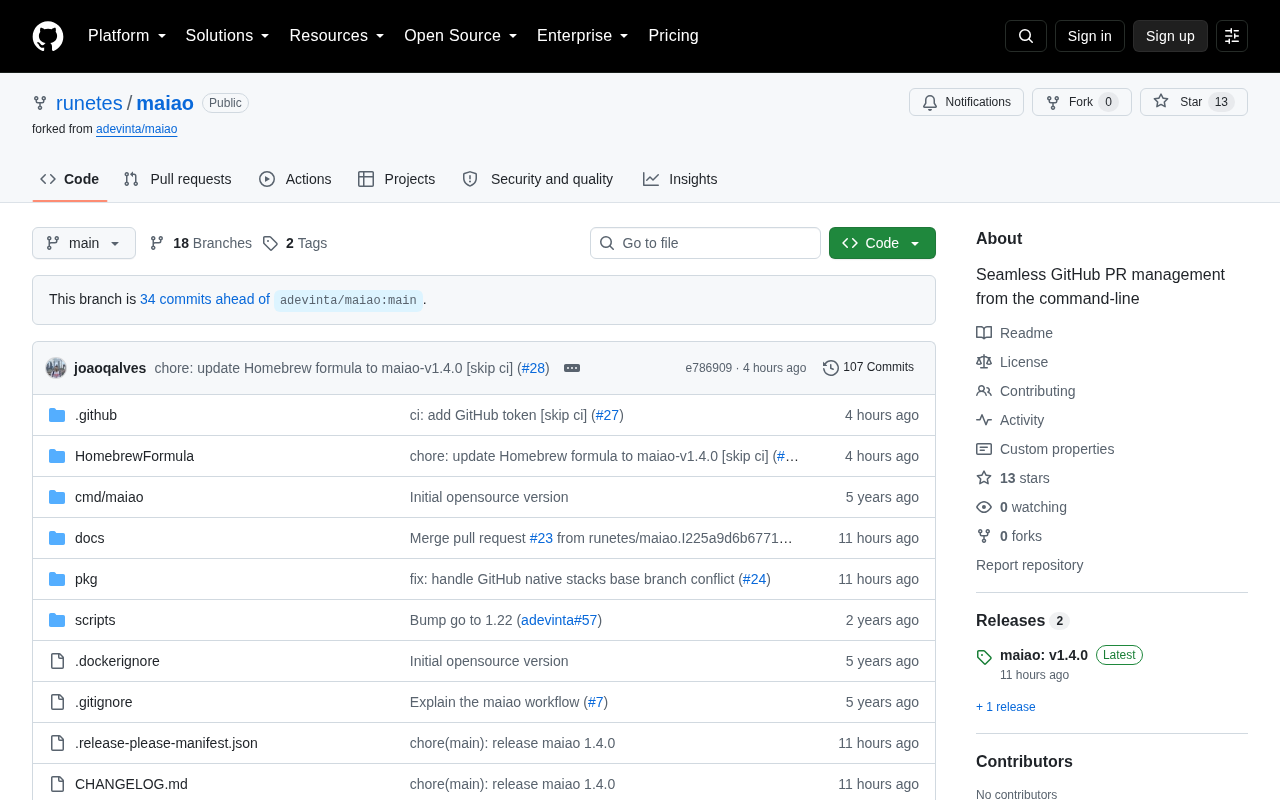
Maiao: Bringing Gerrit-Style Code Review Workflow to GitHub
Maiao is an open-source tool bringing Gerrit-style one-commit-per-review and stacked changes workflow to GitHub, GitLab, and Gitea, enabling fine-grained code review without deploying extra servers.
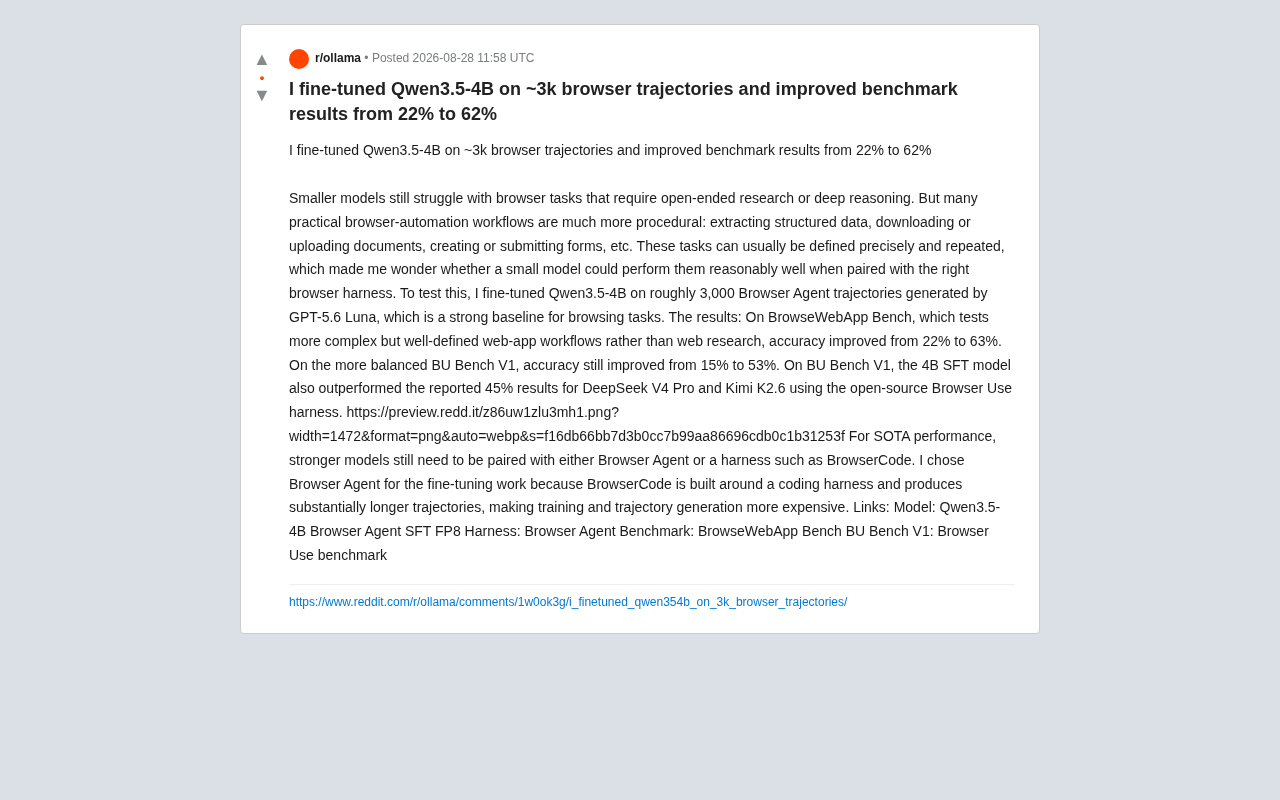
Fine-Tuning a 4B Small Model: Browser Task Accuracy Soars from 22% to 63%
Fine-tuning Qwen3.5-4B on 3,000 browser operation trajectories boosts accuracy from 22% to 63%, even outperforming large models like DeepSeek V4 Pro. Detailed experimental design, benchmark results, and practical insights for developers.
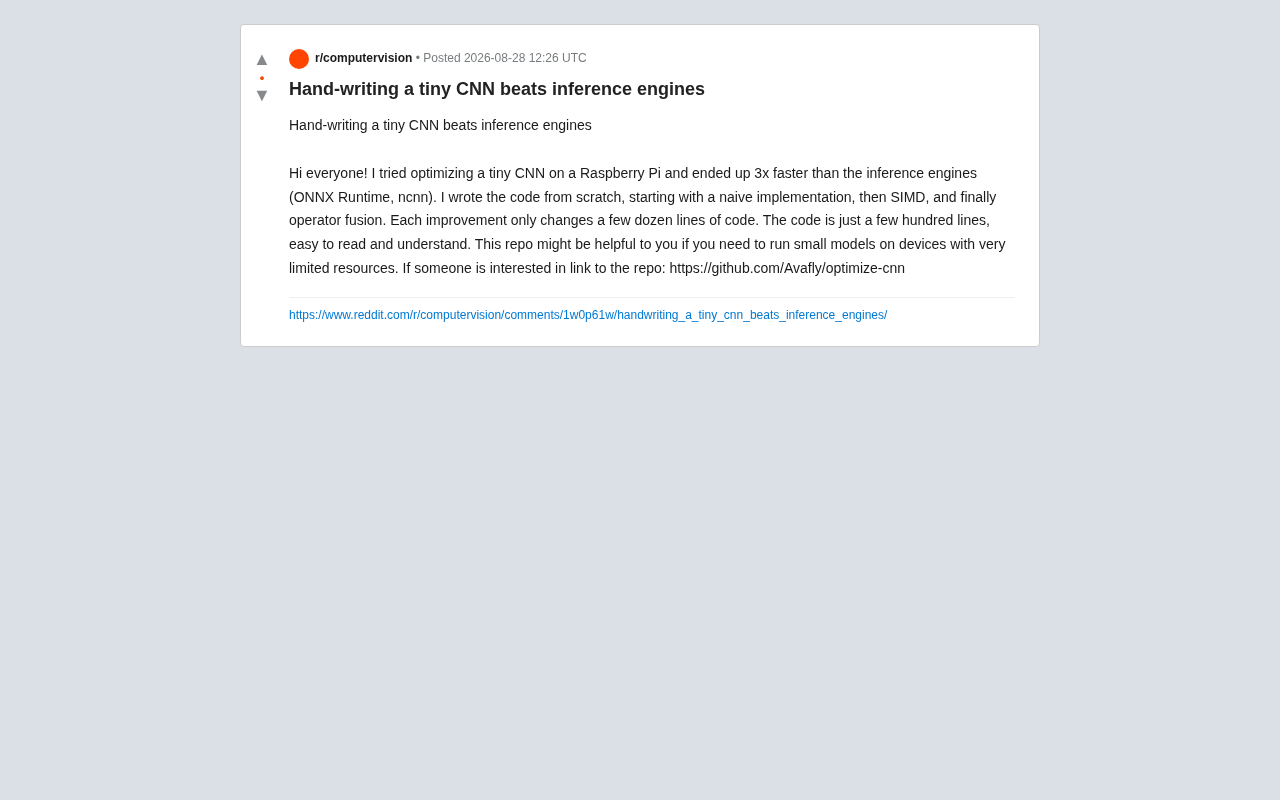
Hand-Written Tiny CNN Runs 3x Faster Than Inference Engines: A Practical Guide to Edge Optimization on Raspberry Pi
A developer hand-wrote a tiny CNN on Raspberry Pi, achieving 3x faster performance than ONNX Runtime and ncnn through SIMD vectorization and operator fusion.