vLLM v0.31.0rc5 Released: Adding an Upper Version Bound for Transformers

vLLM v0.31.0rc5 caps the transformers version to prevent incompatible upgrades from breaking production inference services.
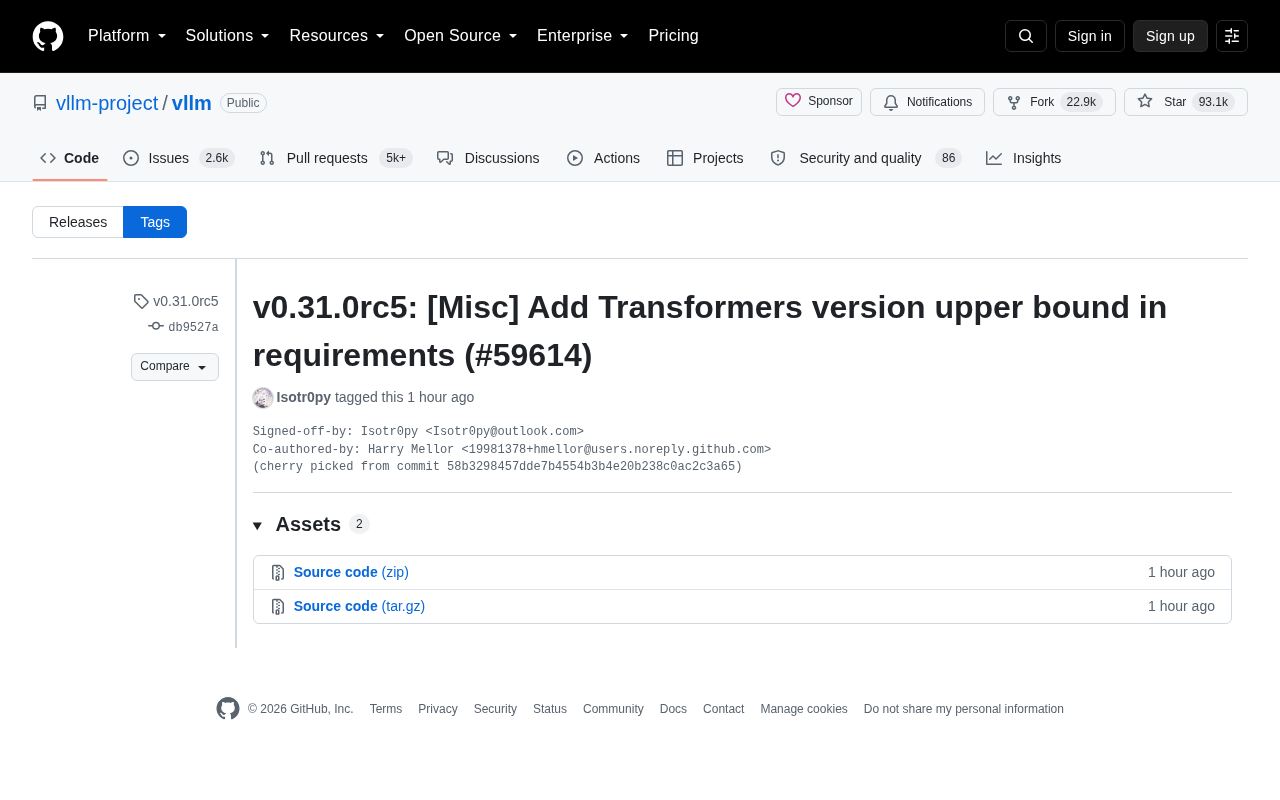
vLLM released v0.31.0rc5 with a key change: adding an upper version bound on the Hugging Face `transformers` library (PR #59614). Since vLLM relies heavily on `transformers` for model loading and tokenization, any incompatible upstream API change could silently break inference services. Submitted by Isotr0py in collaboration with Harry Mellor and merged via cherry-pick, this change ensures users won't auto-upgrade to unvalidated `transformers` versions. The rc5 designation reflects ongoing stability work, and this dependency tightening exemplifies the engineering discipline that distinguishes production-grade projects from experimental ones.
A Small but Critical Dependency Update
vLLM recently released v0.31.0rc5 (release candidate), with a core change that adds an upper version bound constraint on the transformers library in its dependency requirements (PR #59614). This kind of change often goes unnoticed in release notes, yet it directly impacts the stability of inference services in production environments.
vLLM is one of the most widely watched LLM inference acceleration frameworks, with over 93k stars and nearly 23k forks on GitHub — making it a de facto standard for high-throughput LLM serving deployments. It relies heavily on Hugging Face's transformers library to load model architectures, tokenizers, and configurations. As a result, any breaking changes in transformers can cascade and disrupt vLLM's normal operation.
Why Set an Upper Bound on a Dependency
In the Python ecosystem, dependency version management is a balancing act. Specifying only a lower bound (e.g., transformers>=4.x) means the latest version gets pulled by default. The benefit is immediate access to upstream new features, but the risk is clear: once upstream introduces incompatible API changes, downstream projects can break without warning.
This PR was submitted by contributor Isotr0py in collaboration with Harry Mellor, and was merged into the release branch via cherry-pick. The goal is to set a clear version ceiling for transformers, preventing users from automatically upgrading to a newer version that hasn't been validated and may introduce compatibility issues when installing vLLM.
Practical Implications for Production Deployments
For teams running online inference services, this change means a more predictable environment. Without a version ceiling, a single pip install or container rebuild could silently upgrade transformers to an incompatible version, causing model loading failures or unexpected inference behavior. With the upper bound in place, vLLM can guarantee it runs within a tested dependency range, reducing the probability of unexpected downtime.
Cherry-pick is a Git operation that allows developers to "pick" a specific commit from one branch and apply it to another, without merging the entire branch history. In large projects like vLLM, the main development branch is typically under active iteration, while the release branch prioritizes stability and only accepts carefully selected fixes. Through cherry-pick, teams can precisely transplant a bugfix or dependency correction into the release branch without pulling in untested new features — maintaining release stability while responding quickly to critical issues. This workflow is extremely common in mature open-source projects like the Linux kernel and CPython.
The Role of a Release Candidate
It's worth noting that v0.31.0rc5 is still a release candidate (rc5 indicates this is the fifth candidate). This shows that the vLLM team is still polishing stability before formally releasing v0.31.0, and tightening dependency constraints is precisely the kind of work typical of this final stretch.
For general users, release candidates are usually not recommended for critical production environments. However, developers who want to try new features early or need to validate upcoming changes can test ahead of time. The release page also provides the relevant build artifacts (Assets) for easy access.
A Release Candidate (RC) is the stage in a software release process that sits between a feature-complete Beta and the official stable release. An RC signals that the team believes the code has largely reached release quality, but still requires broader testing to catch potential issues. rc5 means this is the fifth candidate version, indicating that several issues were discovered and fixed across the previous four rounds of testing — this dependency constraint tightening is likely one of those fixes. For enterprise users, it's generally advisable to wait for the stable release. For library maintainers or framework integrators, testing RC versions early helps surface upstream/downstream compatibility issues before the official release, providing valuable feedback to the community.
The Engineering Culture Behind a Small Change
This kind of dependency upper-bound commit reflects the rigorous approach to dependency governance in mature open-source projects. As vLLM's user base continues to grow, the stability requirements for the framework keep rising — even a single line change in requirements can affect thousands of deployment instances.
For engineers using vLLM, there's a worthwhile practice to take away: set reasonable version ranges for critical dependencies in your own projects. Don't blindly pin to old versions and miss improvements, but don't allow unconstrained upgrades to introduce risk either. Fine-grained dependency management is often the dividing line between an experimental project and a production-grade one.
Related articles

AI Visibility Metrics: Definitions Matter More Than Dashboards
AI visibility measurement tools are proliferating, but the lack of unified definitions makes data incomparable. This article analyzes the mismatch and explores why repeatable methodology matters more than dashboards, and how a shared vocabulary can make AI search measurement truly credible.

Liquid AI Releases LFM2.5-24B-A2B: A 2B Active-Parameter MoE Built for On-Device Agents
Liquid AI releases LFM2.5-24B-A2B, an open-weights MoE model with 24B total and 2B active parameters for on-device agents, scoring 48.09 on LiveClaw and hitting 184 tokens/s on Apple M5 Max.

25 Free Browser-Based Image Design Tools: No File Uploads, Local Processing for Peace of Mind
25 free browser-based image design tools that run locally with no file uploads. Covers image compression, format conversion, color schemes, WCAG contrast checking, EXIF metadata viewing, and more — no registration needed.