vLLM v0.32.0rc1: Updates Humming Dependency and Removes NVFP4 Workaround

vLLM v0.32.0rc1 updates the Humming dependency and removes the NVFP4 scale workaround, simplifying the low-precision inference numerical path.
vLLM has released v0.32.0rc1, a release focused on dependency governance and numerical precision fixes. It updates the Humming dependency and removes the NVFP4 scale workaround, returning scale calculation to the standard path. For NVFP4 users, this can reduce memory access and kernel overhead; for others, it mainly affects dependency consistency. Led by jinzhen-lin with Codex as co-author.
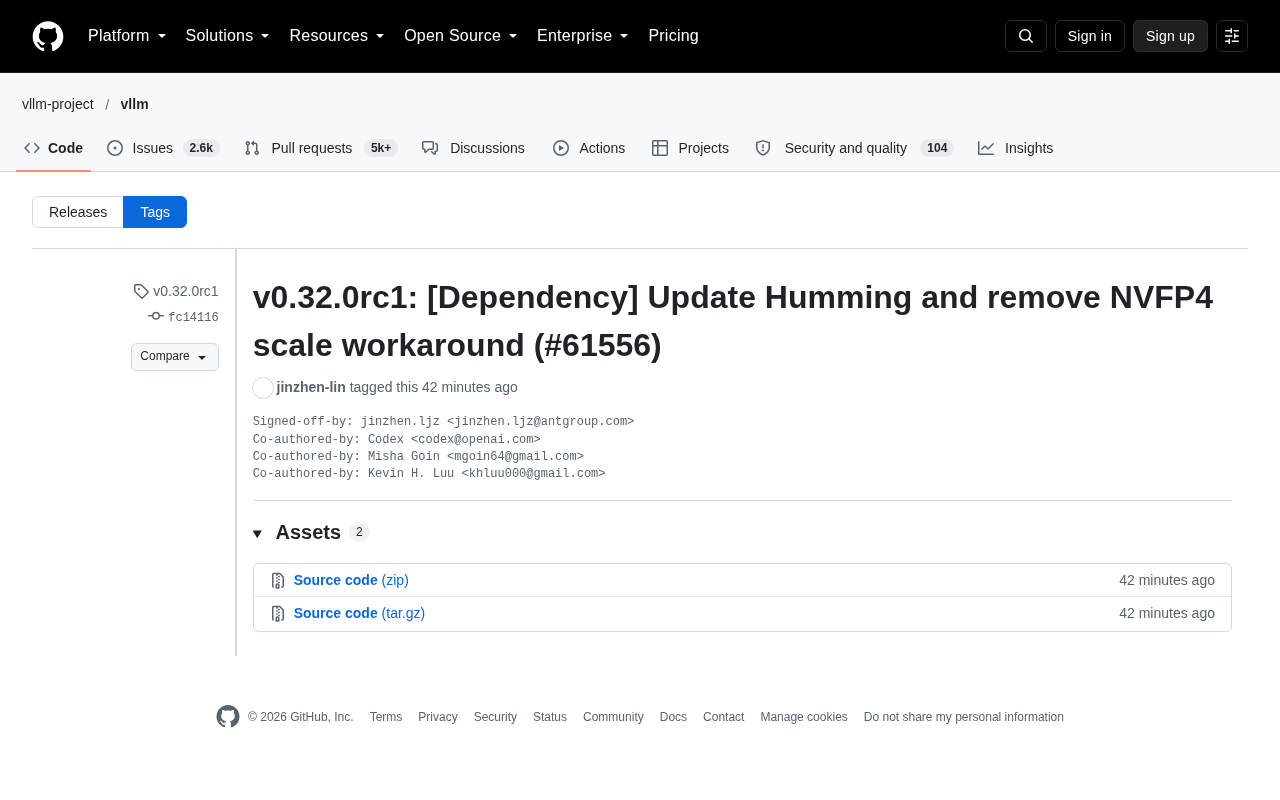
vLLM has released the v0.32.0rc1 release candidate. This update is essentially about dependency governance and low-level numerical precision fixes. There are two core actions: updating the Humming dependency and removing the scale workaround previously introduced for NVFP4. The commit, #61556, was completed by jinzhen-lin, with co-authors including Codex, Misha Goin, and Kevin H. Luu.
What This Update Actually Changes
Judging from the commit title, the changes are focused in two places. Humming is a dependency component in the vLLM ecosystem that handles quantization-related computations, and a version update usually means upstream has fixed several numerical or interface-level issues. Removing the NVFP4 scale workaround is more telling—the very existence of a workaround indicates a known defect previously existed, and now that the upstream dependency is fixed, the temporary patch can be withdrawn.
For inference frameworks, commits of this "patch removal" type are often more noteworthy than newly added features. It means the code path has become cleaner, maintenance burden is reduced, and at the same time the NVFP4 low-precision inference route has taken another step forward in terms of framework-level completeness.
Typical Forms of Quantization Workarounds and Their Costs
A so-called scale workaround usually refers to an extra correction applied on the framework side to the scaling factor of a tensor: for example, forcing the scale up to fp32 before participating in computation, inserting an extra clamp to prevent overflow, or adding a redundant cast before and after a kernel. The common characteristic of such patches is "do not change the interface, only rewrite the numerical path," so they can quickly get functionality running, but the cost is often underestimated.
The explicit cost is additional kernel launches and GPU memory reads/writes, especially when it must be executed once per layer during the decode stage, where accumulated overhead may account for several percentage points. The implicit cost is more troublesome: it causes the framework's actual numerical behavior to deviate from the reference implementation, making precision comparisons, regression tests, and cross-version reproduction all difficult. Removing the patch promptly after the upstream dependency is fixed, in addition to performance regression, also restores the interpretability of "code as documentation"—readers no longer have to judge which section is temporary.
Why NVFP4 Matters
NVFP4 is a 4-bit floating-point format introduced by NVIDIA for the Blackwell architecture. Compared with FP8, it further compresses memory usage and bandwidth pressure. In long-context inference and large-batch scenarios, the bit width of weights and activations directly determines how much KV Cache can fit on a single card.
vLLM's support for NVFP4 has advanced in stages. In early versions, to work around numerical precision issues in upstream libraries, an extra processing step was inserted into the scale calculation. This approach could get things running, but it brought additional kernel calls and the risk of accumulated numerical error. Removing the workaround this time indicates that the fix on the dependency side has been merged, and the framework can follow the standard path.
The Bit-Width Tradeoff Between FP8 and 4-Bit Floating Point
FP8 (E4M3/E5M2) occupies 1 byte per parameter and is currently the mainstream low-precision inference format on Hopper and Blackwell. NVFP4 further compresses each parameter to 4 bits, or 0.5 bytes, theoretically halving both weight memory usage and loading bandwidth. But it is not simply cutting 16-bit floating point down to 4 bits: NVFP4 uses an E2M1 mantissa and exponent allocation, with a very narrow representable range, so it must be used with "block scaling"—every several elements share one high-precision scale, which is multiplied back during dequantization. This also explains why the correctness of scale calculation is so critical for NVFP4: once the scale is contaminated by numerical issues in an upstream library, the error accumulates and amplifies with each layer rather than being absorbed locally.
In addition, NVFP4's compute gains depend on native hardware support. Only Blackwell's fifth-generation Tensor Cores provide FP4 matrix multiplication instructions. Running 4-bit weights on Hopper or older cards usually requires first dequantizing back to FP8/FP16 before computation, saving memory but failing to gain the compute advantage. When evaluating whether to switch to NVFP4, hardware generation often determines the actual benefit more than the framework version.
Actual Impact on Users
If you are using vLLM to deploy NVFP4 quantized models, this version is worth following up on and testing. The most direct change is a simplified scale calculation path, which in theory can reduce some memory access and computation overhead. For throughput-sensitive online services, even a small reduction in the number of kernels may translate into an observable TPS improvement.
If NVFP4 is not currently involved, the impact of this update is mainly reflected in dependency consistency. After the Humming version update, other modules within the team that depend on Humming need to confirm interface compatibility to avoid build failures caused by version drift.
Verification Suggestions During the Release Candidate (rc) Stage
An rc version means the API and core behavior are frozen, but it may still contain undiscovered regressions. For NVFP4 users, the most valuable action when following an rc is not to put it directly into production, but to perform an A/B precision alignment: under the same set of prompts and the same sampling parameters, compare the output differences and perplexity metrics between the workaround version and this version. Focus on long-context scenarios, because the cumulative effect of scale errors becomes more obvious as sequence length grows.
If precision deviation exceeds expectations, the problem may not necessarily be in this repository; it may also come from changes upstream in Humming. In that case, rolling back the dependency version and comparing activation distributions layer by layer is a more reliable way to localize the issue than modifying framework code. For teams not involving NVFP4, the follow-up focus is the build pipeline: confirm that other components internally locked to a Humming version do not have hidden API dependencies, and if necessary add a version consistency check in CI to prevent drift between rc and stable versions from only being exposed downstream.
Version Positioning and Follow-Up Observations
v0.32.0rc1 is a release candidate. According to vLLM's release cadence, the rc stage is usually used to collect regression issues, and the stable version will follow within the next few weeks. This commit was led by Ant Group engineer jinzhen-lin, with Codex participating as co-author, which also reflects the normalization of community collaboration.
There are two things worth watching going forward: first, whether NVFP4's precision performance under the standard path aligns with the workaround version; second, whether other temporary dependency patches can also be cleaned up.
One-line Summary
vLLM v0.32.0rc1 updates the Humming dependency and removes the NVFP4 scale workaround, simplifying the low-precision inference numerical path.
Paragraph Summary
vLLM has released the v0.32.0rc1 release candidate. This update is about dependency governance and numerical precision fixes, with the core actions being updating the Humming dependency and removing the scale workaround previously introduced for NVFP4. The existence of the workaround itself means there was once a known defect; now that upstream has fixed it, the temporary patch can be withdrawn, and NVFP4's scale calculation path returns to the standard implementation. For users deploying NVFP4 quantized models, the simplified path can theoretically reduce memory access and kernel overhead, potentially translating into observable TPS improvements; for teams not involving NVFP4, the impact is mainly in dependency consistency, requiring confirmation that other modules using Humming have compatible interfaces. The commit was led by Ant Group engineer jinzhen-lin, with Codex participating as co-author. The rc stage is usually used to collect regression issues, and the stable version is expected to follow in the coming weeks.
Related articles

AI Is Not a Replacement: Human-AI Collaboration Through the Lens of Factory Root Cause Analysis
Starting from factory root cause analysis, this article explains how AI accelerates evidence chain construction rather than replacing human experts, exploring the pragmatic implementation logic and business value of 'AI supporting people rather than replacing them.'

AI Agent Decision Auditing: Building an Evidence Chain in Regulated Workflows
Starting from a Reddit discussion, this article analyzes three core issues in AI agent decision auditing within regulated workflows: what fields audit records should contain, how to handle feedback latency for erroneous decisions, and how to continuously calibrate LLM judge consistency with human judgment.

Apple Opens Multiseat Subscription Purchasing: App Subscriptions Can Now Be Sold in Bulk to Businesses and Schools
Apple opens multiseat purchasing for auto-renewable subscriptions: businesses and schools can bulk-buy via Apple Business and Apple School Manager, adding or removing seats anytime. Enabled by default in App Store Connect—developers should verify settings; group purchasing sandbox testing opens October 2026.