Voice-Pro: An Open-Source AI Voice Tool Integrating TTS, Voice Cloning, and Speech Recognition

Voice-Pro integrates TTS, zero-shot voice cloning, and Whisper recognition into one open-source Gradio interface.
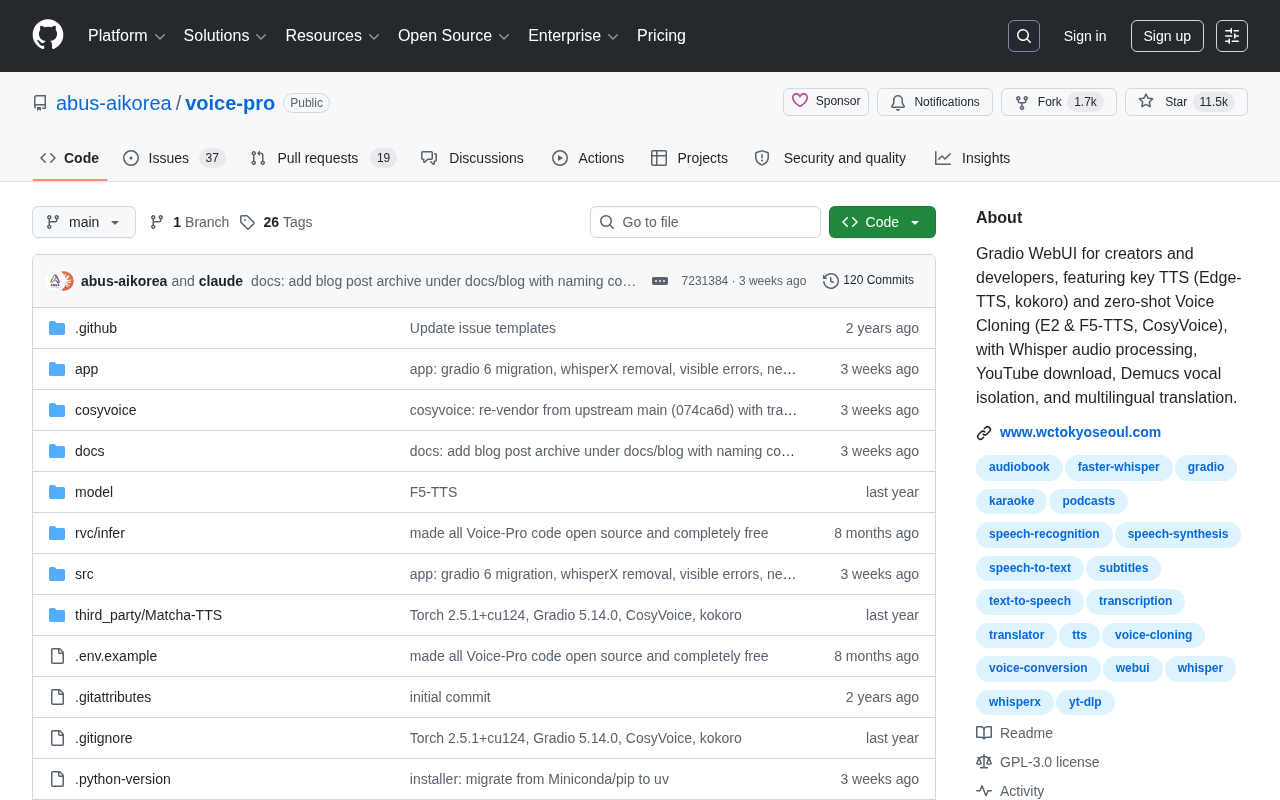
Voice-Pro is a popular open-source project on GitHub (11,500+ stars) that combines Edge-TTS, Kokoro, F5-TTS, CosyVoice, Whisper, and Demucs into a unified Gradio-based web interface. It provides content creators with a complete workflow for text-to-speech, zero-shot voice cloning, speech recognition, translation, and cross-language dubbing — all accessible without deep technical expertise.
An All-in-One Voice Tool Built for Creators
In today's flourishing AI voice technology landscape, the market has no shortage of models with powerful individual capabilities. What's missing is a tool that integrates these capabilities together and makes them accessible to everyday creators. The rapidly rising open-source project Voice-Pro (abus-aikorea/voice-pro) on GitHub targets exactly this pain point.
The project has already garnered over 11,541 Stars and 1,702 Forks, with 53 new Stars in a single day and momentum continuing to build. Built on Gradio's WebUI, it integrates text-to-speech (TTS), zero-shot voice cloning, speech recognition, translation, and more into one intuitive interface, serving both content creators and developers.
Core Features: Packing the Best Open-Source Models into One Interface
Text-to-Speech (TTS): Edge-TTS and Kokoro Dual Engines
Voice-Pro integrates two mainstream TTS solutions: Edge-TTS and Kokoro. Edge-TTS is essentially an unofficial wrapper around Microsoft Azure Cognitive Services' speech synthesis API, leveraging the online speech synthesis capabilities built into Microsoft Edge browser. It can be used for free without an Azure subscription, covering over 400 voices across 75 languages and dialects — its strengths lie in stability and zero cost. Kokoro is a recently popular lightweight open-source TTS model based on an improved StyleTTS2 architecture, achieving impressively natural speech output with only about 80 million parameters while fully supporting offline operation — making it particularly suitable for scenarios with privacy requirements or limited network access. Together, they satisfy both rapid bulk generation needs (Edge-TTS's cloud computing power is virtually unlimited) and offline scenarios with quality audio output (Kokoro's local inference requires no internet connection).
Zero-Shot Voice Cloning: F5-TTS, CosyVoice, and E2-TTS
This is one of Voice-Pro's most compelling capabilities. It integrates three zero-shot voice cloning models: E2-TTS, F5-TTS, and CosyVoice.
Zero-shot voice cloning represents one of the most important breakthroughs in speech synthesis in recent years. Traditional voice cloning requires collecting hours or even tens of hours of recording data from the target speaker, followed by lengthy model fine-tuning to generate speech in a specific voice. Zero-shot cloning, by pre-training on large-scale multi-speaker datasets, enables models to extract acoustic features (such as timbre, intonation patterns, speaking rhythm, etc.) from extremely short reference audio clips and transfer these characteristics to new text content. The core challenge of this paradigm lies in efficient extraction and disentanglement of speaker embeddings — the model must separate "what is being said" from "how it's being said," retaining only the personal characteristics of the latter.
Regarding the technical approaches of the three models: F5-TTS is a Flow Matching-based zero-shot TTS model developed by teams from Shanghai Jiao Tong University and others, using a Diffusion Transformer architecture that generates high-fidelity cloned speech from just a few seconds of reference audio through the flow matching training paradigm. CosyVoice is a large-scale speech synthesis model open-sourced by Alibaba's Tongyi Lab, whose architecture combines the text understanding capabilities of large language models with conditional flow matching for audio generation, supporting multiple languages and dialects with particularly outstanding performance in Chinese-English mixed scenarios. E2-TTS is known for its end-to-end minimalist architecture, reducing dependence on intermediate representations in traditional TTS pipelines. Each has its own strengths, and users can choose flexibly based on their specific scenarios.

Whisper Speech Recognition and Audio Transcription
The project has OpenAI's Whisper model built in for audio transcription and processing. Whisper is a general-purpose speech recognition model released by OpenAI in 2022, whose core innovation lies in the scale and diversity of its training data — it was trained on 680,000 hours of multilingual, multi-task weakly supervised data, covering speech recognition, speech translation, and language identification tasks across 99 languages. Architecturally, Whisper uses a standard encoder-decoder Transformer, converting audio into 80-channel mel spectrograms before feeding them into the encoder, while the decoder generates text tokens in an autoregressive manner.
Whisper's greatest advantage is robustness — it maintains high recognition accuracy even in noisy environments, accented speech, or non-standard recording conditions, making it particularly suitable for processing real-world audio content from platforms like YouTube. Users can convert video or audio files into text transcripts, laying the groundwork for subtitle generation and content repurposing, seamlessly connecting with downstream translation and TTS modules.
A Complete Workflow for Creators
Voice-Pro's value lies not just in stacking models, but in building a complete pipeline around content creation:
- YouTube Download: Directly fetch online video material, eliminating the hassle of manual downloading;
- Demucs Vocal Separation: Using Meta's open-source Demucs model to separate vocals from background music in audio, providing clean material for translation dubbing and secondary creation;
- Multilingual Translation: Translate transcribed text into target languages, and combined with TTS and voice cloning, achieve an automated workflow of "one video, multiple language dubs."
Demucs deserves special mention. It's a music source separation model developed by Meta (Facebook AI Research) that can decompose mixed audio into independent tracks (typically separated into four stems: vocals, drums, bass, and other instruments). Its latest version, Hybrid Transformer Demucs, combines the advantages of time-domain convolutional networks and frequency-domain Transformers, achieving state-of-the-art results on standard music source separation benchmarks. The core challenge of source separation is the "cocktail party problem" — recovering individual source signals from a mixture of superimposed signals. Demucs learns the distribution characteristics of different sound sources in the time-frequency domain through end-to-end training on large-scale music datasets, achieving high-quality separation.
Consider a typical scenario: a creator downloads an English video, transcribes subtitles with Whisper, translates them to Chinese via the translation module, uses voice cloning to preserve the original speaker's timbre while generating Chinese dubbing, and finally retains the original background music through Demucs. The entire cross-language dubbing workflow can be completed almost entirely within a single interface.
Technical Choices and Engineering Value
From a tech stack perspective, Voice-Pro is entirely developed in Python, using Gradio as its frontend framework. Gradio is an open-source Python library maintained by Hugging Face, specifically designed for quickly building interactive web demo interfaces for machine learning models. Its core design philosophy allows researchers and developers to wrap models into web applications with input/output components using just a few lines of Python code, without needing to master frontend development technologies (HTML/CSS/JavaScript). Gradio supports input/output components for various data types including audio, images, text, and video, with built-in queue mechanisms for handling concurrent requests. Due to its deep integration with the Hugging Face ecosystem, Gradio has become the de facto standard for sharing model demos in the AI community, with tens of thousands of online demos on Hugging Face Spaces built with Gradio. This choice lowers the barrier for non-technical users, enabling complex AI models to be packaged into interactive web interfaces at minimal cost.
For developers, Voice-Pro's significance lies in providing an integration paradigm: uniformly packaging SOTA (State-of-the-Art) models scattered across various repositories, avoiding the repetitive work of configuring environments and debugging interfaces one by one. In the AI open-source community, each cutting-edge model typically has its own independent dependency environment, data format, and inference interface. Integrating multiple models into the same project requires solving a series of engineering problems including version conflicts, GPU memory scheduling, and data flow management. Voice-Pro handles all this tedious adaptation work for users. Whether you want to quickly evaluate a TTS solution or build your own dubbing toolchain, you can use this project as a foundation for secondary development.
Important Considerations Before Use
The maturation of voice cloning technology also brings significant ethical and compliance risks that cannot be ignored. Zero-shot cloning means that just a few seconds of audio can reproduce someone's voice. While this brings convenience in dubbing, accessibility applications, and similar scenarios, it could also be used for malicious purposes such as voice forgery and fraud. In recent years, cases of telecom fraud using AI-synthesized voices have emerged in multiple countries, and some regions have enacted specific deepfake regulations (such as the EU AI Act's requirements for high-risk AI systems, China's "Interim Measures for the Management of Generative Artificial Intelligence Services," etc.). When using such tools, be sure to obtain authorization from the voice owner and comply with local laws and regulations.
Additionally, as a project integrating multiple large models, Voice-Pro has certain requirements for local hardware (especially GPU memory). Taking voice cloning models as an example, inference with F5-TTS and CosyVoice typically requires at least 6-8GB of GPU memory, and loading multiple models simultaneously further increases memory demands. A minimum of an NVIDIA RTX 3060 (12GB VRAM) or higher-tier GPU is recommended. Before actual deployment, evaluate your environment configuration and consider model quantization or time-sharing loading strategies to reduce resource usage if necessary.
Summary
Voice-Pro is a typical representative of the current "integration and ease-of-use" trend in the AI voice field. It consolidates a series of quality open-source tools — Edge-TTS, Kokoro, F5-TTS, CosyVoice, Whisper, Demucs, and more — into a unified Gradio interface, providing content creators with a complete workflow from material acquisition, speech recognition, and translation to dubbing generation. For users looking to quickly get started with AI voice creation, as well as developers seeking integration solution references, this is an open-source project well worth bookmarking and trying out.
Related articles

MathCode: An AI Coding Agent Built Specifically for Mathematical Computation
Deep dive into MathCode, an AI coding Agent for math computation. Learn how it uses code execution to overcome LLM reasoning limitations for precise symbolic and numerical calculations.

The Dilemma and Way Forward for Formal Verification: Lessons from 50 Years of Debate
Revisiting the 1979 DeMillo critique of formal verification: examining whether modern tools like Coq, TLA+, and Lean solve fundamental issues of specification correctness and social processes.

In-Depth Analysis of the St. Lucie Nuclear Power Plant Unit 1 Manual Shutdown Event
Detailed analysis of the St. Lucie Unit 1 manual shutdown event, covering 3 control rods dropping into the core, PWR safety mechanisms, and defense in depth principles for nuclear safety.