VoxCPM2: Tokenizer-Free Speech Synthesis with New Breakthroughs in Multilingual Generation and Cloning

OpenBMB releases VoxCPM2, a tokenizer-free TTS project with nearly 40K GitHub stars, covering multilingual generation, voice design, and high-fidelity cloning.
OpenBMB's open-source VoxCPM2 has earned nearly 40,000 GitHub stars. Its core innovation is removing the text and acoustic tokenizers from traditional TTS pipelines, letting the model map text directly to speech in continuous representation space. This simplifies inference, lowers vocabulary costs for multilingual expansion, and supports multilingual generation, text-driven voice design, and high-fidelity cloning. However, the project currently emphasizes capability descriptions over evaluation data, so actual inference efficiency and objective cloning metrics still need verification.
The open-source TTS space has welcomed another major project. VoxCPM2, released by the OpenBMB team, has already garnered nearly 40,000 GitHub stars, and its core selling point—a tokenizer-free architecture—is challenging the design paradigm of traditional speech synthesis pipelines.
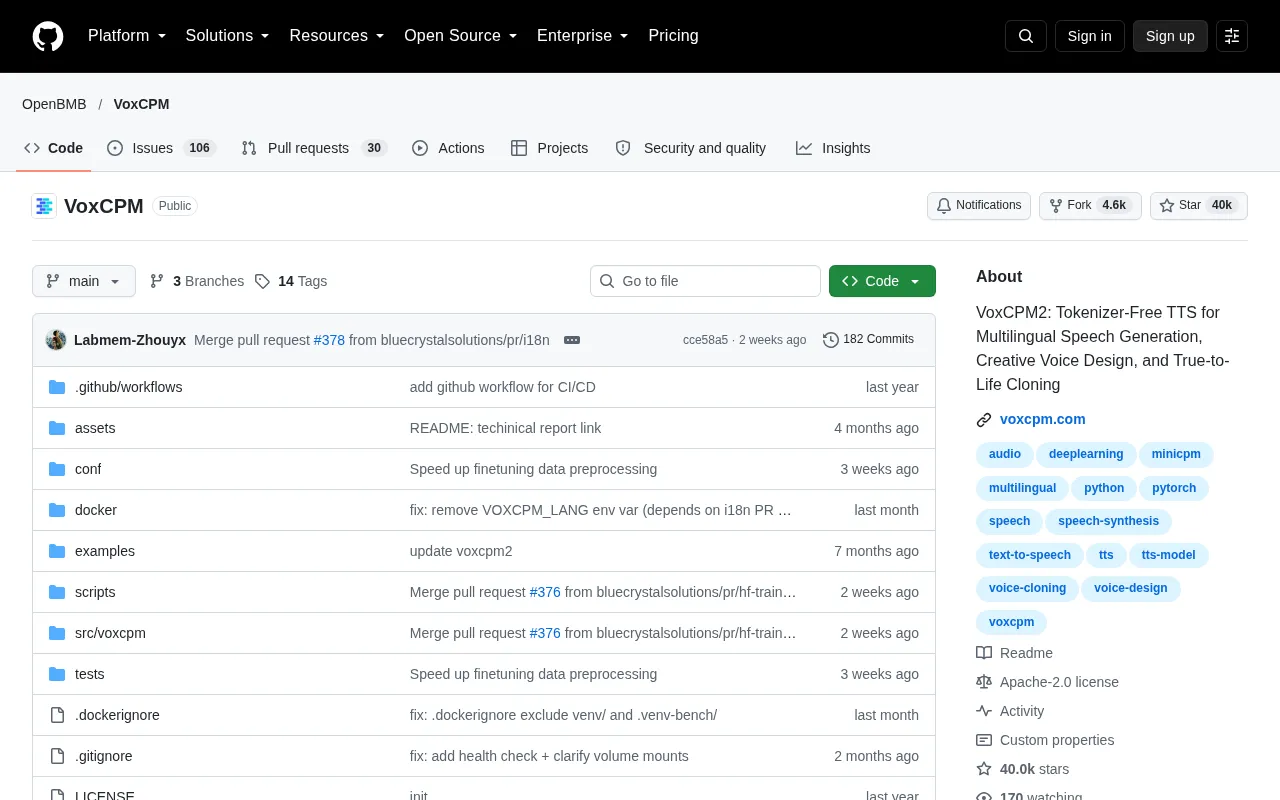
Saying Goodbye to Tokenizers: VoxCPM2's Architectural Shift
Traditional TTS systems typically rely on a text tokenizer and an acoustic tokenizer (such as a discrete codec) as intermediate representations, then reconstruct the waveform through a vocoder. Although this multi-stage pipeline is mature, each layer introduces information loss, and the tokenizer design is often tightly coupled to a specific language.
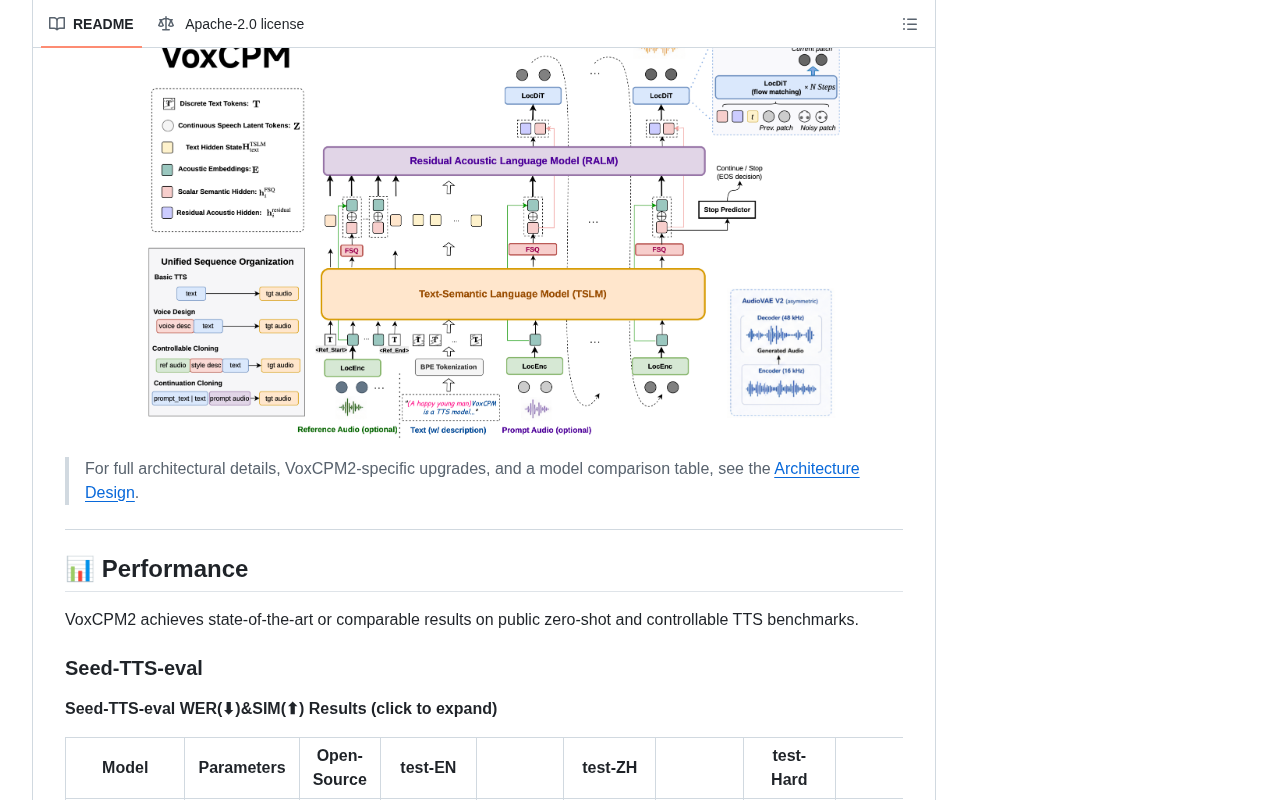
VoxCPM2 takes a more direct path: it removes the tokenizer stage entirely, letting the model perform the text-to-speech mapping in a continuous representation space. This design is especially friendly to multilingual scenarios—there is no need to maintain separate tokenizer vocabularies for each language, greatly reducing the cost of language expansion. The "Multilingual Speech Generation" emphasized in the project description is a direct manifestation of this architectural advantage.
From an engineering perspective, being tokenizer-free means a shorter inference chain and fewer deployment components, which is a practical benefit for developers looking to quickly integrate TTS capabilities.
Acoustic tokenizer (discrete codec) is a key component in traditional TTS pipelines. Its role is to compress continuous speech waveforms into discrete token sequences; common implementations include SoundStream and EnCodec. These models discretize audio layer by layer through residual vector quantization (RVQ), enabling language models to process speech much like text tokens. However, the quantization process itself loses fine-grained information (such as high-frequency harmonics and subtle prosodic variations), and the training data distribution of the codec limits its generalization ability. By removing this stage, VoxCPM2 means the model must model directly in a continuous acoustic space, typically relying on continuous generation paradigms such as diffusion models or flow matching—which also explains why its inference chain can be shorter.
The core challenge of a tokenizer-free architecture lies in alignment: in traditional pipelines, the correspondence between text and acoustic tokens is relatively explicit, whereas in continuous space the model must learn the text-to-waveform mapping on its own. Such approaches usually adopt end-to-end autoregressive or non-autoregressive generation frameworks, paired with pretrained text encoders and acoustic decoders. The advantage is reduced information bottlenecks, but the cost is a greater dependence on the scale and quality of training data. For multilingual scenarios, continuous-space representations naturally avoid the vocabulary explosion problem, which is also the architectural foundation for VoxCPM2's emphasis on multilingual capabilities.
Breaking Down Three Core Capabilities: Generation, Design, and Cloning
VoxCPM2 covers three typical use cases of speech synthesis.
Multilingual speech generation is the foundational capability. With the tokenizer removed, the model handles text input across different languages in a more unified way, and the naturalness degradation problem during cross-lingual switching is expected to be alleviated.
Creative Voice Design points to a "describe and generate" interaction style—users describe voice characteristics through text, and the model directly produces speech that meets the requirements. Such capabilities are clearly in demand in game voice-over and audio content production.
True-to-Life Cloning is currently the most fiercely competitive track in TTS. The project uses "true-to-life" to describe its cloning performance, implying targeted optimization in timbre similarity and prosodic naturalness.
Zero-shot voice cloning is one of the core metrics in current TTS evaluation. It usually refers to a model's ability to synthesize new speech in a target speaker's timbre from just a few seconds to tens of seconds of reference audio, without fine-tuning for that speaker. Its technical foundation generally includes a speaker encoder (extracting timbre embeddings) and a prosody transfer module. Commonly used objective metrics in the industry include speaker similarity (such as SECS, which computes the cosine similarity of embeddings based on a speaker verification model) and word error rate (WER, which measures the intelligibility of synthesized speech). The "true-to-life" used by VoxCPM2 is a subjective description, and its actual performance needs to be verified against the above metrics.
Creative Voice Design relies on cross-modal alignment between text and timbre, typically achieved by introducing paired data of timbre description text and audio during training. The difference between this capability and voice cloning is that cloning is conditioned on reference audio, while voice design is conditioned on natural language descriptions, placing higher demands on the model's semantic understanding and disentanglement of timbre attributes.
What Community Popularity Says
Nearly 40,000 stars, more than 4,500 forks, and 144 new stars in a single day—these figures place it among the top-tier TTS projects on GitHub. The Python tech stack lowers the barrier to entry, and OpenBMB, as a Tsinghua-affiliated open-source team, has mature experience in model open-sourcing and community operations.
Behind the popularity is a real demand gap: existing open-source TTS solutions still struggle to satisfy users in terms of naturalness and cloning similarity in multilingual scenarios such as Chinese, while commercial APIs raise concerns about cost and data privacy. VoxCPM2 happens to fill this gap.
Several Issues Worth Watching
The information currently disclosed by the project is mostly capability descriptions, lacking specific evaluation data. Whether the tokenizer-free architecture is truly superior to traditional approaches in inference efficiency, how the cloning performance measures up on objective metrics, and the specific list of supported languages—all of these need to be verified through a technical report or community testing.
For teams considering adoption, it is advisable to first conduct small-scale comparative tests in the target language and timbre scenarios, with a focus on the stability of long-text synthesis and the cross-sentence consistency of cloned timbres.
One-line Summary
OpenBMB releases VoxCPM2, a tokenizer-free TTS project with nearly 40,000 GitHub stars, covering multilingual generation, voice design, and high-fidelity cloning.
Paragraph Summary
OpenBMB's open-source VoxCPM2 has earned nearly 40,000 GitHub stars. Its core innovation is removing the text tokenizer and acoustic tokenizer from traditional TTS pipelines, enabling the model to map text directly to speech in a continuous representation space. This architecture simplifies the inference chain, reduces vocabulary maintenance costs for multilingual expansion, and supports three capabilities: multilingual speech generation, text-description-driven voice design, and high-fidelity cloning. Community popularity reflects the demand gap in open-source TTS for multilingual naturalness and cloning similarity. However, the project currently focuses on capability descriptions and lacks evaluation data; the actual inference efficiency of the tokenizer-free architecture and objective cloning metrics still need verification through a technical report or community testing.
Related articles

Will GitHub Die? Open Source Maintainer Burnout and the Collaboration Crisis in the AI Era
Lex Fridman podcast discussion on open source maintainer burnout and GitHub's predicament: massive pull requests overwhelm core maintainers, and AI worsens code bloat. Using math journal peer review and Poincaré conjecture verification as analogies, the article analyzes why verification in knowledge production must be deliberately slow, and how open source communities can avoid the failure mode of maintainers exiting.

Stop Building Cookie-Cutter AI Websites: 3 Tools That Transform Your Coding Agent
Three tools that boost AI coding agents: FFmpeg skill for local video editing in Claude Code and Cursor, Hallmark's 50 design themes to fix cookie-cutter AI sites, and Jailbreaks' 25+ model prompts.

How America's Gerontocracy Squeezes the Younger Generation
Americans over 55 hold nearly three-quarters of national wealth, alongside an 80-year-old president and elderly congressional leaders. The Atlantic's Idrees Kahloon explains how gerontocracy drives up housing costs, squeezes opportunities for the young, and explores zoning reform and child poverty reduction as practical fixes.