WaferTetris: A Freeform Mapping Approach for Wafer-Scale Accelerators
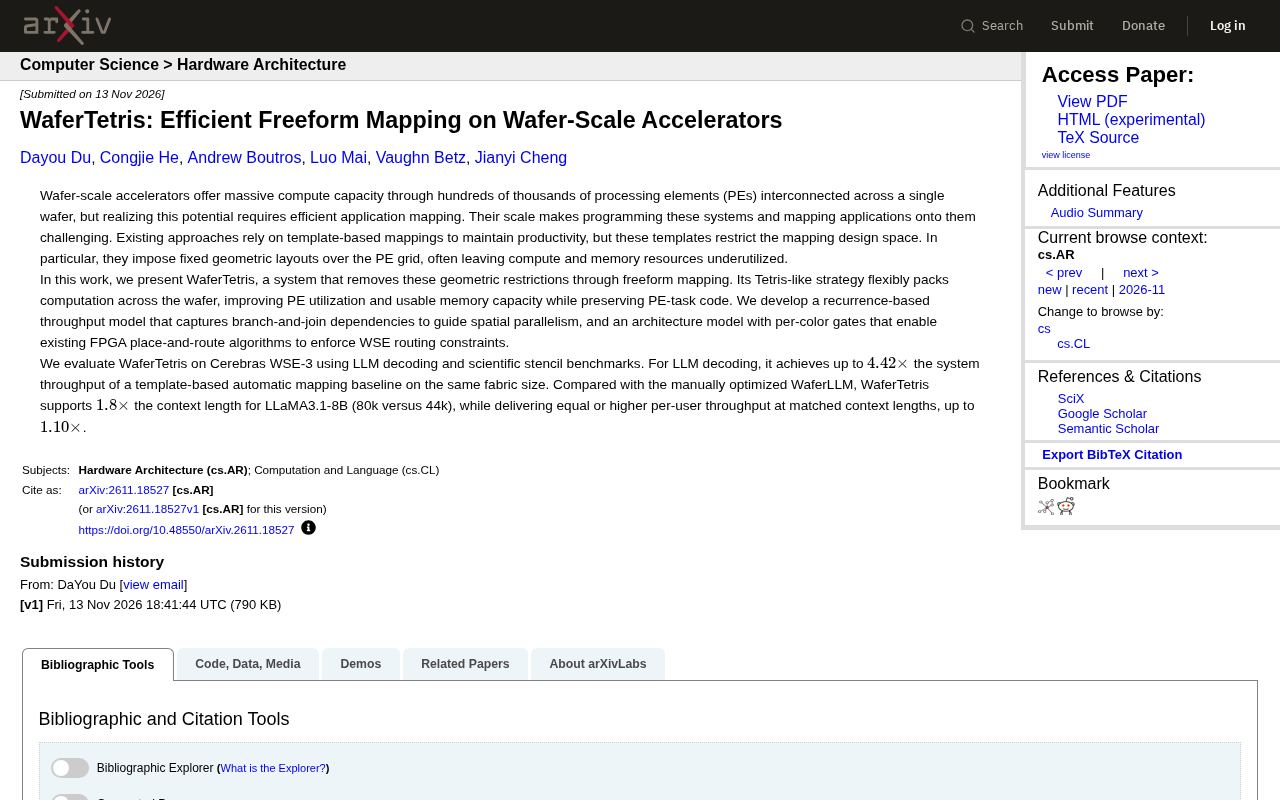
WaferTetris replaces template mapping with freeform mapping, achieving up to 4.42× throughput gains on Cerebras WSE-3.
The article introduces WaferTetris, a new approach for mapping applications onto wafer-scale engines (WSE). Traditional template mapping reduces programming complexity but imposes fixed geometric layouts, often leaving compute and memory resources idle and becoming a throughput bottleneck. WaferTetris proposes freeform mapping, using a Tetris-like strategy to pack tasks irregularly across the wafer, improving PE utilization and available memory while keeping PE task code unchanged. Its enabling techniques include a recurrence-based throughput model capturing branch and join dependencies, and an architecture model with per-color gates that lets existing FPGA place-and-route algorithms enforce WSE routing constraints. On Cerebras WSE-3, LLM decoding throughput reaches 4.42× the template baseline; compared with manually optimized WaferLLM, context length extends to 1.8× (80k vs. 44k), with per-user throughput matching or exceeding it at matched context lengths.
Wafer-scale engines (WSE) deliver massive compute by interconnecting hundreds of thousands of processing elements (PEs) on a single wafer. Unlocking this potential, however, requires efficient application mapping. Existing approaches rely on template-based mapping to maintain productivity, but these templates constrain the mapping design space—they impose fixed geometric layouts, leaving compute and memory resources frequently underutilized.
The Bottleneck of Template Mapping
Traditionally, to reduce programming complexity, wafer-scale accelerators adopt templated mapping strategies. These templates partition the PE grid into regular regions, each executing a specific type of task. While this simplifies development, the fixed geometric layout cannot accommodate diverse application demands—especially when tasks have imbalanced compute and memory requirements, resource utilization drops significantly.
According to the original paper, template mapping often "leaves compute and memory resources underutilized." This becomes a key obstacle to improving overall throughput of wafer-scale systems.

WaferTetris's Freeform Mapping Strategy
WaferTetris eliminates geometric constraints through freeform mapping. At its core is a Tetris-like strategy that flexibly packs computation into various locations across the wafer, improving PE utilization and available memory capacity while keeping PE task code unchanged.
This strategy allows tasks to be arranged irregularly across the PE grid, fully exploiting fragmented free regions. Compared with template mapping, freeform mapping more closely matches the actual communication and computation patterns of applications, reducing idle resources.
Throughput Model and Architecture Model
To enable efficient freeform mapping, WaferTetris develops a recurrence-based throughput model that captures branch and join dependencies to guide spatial parallelism. This model helps the system make better parallelization decisions during mapping.
Meanwhile, the researchers propose an architecture model with per-color gates, enabling existing FPGA place-and-route algorithms to enforce WSE routing constraints. This allows WaferTetris to reuse mature EDA algorithms while satisfying the unique requirements of wafer-scale interconnect.
Per-color gates: The "color" here follows the classic abstraction from FPGA place-and-route: routing resources are colored by categories that can be used simultaneously—resources of the same color do not conflict, while cross-color resources require serialization or lane switching. In WaferTetris's architecture model, each PE's ingress and egress are assigned color tags, and gate circuits only pass signals between same-color channels, thereby encoding WSE's physical routing constraints (such as directionality, channel capacity, and cross-region hop limits) into graph-coloring constraints that placement algorithms can directly consume. As a result, mature FPGA place-and-route tools need no changes to their core algorithms—they only query per-color gates during legality checking to determine whether a connection is feasible. The cost is that the granularity of color partitioning directly affects routability: colors that are too coarse cause false conflicts and waste routing freedom, while colors that are too fine increase solver scale.
Evaluation on Cerebras WSE-3
WaferTetris was evaluated on Cerebras WSE-3 using LLM decoding and scientific template benchmarks. In LLM decoding tasks, compared with a template-based automatic mapping baseline at the same wafer size, WaferTetris achieves up to 4.42× system throughput improvement.
Compared with the manually optimized WaferLLM, WaferTetris supports 1.8× longer context length on LLaMA3.1-8B (80k vs. 44k), while matching or exceeding per-user throughput at matched context lengths, up to 1.10×. These results demonstrate the advantages of freeform mapping in real workloads.
Cerebras WSE-3 is one of the largest wafer-scale chips publicly disclosed, fabricated with TSMC's 5nm process, integrating approximately 4 trillion transistors and 900,000 AI-optimized cores on a single wafer, with 44GB of on-chip SRAM and peak AI compute of about 125 PFLOPS (FP16). Its defining feature is that the entire wafer operates as a single logical device, with cores communicating through ultra-high-speed on-chip interconnect rather than traditional NoCs or inter-chip links, so on-chip bandwidth scales with core count. This architecture makes "mapping" the primary factor determining actual performance: since capacity cannot be scaled by adding cards as in multi-chip systems, any idle PE or memory fragmentation directly translates into throughput loss. The LLaMA3.1-8B inference and scientific template benchmarks used in the evaluation were chosen precisely to test resource scheduling efficiency within a single chip.
Significance and Outlook
The emergence of WaferTetris marks a step toward more flexible and efficient programming of wafer-scale accelerators. By eliminating the geometric constraints of templates, it frees up more compute and memory resources, providing stronger support for large-scale AI models and scientific computing. In the future, this freeform mapping approach is expected to further push the usability and performance boundaries of wafer-scale systems.
For AI practitioners, WaferTetris suggests that on ultra-large-scale hardware, flexible mapping strategies may deliver order-of-magnitude efficiency gains over fixed templates. As wafer-scale accelerators gradually enter the mainstream, such techniques will become increasingly important.
Related articles
When AI Starts Blogging: Scott Aaronso…
When AI Starts Blogging: Scott Aaronson's Kitchen Wine Experiment
Scott Aaronson shares a kitchen wine AI writing experiment on his blog, sparking Hacker News debate. This analysis explores the authenticity gap in AI-generated blog content, transparency disputes, and implications for content creators.

Amazon Loses Recall Case: Liability for 400,000 Dangerous Products Established
A U.S. court ruled Amazon is a distributor, not a logistics provider, and must recall over 400,000 dangerous products. This analysis examines the ruling's impact on platform liability boundaries and e-commerce compliance.

Google Familiar Faces Comes to Walmart's Budget Cameras
Google Familiar Faces facial recognition now supports Walmart's Onn outdoor and floodlight cameras at $35 and $77, but requires a Google Home Premium subscription.