Wallfacer: A Terminal Session Manager Designed for Claude Code

Wallfacer is an open-source terminal session manager built for managing parallel Claude Code sessions.
Wallfacer is a new open-source terminal session manager designed specifically for AI programming tools like Claude Code. It addresses the growing need to manage multiple parallel AI coding sessions efficiently, providing context isolation and session visualization on top of traditional tools like tmux. The article explores its positioning, how it differs from general-purpose terminal multiplexers, and its opportunities and challenges in the rapidly evolving AI developer tools ecosystem.
New Terminal Management Needs in the AI Programming Era
With the rise of command-line AI programming tools like Claude Code and Aider, more and more developers are shifting their daily coding work from graphical IDEs to terminal environments. Claude Code is Anthropic's command-line AI programming tool that allows developers to interact with Claude models directly in the terminal, performing tasks like code generation, refactoring, and debugging. Unlike GUI tools such as Copilot in VS Code or Cursor, it runs entirely in a terminal environment, driving code modifications through natural language instructions and directly reading and writing to the file system. Aider is another popular open-source command-line AI programming assistant that supports multiple LLM backends and works in a git-friendly manner. These tools share a common characteristic: the terminal is their primary interaction interface, sessions typically last a long time, and each session maintains independent conversation context and project state.
This workflow brings flexibility and efficiency, but also raises a new question: when you're running multiple AI programming sessions simultaneously across multiple projects and branches, how do you efficiently manage and switch between these terminal sessions?
Recently, an open-source tool called Wallfacer was launched on Hacker News as a "Show HN" post, targeting precisely this pain point. It's positioned as a "terminal session manager" designed specifically for use cases involving Claude Code and similar AI programming tools. While the project is still in its early stages of adoption, the direction it addresses deserves attention from every heavy user of AI programming tools.
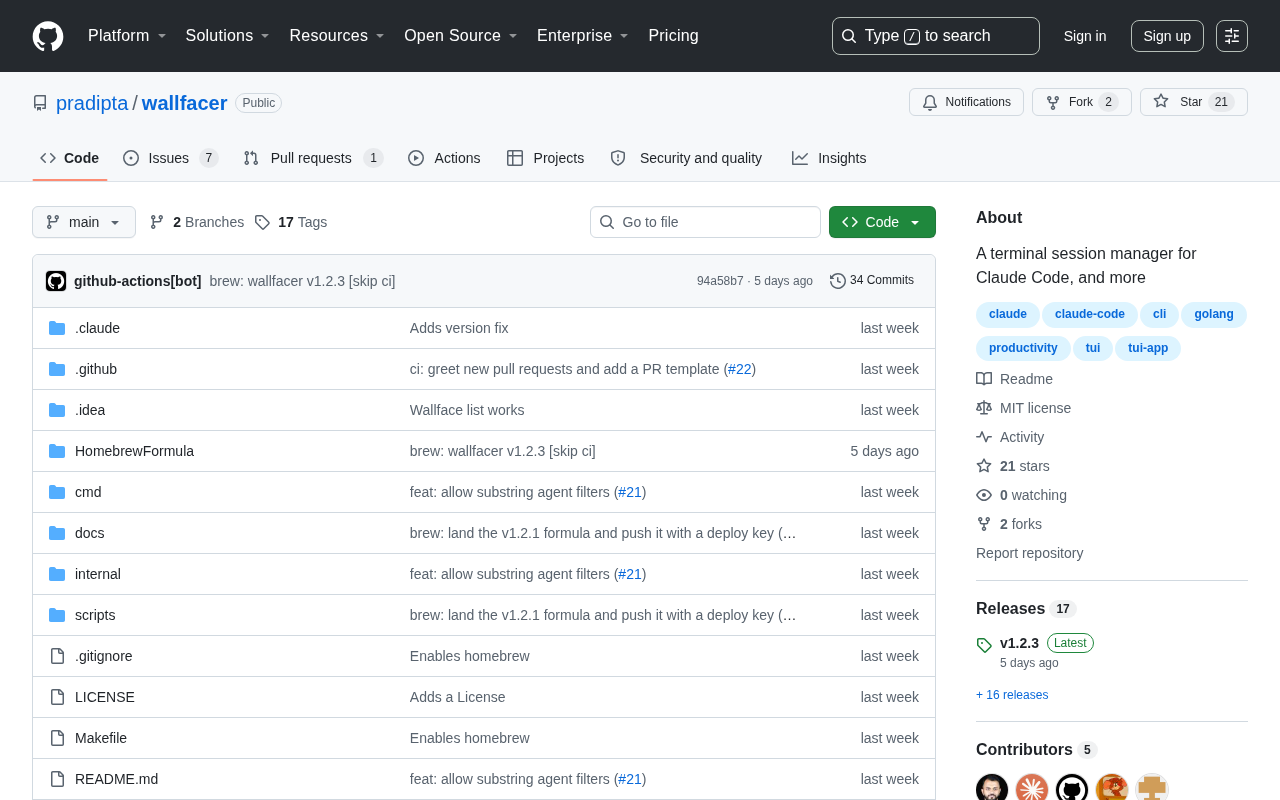
What Wallfacer Is: Core Positioning and Features
A Terminal Session Manager for AI Programming
Wallfacer's core function is managing terminal sessions. From its name — "Wallfacer" (derived from a character concept in the science fiction novel The Three-Body Problem) — you can see the author's intent to imbue the tool with a sense of "strategic oversight and parallel thinking."
In practice, AI programming tools often need to run in the background for extended periods: Claude Code might be analyzing a large codebase, another session could be writing tests, and yet another handling documentation. Traditional terminal multiplexing tools like tmux and screen are powerful, but they're general-purpose tools that haven't been optimized for the specific scenario of AI programming sessions.
tmux (Terminal Multiplexer) and GNU Screen are long-standing terminal multiplexing tools in Unix/Linux systems. They allow users to create multiple virtual terminal sessions within a single terminal window, supporting session detach and reattach — background processes continue running even if the network connection drops. tmux's core concepts include sessions, windows, and panes, and users can switch between different windows and panes using keyboard shortcuts. However, tmux has relatively high configuration complexity, shortcuts need to be memorized, and its general-purpose design means it won't provide dedicated optimization for any specific workflow — all sessions look the same to tmux as equal text terminals with no semantic distinction.
Wallfacer's value proposition is to provide a management experience layer on top of these general-purpose tools that better fits AI programming workflows.
An Open Design Beyond Just Claude Code
Wallfacer doesn't intend to limit itself to Claude Code. This means it can theoretically manage any long-running terminal session — whether it's Aider, Cursor's command-line components, or custom AI Agent scripts. This open design gives Wallfacer the opportunity to become a universal AI session orchestration layer.
Why a Dedicated AI Programming Session Manager Is Needed
Multi-Session Parallelism: The Core Workflow of AI Programming
Unlike traditional programming, AI-assisted programming is inherently "asynchronous" and "parallel" in nature. When you hand a task to Claude Code, it might need tens of seconds or even minutes to think, generate, and modify code. During the wait, developers can easily start another session to handle other tasks.
In this workflow, "multi-session parallelism" becomes the norm. It's not uncommon for a developer to maintain three to five AI programming sessions simultaneously. How to quickly switch between these sessions, check each session's running status, and avoid context confusion becomes a real efficiency bottleneck.
Context Isolation to Prevent Operational Errors
AI programming tools are highly context-dependent. Each session carries specific project code context, conversation history, and task objectives. Large language models work based on a "Context Window" — the maximum number of tokens the model can process in a single inference. Claude's context window reaches up to 200K tokens, enabling Claude Code to read in large amounts of code files for analysis at once. Each AI programming session maintains independent context state, including loaded code files, conversation history, task instructions, and intermediate reasoning results.
If session management is chaotic, it's easy to make mix-up errors — sending instructions meant for Project A to Project B's session. Once these contexts are confused, the AI might generate completely incorrect code modifications or even damage project structure. Therefore, session isolation is not just a matter of management convenience but also code safety. A dedicated session manager can reduce the risk of such operational errors through clear visualization and isolation mechanisms.
Wallfacer vs. tmux and Competitive Analysis
An Experience Upgrade on Top of tmux
Wallfacer is likely built on or similar to underlying multiplexing technology like tmux, but provides a friendlier, more focused interaction interface. By analogy, this is like lazygit is to git — the underlying capabilities already exist, but a carefully designed TUI (Terminal User Interface) layer can significantly improve the daily usage experience.
TUI (Terminal User Interface) is an interaction form between pure command line and graphical interface, providing structured visual interfaces within the terminal, typically including panel layouts, list selections, color highlighting, and other elements. lazygit is a classic representative of this philosophy — it doesn't add new functionality to git, but through an intuitive TUI interface, it transforms operations like viewing diffs, staging files, and resolving conflicts from memorizing complex commands to visual point-and-click operations, greatly reducing cognitive load. Similar tools include lazydocker (Docker management), k9s (Kubernetes management), and others. The core insight of this pattern is: the existence of underlying capabilities doesn't equal efficient usability — a carefully designed interaction layer often unlocks overlooked productivity.
For developers already familiar with tmux, Wallfacer's value isn't in replacing tmux, but in providing AI programming-specific optimizations on top of it, such as session state visualization, quick switching, and task tagging features.
Position in the AI Programming Tool Ecosystem
A third-party tool ecosystem around Claude Code is rapidly forming. From session history management and cost monitoring to multi-session orchestration, the developer community is filling gaps that official tools haven't yet covered. Specifically, this ecosystem spans multiple directions: cost monitoring tools (like ccusage) help developers track API call expenses; prompt management tools help organize and reuse common programming instruction templates; session history visualization tools transform conversation records into searchable knowledge bases; MCP (Model Context Protocol) servers extend AI tools' capability boundaries, enabling them to connect to databases, API documentation, and other external resources.
This ecosystem layering is similar to the early formation of the VS Code plugin ecosystem — the core tool provides foundational capabilities, and the community fills vertical scenario gaps through plugins and companion tools. Wallfacer belongs to the "multi-session orchestration" sub-direction, complementing tools focused on cost tracking or prompt management.
Wallfacer's Opportunities and Challenges
Opportunities in a Blue Ocean Market
Currently, session management for AI command-line programming tools is still a blue ocean. Claude Code itself doesn't provide powerful multi-session visual management capabilities, leaving room for third-party tools. If Wallfacer can polish its usability and stability, it has a real opportunity to become a standard part of many power users' workflows.
Realistic Challenges to Face
As an early-stage open-source project, Wallfacer faces realistic challenges:
- Ecosystem Dependency Risk: The tool is highly tied to Claude Code. If the official team releases similar native functionality, third-party tools' survival space will be squeezed. In the developer tools space, third-party tools being "swallowed" by official features is a common phenomenon, known in the industry as "Platform Risk." Historically, many successful third-party features have eventually been natively integrated by platforms: Chrome extensions replaced by native browser features, npm packages absorbed into the Node.js standard library. However, history also shows that if a third-party tool achieves extreme depth in a specific direction, even when officials release a basic version, advanced users will still choose the more powerful specialized tool — just as Oh My Zsh continues to thrive after Zsh became the default shell on macOS.
- User Habit Barriers: Many experienced terminal users already have mature tmux configurations. Convincing them to migrate to a new tool requires sufficiently strong differentiated value.
- Sustained Maintenance: The long-term vitality of open-source tools depends on community engagement. Currently, the project's popularity is still relatively low and needs time for validation.
Conclusion: The Infrastructure for AI Programming Workflows Is Taking Shape
Wallfacer represents an interesting facet of AI programming toolchain evolution: as AI programming moves from "single Q&A interactions" to "multi-session parallel workflows," the supporting management infrastructure is being catalyzed into existence. It may not become the ultimate winner, but the need it points to — efficiently managing multiple AI programming sessions — is undoubtedly real and growing.
For developers who heavily use Claude Code daily, it's worth following the development of terminal session management tools like this — they might significantly boost your AI programming efficiency when you least expect it. And for tool developers, this is also a reminder: developer experience (DevEx) in the AI era still has vast unexplored territory worth investigating.
Related articles

Unsloth Desktop: The First Open-Source AI Desktop App Supporting Local Training + Inference
Unsloth Desktop is an open-source app for Mac/Windows/Linux that integrates local model training and inference with 2x speed, 70% VRAM savings, GGUF/MLX support, and Claude Code connectivity.

Claude Adds Invisible AI Watermarks: Text Marking Technology Explained and Its Implications
Anthropic adds invisible watermarks to Claude-generated text for AI content identification. This article explains text watermarking technology, its limitations, and implications for creators.

Is Claude Secretly Watermarking AI Content with Steganography? A Deep Dive into the Closed-Source Model Trust Crisis
Reddit users accuse Claude of using steganography to secretly mark AI content, sparking a closed-source transparency debate. We analyze the tech, false positive risks, and open vs closed model trust.