WapiSender: Building WhatsApp Automation with AI and Visual Workflows

WapiSender is an all-in-one WhatsApp automation platform combining AI agents, visual workflows, and MCP protocol.
WapiSender is a WhatsApp automation platform that recently launched on Product Hunt, built on three technical pillars: AI agents, visual workflows, and MCP (Model Context Protocol) tools. It allows businesses to build automation flows with a drag-and-drop editor, handle complex customer conversations with AI agents, and use MCP to connect agents to external tools and business data. The platform also supports APIs and Webhooks, serving both operations teams and developers. Use cases include customer support, bulk marketing campaigns, and order notifications. WapiSender earned 63 upvotes on Product Hunt, with its core differentiator being MCP integration — though pricing, compliance strategy, and real-world stability remain to be validated.
WhatsApp has become a primary communication channel for billions of users worldwide and a critical touchpoint for businesses to reach their customers. Managing high volumes of conversations, automating marketing campaigns, and streamlining business processes have long been challenges for developers and operations teams alike. WapiSender, which recently launched on Product Hunt, aims to tackle these pain points by combining AI agents, visual workflows, and MCP tools.
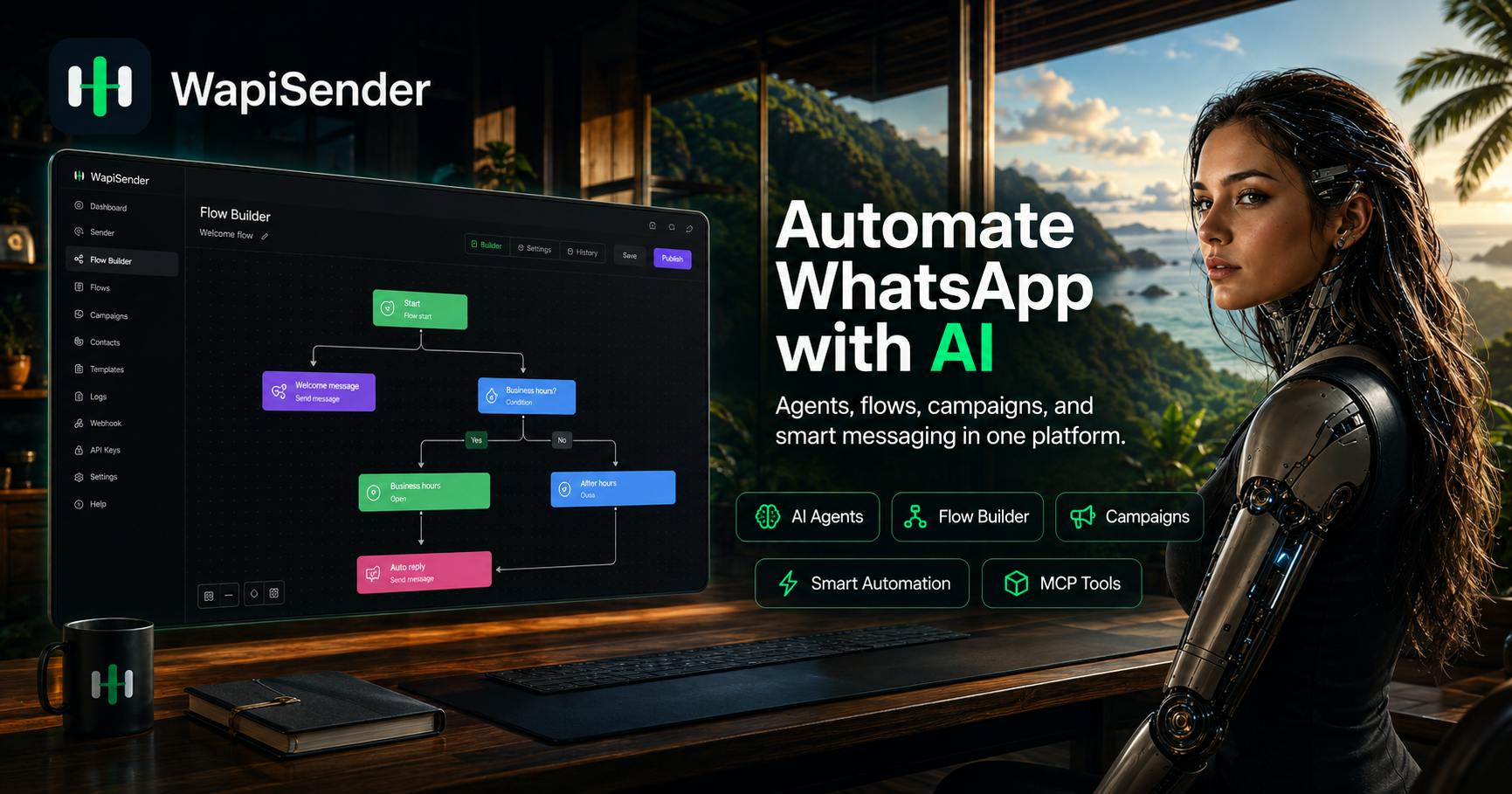
Product Positioning: An All-in-One WhatsApp Automation Platform
WapiSender's core proposition is "Powerful WhatsApp automations with AI, visual flows and MCP" — building WhatsApp automation capabilities through AI agents, visual workflows, MCP tools, APIs, and Webhooks. Its goal is to enable businesses to automate customer conversations, marketing campaigns, and various business processes.
From a product classification standpoint, WapiSender sits under the Messaging, API, and Developer Tools categories, and participated in the Vercel Day event. This positioning signals that it caters both to hands-on operations teams and developers who need deep integration capabilities. On Product Hunt, the product received 63 upvotes and ranked 18th, built by Gilad Levi.
Three Core Technical Pillars
AI Agent-Driven Conversation Automation
Traditional WhatsApp automation relies heavily on fixed keyword triggers and preset replies, which limits flexibility. WapiSender introduces AI agents, enabling the system to more intelligently understand customer intent and generate contextual responses — handling more complex conversation scenarios. For high-frequency touchpoints like customer support and pre-sales inquiries, this capability can significantly reduce the cost of manual intervention.
Visual Workflow Orchestration
Visual flows are key to lowering the barrier to automation. Through a drag-and-drop workflow editor, operations staff without a technical background can design complete pipelines covering trigger conditions, decision branches, and execution actions. This low-code approach makes building marketing campaigns and business processes intuitive, reducing dependency on engineering resources.
MCP Tools and Developer Integration
One of WapiSender's notable features is its support for MCP (Model Context Protocol). As a standard protocol for connecting AI models to external tools, MCP is rapidly becoming critical infrastructure in the AI application ecosystem. Bringing MCP into WhatsApp automation means WapiSender can allow AI agents to invoke external tools and access business data, building a more powerful automation loop. Combined with APIs and Webhooks, developers can deeply embed WapiSender into their existing business systems.
MCP (Model Context Protocol) was released and open-sourced by Anthropic in late 2024, designed to establish a standardized bidirectional interface between AI models and external data sources or tools. Before MCP, every AI application that needed to call an external service — such as a database, CRM, or search engine — required custom integration development, which was costly and hard to reuse. MCP functions like a "USB port" for AI: any MCP-compatible AI model (such as Claude) can call any MCP-compatible tool server through a unified protocol, without building custom adapters each time. Major AI vendors including Anthropic and OpenAI, along with a growing number of developer tools, have announced MCP support, making it a de facto infrastructure standard for the AI agent ecosystem. By bringing MCP into WhatsApp automation, WapiSender enables its AI agents to dynamically invoke external tools via standard protocol — such as querying an order system, reading a customer database, or triggering third-party services — rather than being limited to a fixed set of predefined actions.
Use Cases and Value
Based on the product description, WapiSender primarily covers three categories of use cases:
- Customer conversation automation: AI agents automatically respond to, triage, and handle customer inquiries, improving response speed.
- Marketing campaigns: Bulk outreach, personalized messaging, and automated campaign workflow management.
- Business process automation: Integrating WhatsApp as a node in larger automated systems, such as order notifications and appointment reminders.
For small and medium-sized businesses and e-commerce teams that rely on WhatsApp for operations, this combination of "AI + visual + developer-friendly" lowers the cost of getting started while leaving room for future expansion.
Observations and Considerations
The WhatsApp automation space is far from lacking competition — many established CRM and marketing tools offer similar capabilities. WapiSender's differentiation lies in placing AI agents and the MCP protocol at the center of its product, aligning with the broader trend of AI applications evolving from rule-driven to agent-driven architectures.
That said, based on currently available information, the product's specific pricing, messaging compliance strategy (WhatsApp Business API carries fairly strict policy constraints), and the real-world performance of its AI agents still need more hands-on testing to validate. As a newly launched tool, its stability and ecosystem maturity will also take time to prove.
For teams actively evaluating WhatsApp automation solutions, WapiSender offers an option that integrates the latest AI capabilities and is worth adding to any shortlist.
The WhatsApp Business API itself comes with strict compliance requirements worth keeping in mind. Meta requires businesses to connect through an officially certified BSP (Business Solution Provider), and imposes clear content review and send-rate controls on proactive outbound messages (i.e., template messages). Marketing pushes sent to users who haven't explicitly opted in may result in account suspension. This means any WhatsApp automation platform must operate within a compliance framework, and bulk marketing capabilities are in practice constrained by Meta's policies. For teams evaluating WapiSender, understanding its access method (whether it is an official BSP partner) and how it handles the template message approval process is a key prerequisite for assessing the real-world viability of its campaign features.
Related articles

AI New Grad Resume Diagnosis: How to Stand Out for ML/CV Roles?
How can AI/ML new grads optimize their resumes to get interviews? Based on a real Reddit case, this article analyzes project selection, depth display, and structure for ML/CV roles, with actionable revision advice.

OpenAI Opens Up Decision Models as Competition with Jev Heats Up
OpenAI makes its decision model widely available, directly challenging first mover Jev. We analyze the impact on the decision model competitive landscape and key considerations for developers and enterprises.

Startup Growth Secrets: Early Sales Are Not the Key
At Disrupt, experts from Lovable, Polska, and Theory Ventures said early startup growth depends not on early sales but on a repeatable sales process, a clear ICP, team development, and data-driven iteration.