WarderBox v0.3.1: Adding a Security and FinOps Control Layer to AI Agents
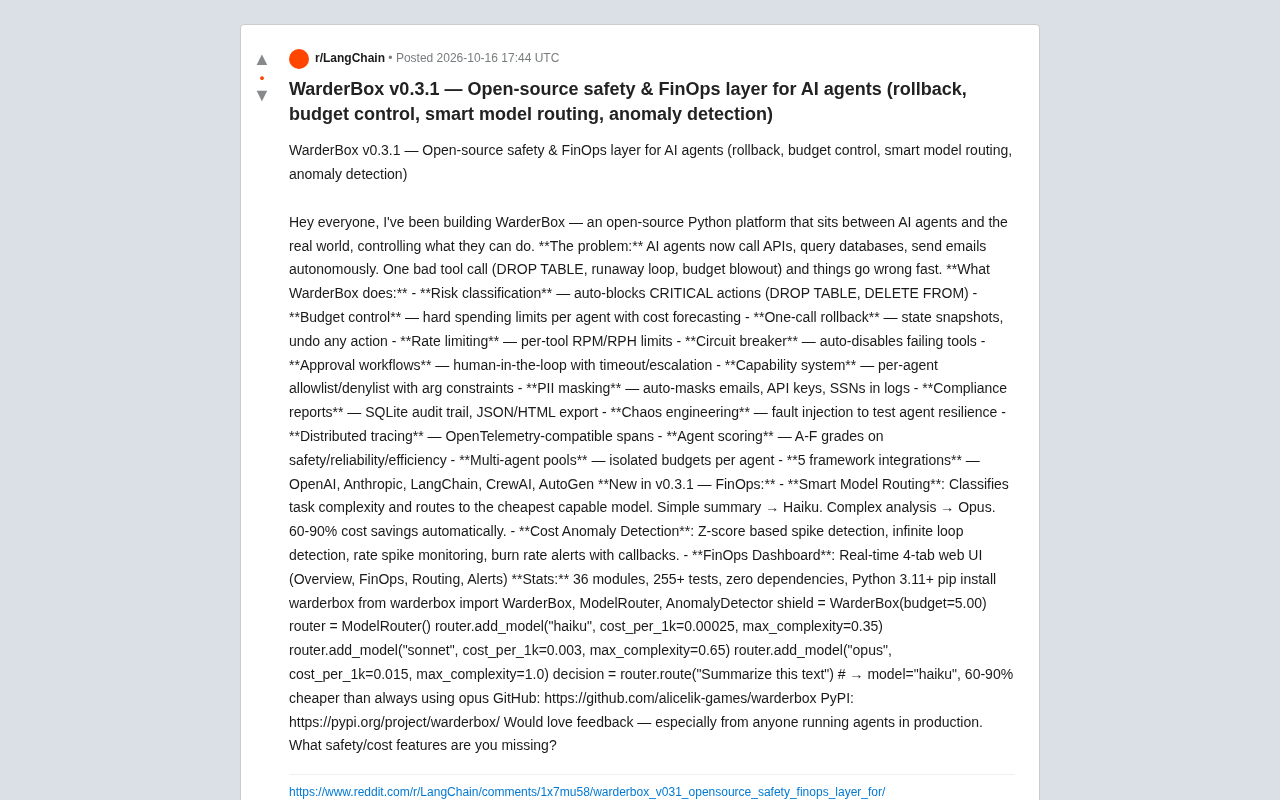
Open-source security and cost control layer WarderBox v0.3.1 released, adding constraint mechanisms to AI Agents.
WarderBox is a zero-dependency open-source Python platform positioned between AI Agents and the real world, acting as a security and cost control layer. It provides 13 features including risk classification, budget control, one-click rollback, rate limiting, circuit breakers, approval workflows, and PII redaction, and integrates five major frameworks: OpenAI, Anthropic, LangChain, CrewAI, and AutoGen, with 36 modules and 255+ tests. The core of v0.3.1 is FinOps: ModelRouter routes requests to the "good enough and cheapest" model based on task complexity, claiming automatic 60%–90% cost savings; AnomalyDetector monitors infinite loops, rate spikes, and burn-rate anomalies based on Z-score; and it provides a four-tab real-time dashboard.
AI Agents are moving from demo toys to production environments. They call APIs, query databases, send emails, and autonomously complete increasingly complex tasks. But with greater capability comes greater potential for damage—a single mistaken tool call (such as DROP TABLE), a runaway loop, or a budget overrun can plunge an entire system into trouble.
Developer alicelik-games released WarderBox v0.3.1 on Reddit, an open-source Python platform positioned between AI Agents and the real world, acting as a security and cost control layer.
What Problem Does It Solve?
The core pain point is clear: Agents have execution capabilities but lack constraint mechanisms. Traditional software has permission systems, transaction rollbacks, and circuit breakers, while most Agent frameworks leave all of these for developers to implement themselves. WarderBox attempts to package these capabilities into a reusable middleware layer.
The project provides 13 core security features:
- Risk Classification: Automatically intercepts CRITICAL-level operations such as
DROP TABLE,DELETE FROM - Budget Control: Sets hard spending limits per Agent, with cost prediction support
- One-Click Rollback: Undoes any executed operation based on state snapshots
- Rate Limiting: Sets RPM/RPH limits per tool
- Circuit Breakers: Automatically disables persistently failing tools
- Approval Workflows: Human-in-the-loop with timeout and escalation mechanisms
- Capability System: Per-Agent allow/deny lists with parameter constraints
- PII Redaction: Automatically masks emails, API Keys, and SSNs in logs
- Compliance Reporting: SQLite audit trails with JSON/HTML export
- Chaos Engineering: Fault injection to test Agent resilience
- Distributed Tracing: OpenTelemetry-compatible spans
- Agent Scoring: A-to-F ratings for safety/reliability/efficiency
- Multi-Agent Pools: Independent budget isolation per Agent
Framework integrations cover five major solutions: OpenAI, Anthropic, LangChain, CrewAI, and AutoGen. The entire project consists of 36 modules, 255+ tests, zero external dependencies, and requires Python 3.11+.
Circuit Breaker originates from stability patterns in distributed systems, first systematically proposed by Michael Nygard in Release It!. It works like a household fuse: when a tool or downstream service fails consecutively beyond a threshold, the circuit breaker "trips," and subsequent calls are immediately rejected rather than continuing to wait for timeouts, thereby avoiding cascading failures and resource exhaustion. After a cooling-off period, the circuit breaker enters a "half-open" state, allowing a small number of probe requests through—if successful, it recovers; if failed, it remains open. In Agent scenarios, circuit breakers are especially important because LLMs often repeatedly retry the same failed tool call. Without interception, this quickly burns through budgets and drags down the entire task chain.
Z-score (standard score) is a statistical metric measuring how many standard deviations an observation deviates from the mean, with the formula z = (x − μ) / σ. In cost anomaly detection, the system continuously tracks the mean and standard deviation of historical cost samples. When the z-value of a request or time window exceeds a threshold (e.g., 3), it is flagged as anomalous. Its advantage is adaptiveness: sensitivity adjusts automatically to the business baseline without manually setting fixed amounts. Its limitation is sensitivity to trends and seasonality—if costs are steadily rising, sliding windows or seasonal decomposition are needed to avoid false positives.
v0.3.1 Focus: FinOps
The core of this update is cost governance.
Intelligent Model Routing
ModelRouter evaluates task complexity and then routes requests to the model that is "good enough and cheapest." The example given in the original post is intuitive: simple summarization goes to Haiku, complex analysis goes to Opus. The developer claims this automatically delivers 60%–90% cost savings.
In practice, you can register cost and complexity limits for each model:
from warderbox import ModelRouter

router = ModelRouter()
router.add_model("haiku", cost_per_1k=0.00025, max_complexity=0.35)
router.add_model("sonnet", cost_per_1k=0.003, max_complexity=0.65)
router.add_model("opus", cost_per_1k=0.015, max_complexity=1.0)

decision = router.route("Summarize this text")

**FinOps** (Financial Operations, cloud financial operations) is a practice framework promoted by the FinOps Foundation, originally used to manage cloud spending. Its core principle is treating cost as a first-class engineering decision, using a "visibility—optimization—operations" loop to make engineering, finance, and business teams jointly responsible for cloud resources. Applied to AI Agents, FinOps focuses on the balance between token consumption, model unit costs, call frequency, and task output value. Unlike traditional cost cutting, FinOps emphasizes "unit economics"—for example, how much each completed task costs, rather than simply reducing the total bill. WarderBox categorizes real-time dashboards, anomaly alerts, and intelligent routing under this umbrella, bringing the pay-as-you-go nature of LLMs into an observable and governable framework.

**Model routing**'s feasibility is built on two facts at the model layer: first, different LLMs have clear capability tiers, with vendors like OpenAI and Anthropic offering multiple levels from lightweight to flagship; second, the difficulty distribution of the same batch of real requests is typically highly skewed—most are simple tasks, and only a minority truly require flagship models. Complexity classifiers are generally implemented based on heuristic rules (prompt length, presence of code or multi-step reasoning instructions) or small classification models. The caveat is "distribution drift": the task distribution assumed during training or tuning may change after deployment, causing originally simple prompts to be misclassified as complex, or vice versa. Therefore, production environments typically need fallback strategies—such as rolling back to a higher-tier model when output quality is insufficient—and A/B observation of routing decisions.
# → model="haiku"
Cost Anomaly Detection
AnomalyDetector performs burst detection based on Z-score, while monitoring infinite loops, rate spikes, and supporting burn-rate alert callbacks. For long-running Agent tasks, this type of detection can identify the classic failure of "stuck in a loop burning money" early.
FinOps Dashboard
Provides a four-tab real-time Web UI: Overview, FinOps, Routing, Alerts. For developers who need to show cost distribution to their teams, this is much friendlier than digging through logs.
Quick Start
pip install warderbox
from warderbox import WarderBox, ModelRouter

shield = WarderBox(budget=5.00)
The project is published on GitHub and PyPI as open source.
Some Observations
WarderBox's positioning hits a real gap. Agent framework layers (LangChain, CrewAI, etc.) focus on "how to get Agents to complete tasks," while WarderBox focuses on "how to prevent Agents from causing damage while completing tasks." These two layers are conceptually orthogonal.
Zero dependencies is a highlight. If security middleware itself has complex dependencies, it is difficult to confidently embed it in critical paths. With 255+ tests and 36 modules, this is clearly not a weekend project but the product of sustained investment.
Worth noting is the actual effectiveness of intelligent model routing. Complexity classification itself carries misjudgment risk—routing complex tasks incorrectly to cheaper models may cost far more in output quality degradation than the savings. The 60%–90% savings claimed by the developer will depend on task distribution and classifier accuracy in real production environments.
Also, the boundaries of one-click rollback deserve attention. For reversible state operations (such as snapshots before database writes), rollback is reliable; but for emails already sent or external APIs already called, rollback is more "compensation" than "undo." This needs clear expectations when in use.
The developer is soliciting feedback from production users, particularly regarding missing security/cost features. For teams pushing Agents into production, this project deserves a place on the evaluation list.
Human-in-the-Loop (HITL) is a key pattern in safe Agent design: before executing high-risk operations (such as fund transfers, data deletion, or external communications), the process pauses and requests human approval. WarderBox's approval workflow adds timeout and escalation mechanisms on top of this—if the approver does not respond within a specified time, the request automatically escalates to a supervisor or is rejected according to a preset policy, preventing tasks from hanging indefinitely. The value of HITL lies in trading a small amount of human intervention for final oversight of high-risk actions, at the cost of increased latency and operational burden. In practice, it requires finely delineating "which operations must be approved and which can be automatically allowed," otherwise too many approval gates will completely undermine Agent autonomy.
One-line Summary
Open-source security and cost control layer WarderBox v0.3.1 released, adding constraint mechanisms to AI Agents.
Paragraph Summary
WarderBox is a zero-dependency open-source Python platform positioned between AI Agents and the real world, acting as a security and cost control layer. It provides 13 features including risk classification, budget control, one-click rollback, rate limiting, circuit breakers, approval workflows, and PII redaction, and integrates five major frameworks: OpenAI, Anthropic, LangChain, CrewAI, and AutoGen, with 36 modules and 255+ tests. The core of v0.3.1 is FinOps: ModelRouter routes requests to the "good enough and cheapest" model based on task complexity, claiming automatic 60%–90% cost savings; AnomalyDetector monitors infinite loops, rate spikes, and burn-rate anomalies based on Z-score; and it provides a four-tab real-time dashboard. The article notes that routing savings depend on classifier accuracy, and rollback for external irreversible operations is more compensation than undo.
Related articles

Why Does the Tesla Roadster Need to Fly? A Deep Dive into Musk's Wild Demo
Tesla's Roadster launch showed wall-climbing, upside-down driving, and flying stunts—but The Vergecast notes the demo car may lack a battery, the Rocket version is invite-only and not street-legal, and the website terms don't guarantee delivery. After nine years of delays, why does this car still need to exist?

AI Is Not a Replacement: Human-AI Collaboration Through the Lens of Factory Root Cause Analysis
Starting from factory root cause analysis, this article explains how AI accelerates evidence chain construction rather than replacing human experts, exploring the pragmatic implementation logic and business value of 'AI supporting people rather than replacing them.'

AI Agent Decision Auditing: Building an Evidence Chain in Regulated Workflows
Starting from a Reddit discussion, this article analyzes three core issues in AI agent decision auditing within regulated workflows: what fields audit records should contain, how to handle feedback latency for erroneous decisions, and how to continuously calibrate LLM judge consistency with human judgment.