Warhound Raises $200 Million: Genetically Engineered "War Dogs" Paired with Anduril Gear

Warhound comes out of stealth with $200M to genetically engineer dogs for military and law enforcement use.
Warhound is a startup jointly driven by Colossal Biosciences founder Ben Lamm and Anduril founder Palmer Luckey. This week it came out of stealth and announced a $200 million financing round. The company aims to genetically engineer dogs for military and law enforcement missions and equip them with Anduril's advanced gear. The project combines bioengineering and defense technology and may involve genetic adjustments to dogs' physical, sensory, and behavioral traits, though the specific technical approach has not been disclosed. The $200 million round reflects investor interest in the "bio + defense" intersection, while the project also faces controversy over animal welfare, bioethics, and international regulation. The Warhound case illustrates how frontier technology convergence is breaking industry boundaries and has implications for the tech industry.
The "War Dog" Project Emerges from Stealth Mode
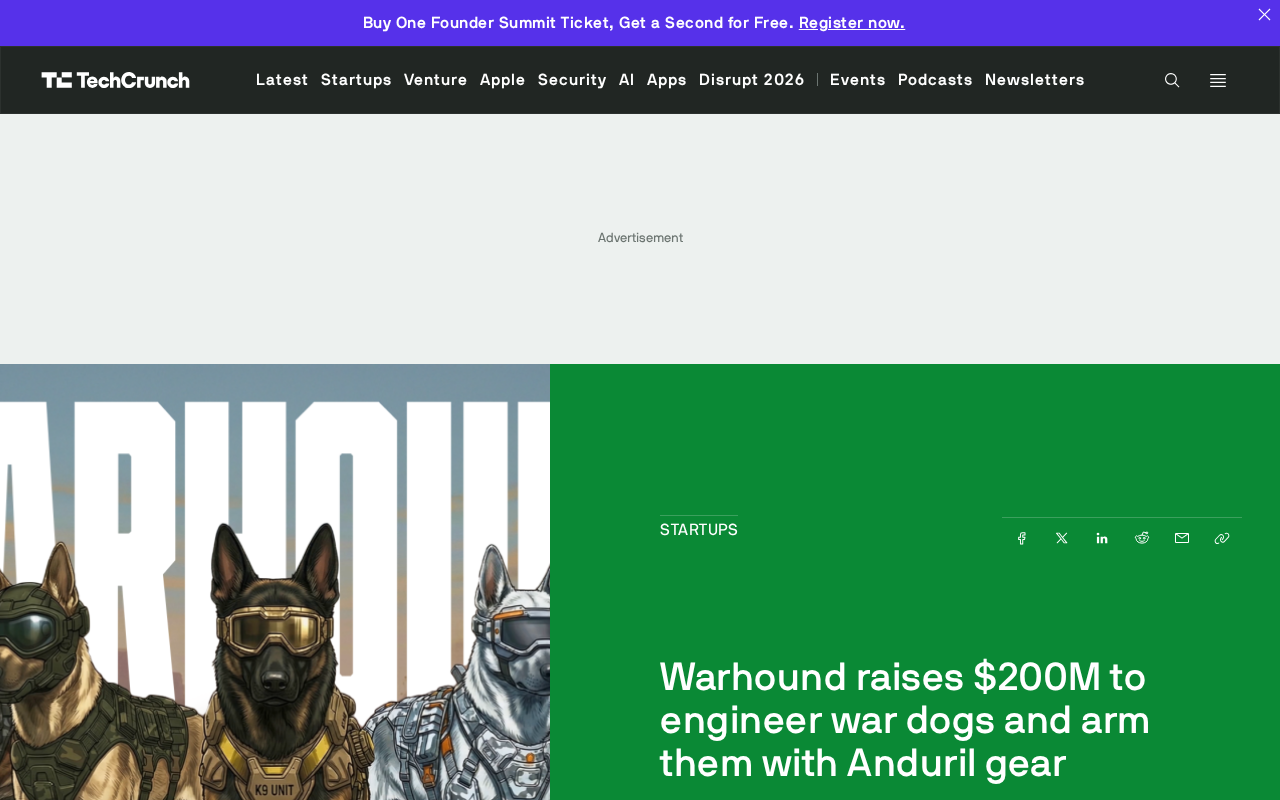
This week, a startup called Warhound came out of stealth mode and announced it had raised $200 million. The company's goal sounds like science fiction: genetically engineering dogs to adapt to military and law enforcement missions, and equipping them with advanced gear from Anduril.
Warhound is jointly driven by Colossal Biosciences founder Ben Lamm and defense tech upstart Palmer Luckey (founder of Anduril). According to RSS feed reports, the company's core focus is "engineering dogs for the military and law enforcement." The news quickly drew attention in tech and defense circles because it touches on many sensitive issues at the intersection of biotechnology and defense technology.
Stealth Mode is a common way for startups to operate: in the early days, the company does not publicly disclose business details or conduct marketing, and only quietly completes product development, team building, and early financing. When the company is ready for an official public launch, it announces "coming out of stealth," usually alongside funding news. This strategy is especially common in biotechnology and defense technology, because both types of business often involve sensitive technology, long R&D cycles, and strict regulatory approval; premature exposure can bring competitive pressure or public opinion risk. Warhound chose to come out of stealth after completing a $200 million round, which fits the typical rhythm of this model.
A Rare Intersection of Genetic Engineering and Defense Technology
What makes Warhound unique is that it points gene-editing technology—usually used to protect endangered species or for medical research—directly at military applications. Ben Lamm is known in biotech for his "de-extinction" projects, while Palmer Luckey is one of the most controversial entrepreneurs in defense technology. Their collaboration means Warhound has both bioengineering capability and defense procurement channels.
From a technical perspective, genetically engineering dogs to enhance their military suitability could involve adjustments to physical fitness, sensory acuity, endurance, or even behavioral traits. However, this direction will inevitably face ethical review, regulatory hurdles, and questions about animal welfare. Warhound has not yet disclosed its specific technical approach or gene-editing targets.
Colossal Biosciences is a biotech company founded by Ben Lamm, known for its "de-extinction" projects that attempt to revive extinct species such as the woolly mammoth and the dodo through gene-editing technologies such as CRISPR. The company's technical approach centers on genome sequencing, gene editing, and synthetic biology. Although its scientific feasibility is debated, it has attracted substantial capital attention. Ben Lamm himself is a serial entrepreneur who has founded multiple tech companies. The founding of Warhound means he is shifting his genetic engineering capabilities from "reviving extinct species" to "modifying active-duty dogs"—a pivot that is more sensitive in both ethics and application scenarios and more likely to trigger regulatory scrutiny.
The Logic and Controversy Behind the $200 Million Round
A $200 million financing round is quite substantial for a startup that has just come out of stealth. It reflects investors' strong interest in the "bio + defense" intersection and also hints at demand for nontraditional capabilities in military modernization. As a unicorn in defense technology, Anduril has clear synergy potential with Warhound's biological approach—for example, equipping dogs with sensors, communication devices, or augmented reality headsets.
However, the project has also drawn criticism. Applying genetic engineering to military purposes and modifying animals for combat scenarios touches a sensitive nerve in bioethics. Animal rights organizations may strongly oppose the concept of "engineered dogs." In addition, whether gene editing in the military field is subject to sufficient international regulation remains an open question.
Anduril Industries is a defense technology company founded by Palmer Luckey in 2017, with core businesses in autonomous systems, drones, sensor fusion, and border surveillance technology. It is valued at more than $10 billion and is a representative unicorn in defense technology. Anduril's business model emphasizes "software-defined hardware," that is, using AI and sensor networks to improve the autonomy and situational awareness of traditional military equipment. The synergy potential between Warhound and Anduril lies in the fact that Anduril can provide dogs with communications, positioning, night vision, or augmented reality headsets, while Warhound can biologically enhance dogs' physical and sensory capabilities; together, the two could form an enhanced combat unit of "biology + equipment." However, this synergy currently remains at the conceptual level, with no public product details.
Implications for AI and the Tech Industry
The Warhound case reminds us that the convergence of frontier technologies is breaking down traditional industry boundaries. Genetic engineering is no longer limited to medicine and agriculture, and defense technology is no longer just hardware and software. When biotechnology meets autonomous systems and advanced equipment, new product forms and ethical frameworks need to be rethought.
For readers interested in AI and tech trends, although Warhound is not directly involved in artificial intelligence, it represents an extreme expression of "technological radicalism": using engineering to modify living organisms to serve specific human goals. This line of thinking is similar to the logic of targeted optimization of agents in the AI field, except that the object shifts from code to life.
Warhound has not yet announced a product timeline or specific mission scenarios. How the $200 million will be used, whether the technology can pass regulatory review, and how the public will accept it are all key variables determining whether the company can truly "come out of stealth."
One-line Summary
Warhound comes out of stealth with a $200 million round to genetically engineer dogs for military and law enforcement use.
Paragraph Summary
Warhound is a startup jointly driven by Colossal Biosciences founder Ben Lamm and Anduril founder Palmer Luckey. This week it came out of stealth and announced a $200 million financing round. The company aims to genetically engineer dogs to adapt to military and law enforcement missions and equip them with Anduril's advanced gear. The project combines bioengineering with defense technology and may involve genetic adjustments to dogs' physical, sensory, and behavioral traits, but the specific technical approach has not been disclosed. The size of the $200 million round reflects investors' interest in the "bio + defense" intersection, while the project also faces controversy over animal welfare, bioethics, and international regulation. The Warhound case reflects the trend of frontier technology convergence breaking industry boundaries and offers lessons for the tech industry.
Related articles

iPhone Duo Hands-On: Is the $2,000 Small-Screen Foldable Worth It?
YouTube's Allison shares her iPhone Duo hands-on: dual-screen multitasking doubles efficiency, great video viewing, nice matte finish—but thick body, small outer screen, and a $2,000 luxury price.

Sentry's Ad Cracks Up Developers: Can On-call Actually Be Fun?
Sentry's ad short film taps into developers' on-call anxiety, using humorous dialogue to showcase its observability platform—errors, logs, traces, metrics, replays, and releases in one place.

LLM App Getting Worse With Every Change? Build an Effective Evaluation System in Three Steps
How do you know if your LLM app is getting better or worse? A Reddit-based guide to test sets, automated regression evaluation, LLM-as-judge scoring, and structured agent tracing.