WaseiGo: The Ultimate Japanese Learning Tool for Mastering 1,000+ Wasei-Eigo Words

WaseiGo helps Japanese learners master 1,000+ wasei-eigo false friends through dialogues, quizzes, and native audio.
WaseiGo is an Android app that tackles a unique pain point in Japanese learning: wasei-eigo, or Japanese-made English words that look familiar but carry entirely different meanings. With 1,000+ curated entries, two-voice dialogues with native audio, picture quizzes based on retrieval practice principles, and a searchable dictionary, the app offers a focused, effective tool. Its one-time purchase model appeals to learners tired of subscription fatigue.
When "Consent" Means a Power Outlet: The Trap of Wasei-Eigo
In Japan, if you say "consent" (コンセント/konsento), a Japanese person will point to the power outlet on the wall. If you describe something as a "claim" (クレーム), it actually means "complaint" rather than "claim" in the legal sense. These seemingly familiar English words carry entirely different meanings in the Japanese context — they're called wasei-eigo (Japanese-made English).
WaseiGo, an educational app recently launched on Product Hunt, targets precisely this unique language learning pain point. Built by developer Takeshi Nogi, this Android app helps learners master over 1,000 vocabulary words that "look like English but have been redefined by Japan." The product earned 77 upvotes after launch, ranking 17th on the daily leaderboard.
What Is Wasei-Eigo? And Why Does It Deserve Dedicated Study?
Wasei-eigo is a special category of loanwords in Japanese. They borrow the pronunciation and spelling shell of English words, but the meanings have shifted, narrowed, or been completely reconstructed after entering Japan.
The formation of wasei-eigo can be traced back to the Meiji Restoration era (starting in 1868), when Japan introduced Western technology and culture on a massive scale, and large numbers of English words entered the Japanese lexicon through katakana transliteration. However, due to translators' misunderstandings, structural limitations of the Japanese language, and Japan's own cultural needs, many words underwent semantic drift after adoption. For example, "コンセント" likely originated from an abbreviation of "concentric plug" rather than "consent" itself. This phenomenon accelerated further during the postwar American occupation and the economic globalization wave of the 1980s, as Japanese society absorbed, transformed, and assigned new meanings to a flood of English words. Wasei-eigo differs from standard loanwords (gairaigo), which typically retain the core meaning of the original word. Wasei-eigo, by contrast, represents a distinctly Japanese reinvention of meaning, forming a unique lexical subsystem.
For native English speakers or Japanese learners with an English background, these words actually create a "familiar trap" — you think you understand them, but your understanding is completely wrong.
Common Examples of Semantic Shift in Wasei-Eigo
- コンセント (consent): Not "agreement," but "power outlet"
- クレーム (claim): Not "assertion/legal claim," but "complaint"
- マンション (mansion): Not "a grand estate," but "an apartment building"
- There are many more covering everyday life, business, and technology domains
This phenomenon is known in linguistics as "false friends" — one of the most error-prone aspects of cross-language learning. The concept of "false friends" was first introduced by French linguists Maxime Koessler and Jules Derocquigny in 1928. The danger lies in what cognitive psychology calls the "interference effect": when learners encounter a word with a familiar form, the brain automatically activates its existing semantic network, forming a preconceived understanding. This automatic semantic retrieval process is faster and more dominant than conscious learning, which means correcting false friend misconceptions requires roughly 2–3 times the cognitive effort of learning an entirely new word. In Japanese learning, the false friend problem with wasei-eigo is particularly severe because the katakana writing system itself signals "this is a foreign word," further reinforcing learners' tendency to associate it with the original English meaning.
Because learners carry preconceived notions about the original English words, correcting these misunderstandings is often harder than learning an entirely new word from scratch. The core value of WaseiGo lies in systematically organizing and teaching this set of high-frequency, error-prone wasei-eigo vocabulary.
WaseiGo's Product Design Highlights
Rather than using a tedious flashcard-listing approach, WaseiGo incorporates several clever design choices that make learning wasei-eigo more efficient and engaging.
Two-Voice Dialogues with Native Audio
The app presents real-world usage scenarios for each word through illustrated two-voice dialogues, accompanied by audio recorded by native Japanese speakers. This contextual teaching method helps learners not only memorize definitions but also understand how words are actually used in real Japanese conversation, avoiding the common problem of "memorizing words but not knowing how to use them."
"Guess First, Learn After" Picture Quiz Mechanism
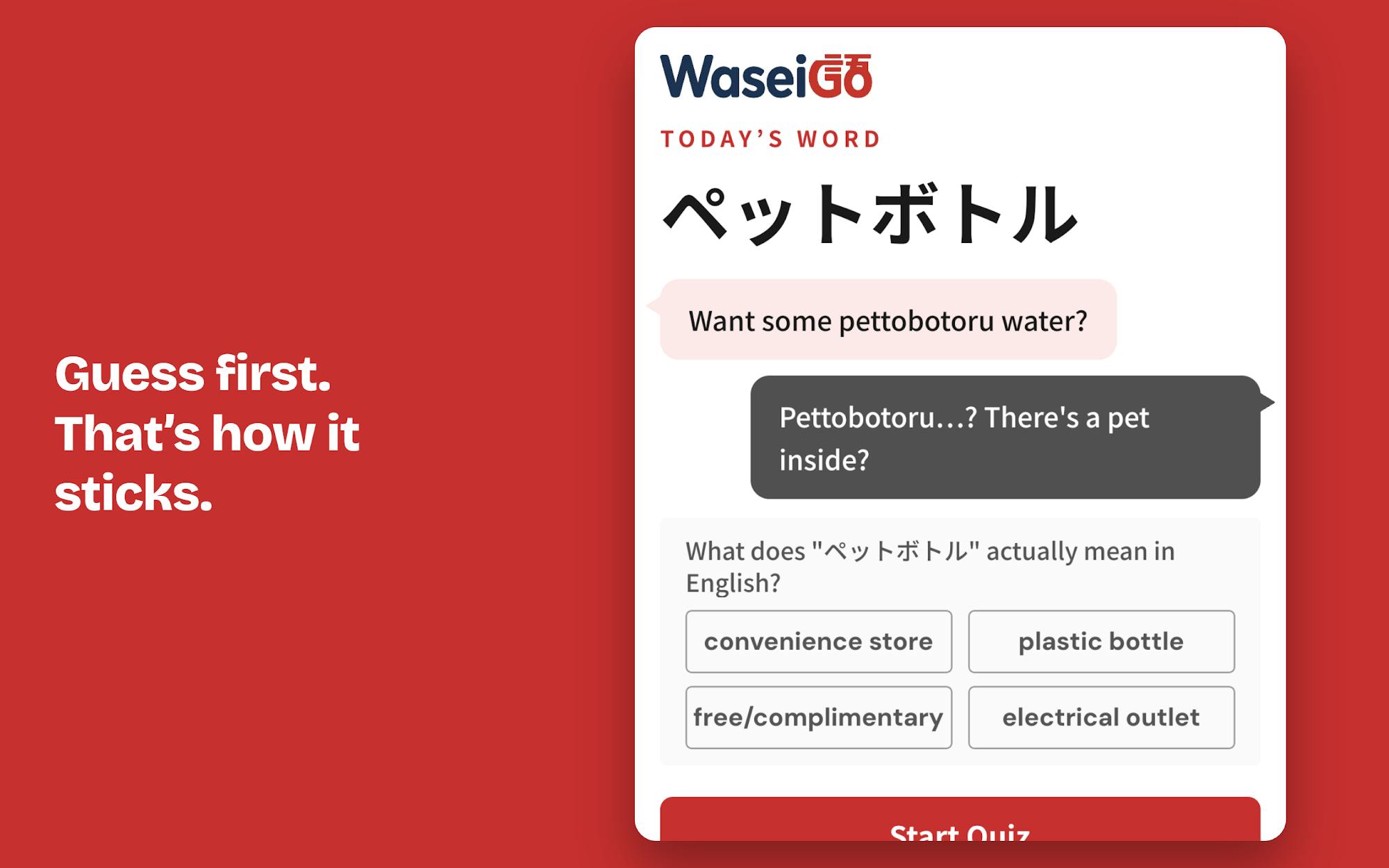
WaseiGo features a picture quiz system that follows a "guess first, then understand why" learning logic. Learners first guess the meaning of a wasei-eigo word based on images or context, and then the app reveals the correct meaning along with an explanation of the semantic evolution behind it.
This design aligns with two principles from cognitive science: "retrieval practice" and the "generation effect" — actively attempting to recall or guess produces stronger memory than passively receiving information. Retrieval practice is a highly effective learning strategy supported by extensive empirical research in cognitive psychology. Its core principle was systematically articulated by Washington University psychologist Henry Roediger III and colleagues in their 2006 research: the very act of actively retrieving information from memory strengthens the memory trace, significantly outperforming repeated reading or passive review. The "generation effect," first identified by Slamecka and Graf in 1978, refers to the finding that people remember information they actively generate (even incorrect guesses) more deeply than information they passively receive. WaseiGo's "guess first, learn after" design cleverly combines both principles: the guessing process activates retrieval practice, while the correction after a wrong guess leverages "error-driven learning" — correct information received after making a mistake produces stronger memory encoding due to prediction error. For correcting deeply ingrained false friend misconceptions, exposing the error before correcting it tends to be particularly effective.
Built-in Searchable Wasei-Eigo Dictionary
Beyond systematic lessons, WaseiGo also includes a searchable dictionary that allows learners to look up any wasei-eigo word on the spot, serving as an instant reference tool for daily study and reading.
One-Time Purchase, No Subscription
In an era dominated by subscription models, WaseiGo takes a more user-friendly approach to monetization:
- Free trial: A portion of the wasei-eigo content is available for users to try
- One-time purchase: A single payment unlocks all 1,000+ vocabulary items
- No subscription fees: No recurring charges of any kind
This "buy once, use forever" model is growing increasingly popular among educational tool apps, and it's especially well-suited for vertical knowledge products with relatively fixed content that doesn't require frequent updates. In fact, since around 2016, the mobile app industry has undergone a massive shift from one-time purchases to subscriptions — Apple's 2016 decision to adjust the subscription revenue split from 70/30 to 85/15 (from the second year onward) further fueled this trend. By 2023, subscription app revenue accounted for roughly 80% of total app revenue on the App Store and Google Play. However, consumer "subscription fatigue" has been growing in parallel: a 2023 report by research firm Bango showed that over 72% of users had canceled at least one service due to having too many subscriptions. In the educational tools space, subscriptions make sense for platforms with continuously updated content, but for vertical knowledge products with relatively fixed content, a one-time purchase often lowers the decision-making barrier and improves conversion rates. Independent developers also tend to favor the one-time purchase model because it reduces the operational pressure of maintaining continuous content updates. For Japanese learners with clear goals, the one-time purchase model eliminates the psychological burden of a long-term subscription.
A Niche but Precisely Targeted Product
WaseiGo is a textbook example of a "small but beautiful" indie app. It doesn't try to be an all-encompassing Japanese learning platform; instead, it zeroes in on the specific pain point of wasei-eigo and does one thing thoroughly.
From a product perspective, this positioning has unique value:
- The pain point is real and frequent: Wasei-eigo is genuinely a common source of errors for English-speaking learners, and the market lacks systematic, dedicated tools
- Solid content moat: Compiling 1,000+ wasei-eigo words with accompanying dialogues, audio, and illustrations requires substantial content investment
- Clear target user profile: Aimed at intermediate to advanced Japanese learners who already have a foundation in English
Of course, as an indie app focused on the Android platform, its current reach and visibility remain limited. For iOS users or those seeking a more comprehensive Japanese learning path, WaseiGo works best as a supplement to mainstream Japanese learning tools like Duolingo and WaniKani, rather than a replacement. It's worth noting that the current Japanese learning tool ecosystem is already quite rich: WaniKani, developed by the Tofugu team, is a kanji and vocabulary learning platform that uses a Spaced Repetition System (SRS) to help learners master approximately 2,000 common kanji and over 6,000 vocabulary words; Duolingo, the world's largest language learning platform, had over 100 million monthly active users as of 2024, with its Japanese course covering beginner to intermediate paths; and there are additional specialized tools like Anki (an open-source spaced repetition tool), Bunpro (grammar-focused learning), and Italki (online tutoring). WaseiGo's positioning fills a gap in this ecosystem — virtually none of the mainstream tools treat wasei-eigo as a standalone learning module, leaving learners to correct their understanding only when they happen to encounter specific words.
Conclusion
WaseiGo reminds us that the most dangerous words in Japanese learning aren't the completely unfamiliar ones — they're the wasei-eigo false friends that "you think you already know." Through contextual dialogues, native audio, and a guess-first-learn-later quiz design, this app provides Japanese learners with an efficient, purpose-built tool for conquering wasei-eigo. If you've ever been confused by コンセント or クレーム, WaseiGo is worth a try.
Related articles

Gemini 4 Argon Hands-On: AI Builds Board Games, Constructs Temples, and Trains Robots Autonomously
Gemini 4 Argon hands-on roundup: AI autonomously builds a desk racetrack and temple in Blender, writes a ray tracing engine, trains a humanoid robot to sink 7 shots, plus API pricing and developer access.

The Magic Octagonal Coin: Why Only 9% of People Can Predict Its Flip?
Only 9% of people can correctly predict the Magic Octagon coin flip. This article explains its spatial rotation mechanism, common cognitive pitfalls, and a new hypothesis based on Relevance Theory, exploring the limits of human spatial reasoning.

Sam Altman: AI Is Entering the Era of Scientific Discovery — Math Breakthroughs Will Replicate in Biology and Energy
Sam Altman says AI is entering the era of scientific discovery — math breakthroughs will replicate in biology, materials science, and energy to help develop new drugs and energy sources.