WaterMe Plant Care App Deep Dive: Breaking Down Core Features Like Weather-Adaptive Tracking, Plant-Sitter Handoffs, and More
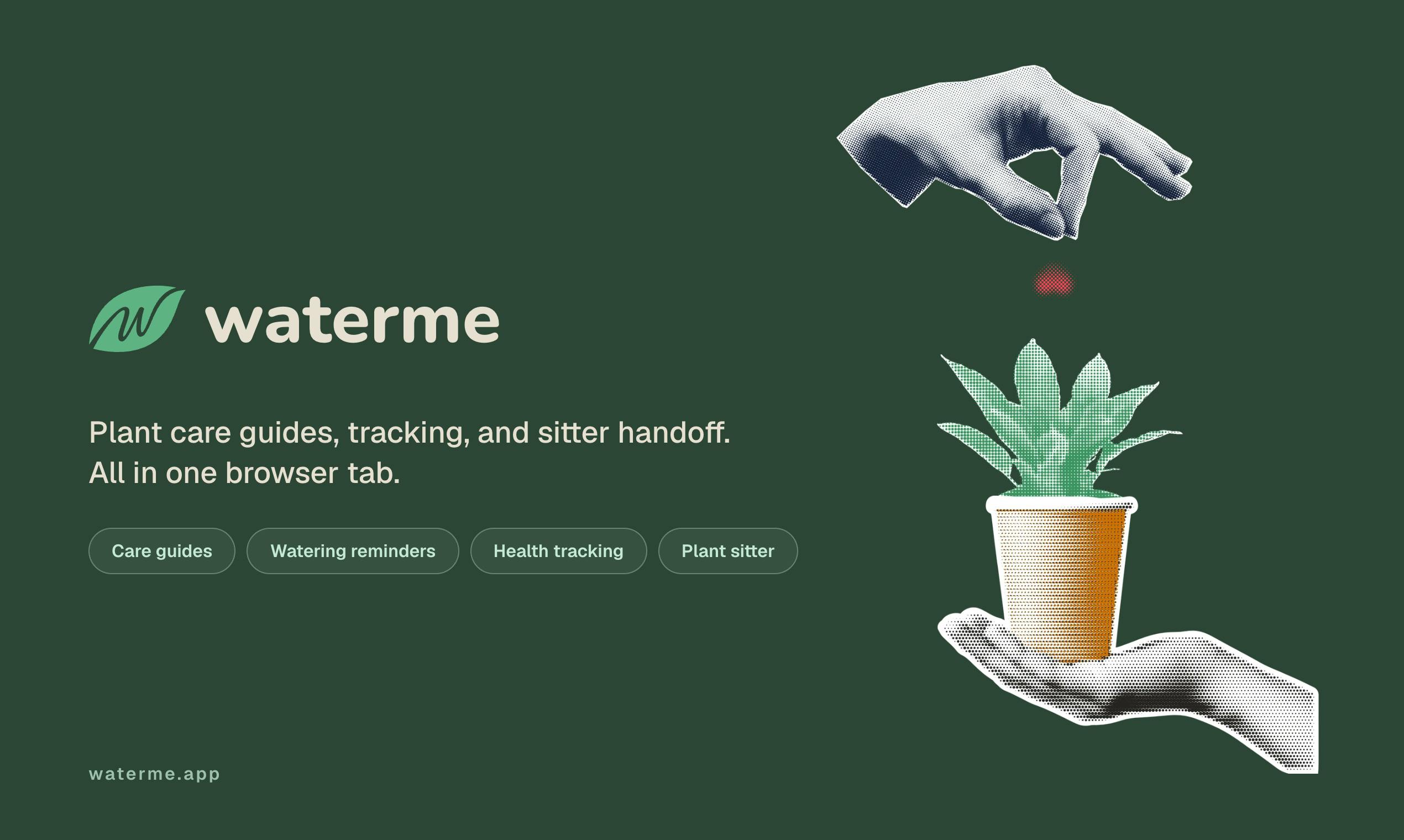
WaterMe is a Web-based plant care hub featuring weather-adaptive watering and seamless plant-sitter handoffs.
WaterMe is a Web app launched on Product Hunt positioning itself as an all-in-one plant care hub. Its standout features include weather-adaptive watering tracking using real-time meteorological data, photo timelines for monitoring plant growth, multilingual care guides, and a seamless plant-sitter handoff system for when users travel. While its Web-first approach lowers adoption barriers, challenges remain around push notification reliability and competing with established native apps like Planta and Blossom.
When Plant Care Meets Smart Technology
Caring for plants seems simple, but it's trickier than it looks: watering frequency, lighting conditions, seasonal changes, travel-related plant sitting… each aspect can overwhelm beginners. WaterMe, recently launched on Product Hunt, aims to solve the fragmented pain points of plant care with a comprehensive digital solution.
Product Hunt is one of the world's most influential platforms for discovering new products, with dozens of products launching daily to compete for visibility. Product rankings are determined by a combination of upvote count, comment engagement quality, and a time-decay algorithm — a top-5 daily ranking typically means receiving 200–500+ votes that day. This Web app, positioned as an "all-in-one plant care hub," received 13 votes and 7 comments on launch day, ranking 17th. While these numbers are far from blockbuster — especially considering that Product Hunt's core user base consists mainly of tech professionals and early adopters, making lifestyle products like plant care less of a natural fit — its product philosophy is quite representative among similar tools. It aspires to be much more than just a "smart watering reminder."
WaterMe Core Features: Far More Than Watering Reminders
WaterMe explicitly emphasizes that the product "goes beyond simple reminders." Based on its disclosed features, the platform includes the following key modules:
Weather-Adaptive Smart Watering Tracker
Traditional plant reminder apps typically push watering notifications based on fixed schedules, ignoring real-world environmental changes. WaterMe introduces a "weather-adaptive tracking" mechanism — it dynamically adjusts care recommendations by incorporating local weather data. For example, it reminds users to increase watering frequency during hot, dry conditions, and appropriately delays watering cycles during rainy seasons.
The technical implementation of this feature typically relies on third-party weather APIs (such as OpenWeatherMap or WeatherAPI), fetching real-time meteorological data for the user's location — including temperature, humidity, precipitation, UV index, and other parameters — to dynamically calculate plant transpiration rates and soil moisture evaporation speeds. In agriculture, this approach is well-established and known as the Evapotranspiration (ET) model. The commonly used Penman-Monteith equation is the standard calculation method recommended by the Food and Agriculture Organization (FAO) of the United Nations. WaterMe essentially simplifies this agricultural-grade precision irrigation concept and brings it down to consumer-level home gardening scenarios. If implemented solidly, this design can significantly reduce overwatering or underwatering problems caused by "mechanical reminders."
Multilingual Plant Care Guides
The product offers "multilingual guides," targeting a global user market rather than being limited to a single language. For international users or non-English-speaking gardening enthusiasts, a localized knowledge base in their native language can dramatically lower the learning curve and make plant care much more accessible.
Plant Growth Photo Timeline
WaterMe supports a "photo timelines" feature, allowing users to chronologically document their plants' growth status. This serves not only as an emotionally engaging way to record progress but also as a practical diagnostic tool — by comparing photos from different periods, users can visually spot issues like yellowing leaves, leggy growth, or disease, helping them take timely action.
In professional horticulture and plant science, this kind of time-series image recording is called phenotyping. By regularly photographing the same plant, you can track growth rate, leaf color changes, and plant form development, as well as perform root-cause analysis when problems arise. In recent years, combining computer vision and deep learning technologies, some research teams have been able to automatically identify nutrient deficiency symptoms (such as older leaf yellowing caused by nitrogen deficiency, or new leaf yellowing caused by iron deficiency) and pest/disease types from plant leaf photos. If WaterMe introduces AI image analysis capabilities on top of its photo timeline in the future, it would upgrade this feature from a "recording tool" to an "intelligent diagnostic tool" — a qualitative leap.
Seamless Plant-Sitter Handoff Feature
Perhaps the most differentiated feature is "effortless plant-sitter handoffs." When users travel, they can transfer their care plan to a friend or neighbor helping out with a single click. The plant-sitter doesn't need to understand all the care details — they simply follow the app's guidance to complete tasks like watering. This scenario-driven design precisely addresses the high-frequency pain point of "no one to look after plants during business trips or vacations."
WaterMe's Product Positioning and Technical Path
Looking at its category tags, WaterMe is classified under Web App, Productivity, and Plants. The choice of a pure browser-based approach over a native app reflects deliberate strategic considerations:
- Zero installation barrier: Users can access it through a browser without downloading anything, dramatically reducing usage friction
- Cross-platform consistency: A unified experience across phones, tablets, and desktops
- Rapid iteration: Web application deployment and updates are far more flexible than app store review processes
However, this path also raises concerns. Plant care is inherently a high-frequency, lightweight scenario that demands instant notifications, yet Web Apps are naturally weaker than native apps when it comes to push notifications, offline usage, and background processes. Among modern web technologies, PWA (Progressive Web App) offers a middle-ground solution — using Service Workers for offline caching and background sync, and the Web Push API for push notifications, gradually bringing Web apps closer to native experiences. However, actual effectiveness varies by platform: Android has good PWA support, while iOS has long restricted Web Push capabilities (Safari's Web Push support wasn't opened until iOS 16.4 in 2023). Whether WaterMe has adopted PWA architecture, and what its actual push notification delivery rate is across different platforms, are critical technical variables that affect product experience. WaterMe's ability to solve the core experience issue of "watering reminder delivery rate" will directly determine its user retention.
Who Is WaterMe's Target User?
Overall, WaterMe's target user profile is fairly clear:
- Urban plant beginners: Owning a few indoor plants but lacking systematic care knowledge
- Succulent and foliage plant enthusiasts: Those with a larger collection who need a unified management tool
- Frequent business travelers: Those who need handoff features to ensure plant survival during their absence
These users prioritize "convenience" far above "expertise." Through weather-adaptive watering reminders, one-click plant-sitter handoffs, and other features, WaterMe attempts to shift the cognitive burden of plant care onto the system — an approach aligned with the current evolution of utility products toward "automation and scenario-driven design."
A Refined Experiment in a Niche Market
Plant care apps are not a new category — the market already has established competitors like Planta and Blossom. Planta, developed by a Swedish team, is known for its AI-driven light metering feature — users can measure indoor light intensity through their phone camera, and the system recommends plant species suited to that environment. Its paid subscription model has already accumulated millions of users. Blossom focuses on plant identification, using computer vision technology to enable photo-based plant species recognition and disease diagnosis. Both are native apps with significant first-mover advantages in app store ratings and download numbers.
WaterMe's breakthrough lies not in inventing entirely new features, but in integrating weather data, multilingual support, photo records, and plant-sitter handoffs into a lightweight Web hub, emphasizing "completeness" and "frictionless experience." Choosing the Web-based differentiation path avoids the red ocean of app store traffic competition, but it also means giving up app store organic search traffic — an important customer acquisition channel.
Based on initial Product Hunt feedback, the product is still in its early validation stage — 13 votes suggest it still needs more market education and word-of-mouth momentum. But for a vertically focused lifestyle tool, making differentiated features like "weather-adaptive tracking" truly useful matters far more than blindly chasing feature count. WaterMe's story is essentially a refined experiment in "how to use product design to eliminate life's trivial frictions."
Key Takeaways
Related articles

AI Writes Code, Will Programmers Lose Their Jobs? The Truth About Devin's Autonomous Programming
Devin and other autonomous AI coding agents are changing software development: from Copilot-assisted coding to fully automated engineering agents, the programmer's role shifts from writing code to system design and oversight. This article analyzes the impact of AI programming on employment, code security, and junior developer training, as well as the real direction of programmer demand under the efficiency paradox.

Citigroup's 14,000 Engineers Use Devin, Slashing Tech Outsourcing Bill by 30%
Citigroup's 14,000 engineers used AI coding agent Devin to cut its tech vendor bill by 30% and speed releases 30-40%, while JPMorgan says AI gains aren't in earnings yet.

AGENTS.md in Practice: Making Coding Agents Actually Work
AGENTS.md and CLAUDE.md can boost coding agent performance, but research shows misuse raises costs 20%. Here's what to write, what to delete, the 200-line and 32KB limits, monorepo nesting rules, and a security warning.