Waymo Robotaxis Roll Into Las Vegas Airport

Waymo sets up dedicated zones at Las Vegas Airport for autonomous pick-up and drop-off, marking its entry into a high-value hub scenario.
Waymo announced that it has officially begun offering robotaxi pick-up and drop-off service at Harry Reid International Airport in Las Vegas, with passengers able to board and exit at dedicated "autonomous vehicle zones" at Terminal 1 and Terminal 3. Airport transfers are a high-value scenario with long distances, high fares per trip, and stable demand; this deployment means Waymo's service expands from short intra-city trips to transportation hub connections. Airport roads have complex structures, dense pedestrian and vehicle traffic, and temporary controls; setting up dedicated pick-up and drop-off zones rather than mixing into regular lanes reflects a relatively conservative and controllable operational strategy and also facilitates passenger guidance and airport safety oversight. Las Vegas has well-structured roads and a friendly climate and has long been a popular city for autonomous driving operations. However, the report comes from a single RSS source and does not disclose key details such as fleet size, operating hours, or pricing, so actual experience and commercial performance remain to be seen.
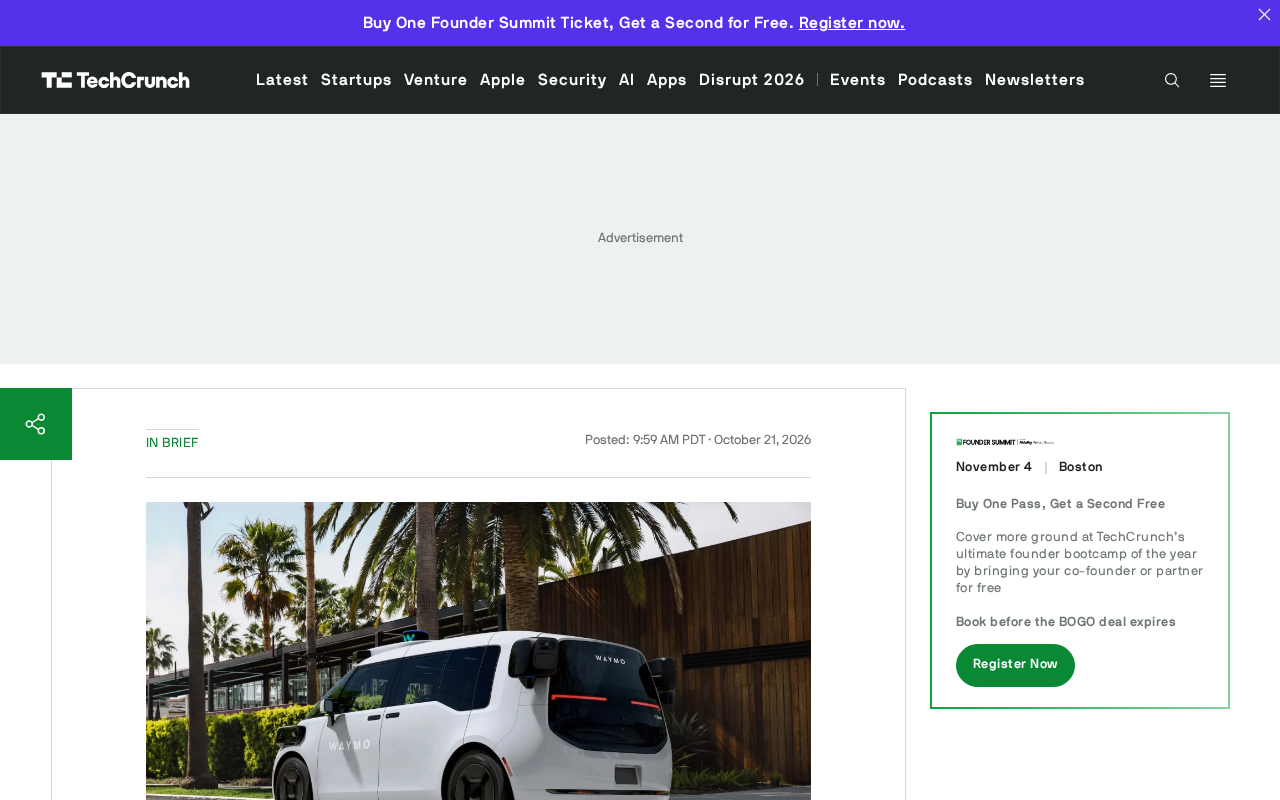
Waymo's robotaxi service has entered the airport scene for the first time. According to an RSS source, the company has officially begun offering pick-up and drop-off service at Harry Reid International Airport in Las Vegas, with passengers able to board and exit at dedicated "autonomous vehicle zones" at Terminal 1 and Terminal 3.
The Airport Scenario: A Key Leap for Autonomous Driving Commercialization
Airport transfers have long been a high-value scenario for the ride-hailing and taxi industry—long distances, high fares per trip, and stable demand. For Waymo, securing the airport means its service expands from short intra-city trips to connecting transportation hubs across the metropolitan area, significantly broadening the imagination space of its business model.
However, the airport environment places higher demands on autonomous driving systems: complex terminal road structures, dense vehicle and pedestrian traffic, frequent temporary controls, and the need to coordinate dedicated pick-up and drop-off zones with airport operators. Waymo's choice to set up "autonomous vehicle zones" rather than mixing into regular lanes indicates a relatively conservative and controllable operational strategy.
Commercial characteristics of the ride-hailing/taxi airport transfer scenario: Airport transfers are regarded as a high-value scenario because of their demand structure and pricing mechanism. Taking the U.S. market as an example, airport round trips are typically classified as "long-distance orders," with travel distances generally in the 15-40 km range, and fares per trip significantly higher than short intra-city orders under 5 km; at the same time, flight arrival peaks are fixed, demand is highly predictable, and capacity scheduling is easier. But this scenario also has clear constraints: airports typically charge access fees or per-trip fees for commercial passenger vehicles, and terminal-front roads are mostly governed by airport authorities rather than municipal traffic departments, meaning operators must obtain separate permits. This is precisely why autonomous driving companies entering airports need to coordinate dedicated zones with airport operators rather than directly reusing city road operating licenses.
What the Dedicated Zone Model Means
The dedicated zone design at Terminal 1 and Terminal 3 effectively incorporates autonomous vehicles into the airport's ground transportation management system. This model has several direct benefits: fixed passenger boarding and alighting locations make guidance easier; vehicle dwell times are controllable, reducing occupation of terminal-front roads; and it facilitates safety oversight by airport authorities.
From an industry perspective, this aligns with the logic of some airports setting up dedicated ride-hailing pick-up points, indicating that autonomous driving services are gradually being accepted by mainstream transportation infrastructure rather than being treated as a special exception.
Autonomous Pick-up/Drop-off Zone (Geofenced Pick-up/Drop-off Zone): Refers to fixed pick-up and drop-off geofences designated by operators at the map level, where vehicles are only permitted to stop and hand over passengers within that area. The technical logic is to remove complex terminal-front roads from the autonomous system's real-time decision-making scope and instead rely on preset fixed routes and stops, thereby reducing the system's difficulty in handling dense crowds and temporary traffic controls. This approach is not uncommon in the industry: most airports also adopt centralized management for ride-hailing pick-up points to alleviate terminal-front road congestion. For autonomous driving, fixed stops also facilitate remote monitoring and manual intervention by operators.
Competitive Landscape and Deployment Pace
Las Vegas has long been a popular city for autonomous driving companies to test and operate, with well-structured roads and relatively friendly climate conditions. Waymo's operational experience accumulated here, combined with the opening of the airport scenario, may accelerate its integration with local public transit, hotel shuttle services, and more.
It should be noted that this information comes from a single RSS source, and the report only discloses the pick-up and drop-off locations, without covering key details such as fleet size, operating hours, pricing strategy, or whether all terminal time slots are covered. These operational parameters will directly affect the actual experience and commercial performance of the airport service and are worth following up on.
Conditions of Las Vegas as an Autonomous Driving Test City: Nevada, where Las Vegas is located, was one of the earliest U.S. states to legislate for autonomous driving, having passed a bill in 2011 allowing autonomous vehicles to test on public roads, with a relatively mature regulatory framework. The city's roads are primarily grid-layout, and the climate is dry with little rain or snow, which is friendly to perception systems (especially the performance degradation of lidar and cameras in adverse weather). In addition, Las Vegas has dense convention and tourism traffic, with strong demand for short-distance, high-frequency trips, making it easy to accumulate operational data. These factors together explain why multiple autonomous driving companies have chosen the city as a priority for commercialization.
Potential Impact on the Mobility Ecosystem
Airports are the face of urban transportation and an important window for passengers to build trust in autonomous driving. If Waymo can run stable pick-up and drop-off service at the airport, it will create a demonstration effect for airport access in other cities. Conversely, any operational accident or experience issue would also amplify negative impacts.
For ordinary passengers, the most direct change is having one more option to hail an autonomous taxi at the airport; for the industry, the opening of the airport scenario is another signal that autonomous driving is moving from "demonstration zones" to "infrastructure."
One-line Summary
Waymo sets up dedicated zones at Las Vegas Airport for autonomous pick-up and drop-off, marking its entry into a high-value hub scenario.
Paragraph Summary
Waymo announced that it has officially begun offering robotaxi pick-up and drop-off service at Harry Reid International Airport in Las Vegas, with passengers able to board and exit at dedicated "autonomous vehicle zones" at Terminal 1 and Terminal 3. Airport transfers are a high-value scenario with long distances, high fares per trip, and stable demand; this deployment means Waymo's service expands from short intra-city trips to transportation hub connections. Airport roads have complex structures, dense pedestrian and vehicle traffic, and temporary controls; setting up dedicated pick-up and drop-off zones rather than mixing into regular lanes reflects a relatively conservative and controllable operational strategy and also facilitates passenger guidance and airport safety oversight. Las Vegas has well-structured roads and a friendly climate and has long been a popular city for autonomous driving operations. However, the report comes from a single RSS source and does not disclose key details such as fleet size, operating hours, or pricing, so actual experience and commercial performance remain to be seen.
Related articles

Why Does the Tesla Roadster Need to Fly? A Deep Dive into Musk's Wild Demo
Tesla's Roadster launch showed wall-climbing, upside-down driving, and flying stunts—but The Vergecast notes the demo car may lack a battery, the Rocket version is invite-only and not street-legal, and the website terms don't guarantee delivery. After nine years of delays, why does this car still need to exist?

AI Is Not a Replacement: Human-AI Collaboration Through the Lens of Factory Root Cause Analysis
Starting from factory root cause analysis, this article explains how AI accelerates evidence chain construction rather than replacing human experts, exploring the pragmatic implementation logic and business value of 'AI supporting people rather than replacing them.'

AI Agent Decision Auditing: Building an Evidence Chain in Regulated Workflows
Starting from a Reddit discussion, this article analyzes three core issues in AI agent decision auditing within regulated workflows: what fields audit records should contain, how to handle feedback latency for erroneous decisions, and how to continuously calibrate LLM judge consistency with human judgment.