Wazza Pro: An AI Production Pipeline Built for Film and Animation Studios
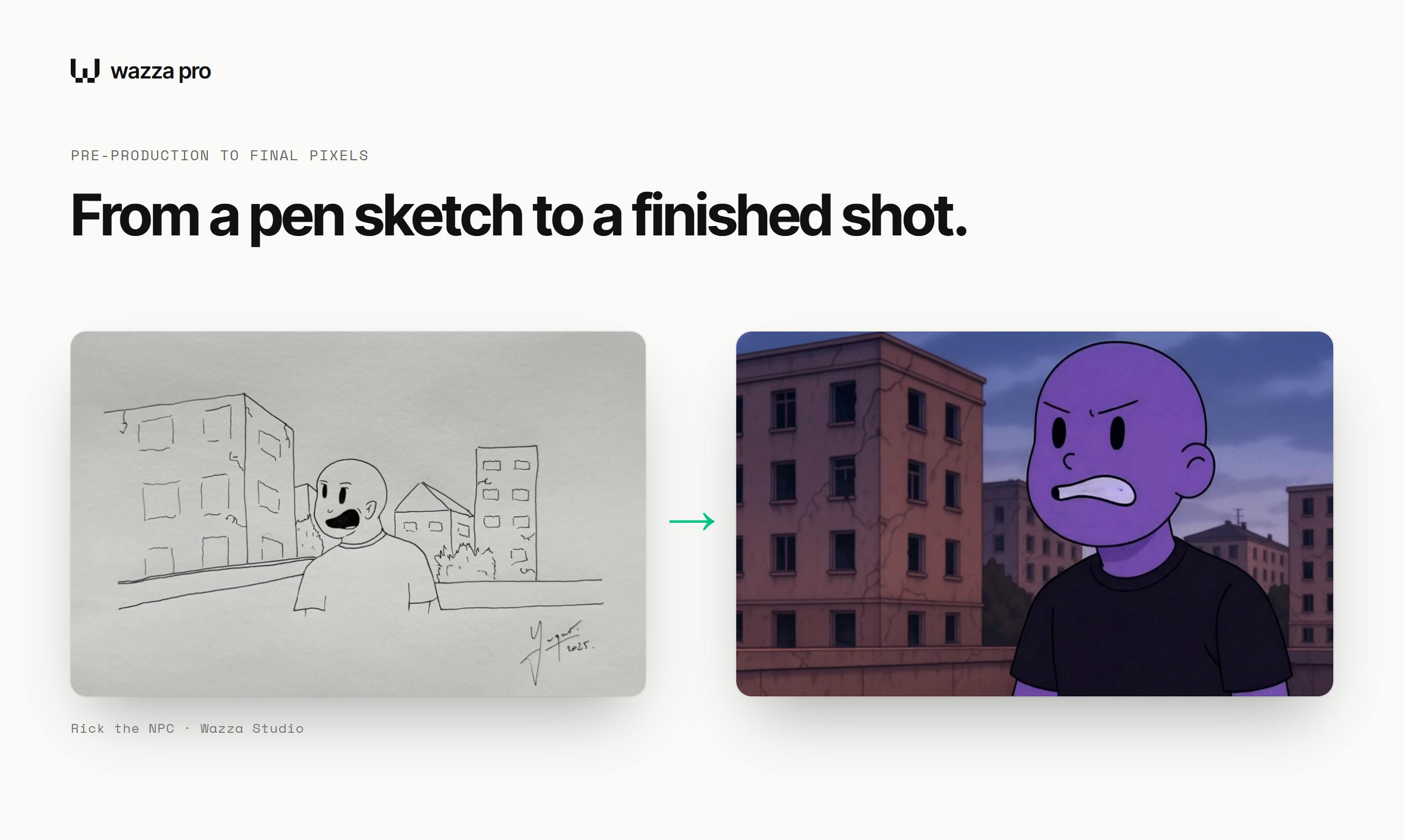
Wazza Pro embeds AI into studio hybrid pipelines to deliver QC-passing masters.
Wazza Pro is an AI production pipeline on Product Hunt that runs inside studio hybrid workflows rather than as a standalone generator. It outputs final pixels, 3D meshes, VFX, and sound masters that pass delivery QC, checks compliance with streaming platform rules, and provides fix recommendations. It includes 40+ AI tools, script-to-storyboard planning, and upfront cost display, targeting professional studios with $5 in free credits.
Film and animation production is being reshaped by AI tools, but the real pain point has never been "is there an AI for this" — it's "can AI be embedded into existing hybrid production workflows and deliver final assets that pass QC?" Wazza Pro, launched on Product Hunt, targets exactly this gap: it positions itself as an AI production pipeline that runs inside a studio's hybrid pipeline, from pre-production through post, directly outputting deliverable final pixels, meshes, VFX, and sound masters.
From Pre-Production to Post: An AI Pipeline That Delivers Masters
The core differentiator for Wazza Pro is its delivery standard. Most AI video or animation tools stop at "generating a clip that looks good," whereas Wazza Pro emphasizes outputting "masters" — master files that can pass delivery QC, covering final pixels, 3D meshes, visual effects, and sound. This means it attempts to solve the last-mile problem of the production workflow rather than remaining at the proof-of-concept stage.
According to its Product Hunt page, Wazza Pro can check whether masters comply with streaming platform delivery rules and provide fix recommendations for each failed item. For productions that need to deliver content to platforms like Netflix, this kind of automated QC and remediation guidance can significantly reduce back-and-forth communication costs.
Delivery QC (Quality Control) is a standardized step in film post-production: before content is delivered to a broadcaster or distributor, technical parameters are verified item by item, including resolution, frame rate, color space, loudness, subtitle formats, and file packaging, to confirm compliance with platform specifications. Streaming platforms such as Netflix and Disney+ publish detailed delivery specification documents; non-compliant items result in rejected deliveries and rework. Traditional QC relies on manual item-by-item checks or specialized software, which is time-consuming and prone to omissions. Wazza Pro builds QC rules in and automatically generates fix recommendations, effectively moving this step from "post-hoc inspection" to "built into the process" — which is the key distinction from ordinary generative tools.
40+ AI Tools and Script-to-Storyboard Planning
At the tool level, Wazza Pro includes 40+ AI tools covering multiple stages of the production pipeline. It also offers film planning capability from script to storyboards (boards), so the early creative phase can also be completed in the same environment. This combination of "planning + execution" makes it more like a production management system combined with an AI toolset rather than a single-function generator.
One detail worth noting is the cost transparency design: every step displays its cost before execution. For production studios that budget by project, this directly addresses a common blind spot of AI tools in budget management — the invocation costs of generative tools are often hard to estimate, and Wazza Pro moves costs upfront, before execution.
Storyboard is a core intermediate artifact in film and animation production that bridges the script and the final cut, using a series of sketches with shot descriptions to plan camera positions, composition, action, and pacing. In traditional workflows, storyboards are hand-drawn by storyboard artists or created with specialized software, taking days to weeks. AI-assisted storyboard generation can automatically break down shots from a script and output visualized sketches, greatly compressing the pre-production cycle, but it also brings challenges of style consistency and editability — whether the generated results can be further modified by directors and storyboard artists determines their usability in professional pipelines. Wazza Pro incorporating this capability into a unified environment means planning artifacts can flow directly into subsequent production stages, reducing format conversion and information loss.
Pricing and Early Feedback
Wazza Pro offers $5 in free credits for new users to get started, lowering the barrier to trial. On Product Hunt, the product received 5 votes and 7 comments, ranking 20th. This data indicates it is still in an early exposure phase with limited community discussion heat, but the fact that comments outnumber votes also suggests some willingness to discuss among those who have actually tried it.
From a product positioning standpoint, Wazza Pro targets professional studios with mature pipelines rather than individual creators. Its emphasis on hybrid pipeline integration, delivery QC, and cost visibility all address team-level production needs. Value validation cycles for this type of product are typically long, and early ranking data is insufficient to judge its actual performance.
Hybrid Pipeline refers to selectively introducing AI or procedural tools into a traditional production workflow rather than fully automating the entire process. A typical form is: humans handle creative decisions, keyframes, and final approval, while AI takes on repetitive tasks such as generation, frame interpolation, rotoscoping, and denoising. This model places high demands on tool interface compatibility — AI output must be able to enter existing editing, compositing, and color grading software and comply with established naming and version management conventions. Wazza Pro's emphasis on "running inside a studio's hybrid pipeline" directly addresses this reality: professional studios rarely start from scratch; they want new tools to embed into existing workflows and reduce friction.
Signals Worth Watching
Wazza Pro represents the direction in which AI tools are evolving from "single-point generation" to "pipeline integration." As generative capabilities become increasingly commoditized, whoever can seamlessly embed AI into existing professional workflows and guarantee delivery quality is more likely to be adopted by studios. Its master QC and upfront cost design offer a valuable reference point for evaluating similar products. However, whether the product can actually pass the delivery test of real projects still requires feedback from more users to verify.
One-line Summary
Wazza Pro embeds AI into studio hybrid pipelines and directly delivers masters that pass QC.
Paragraph Summary
Wazza Pro is an AI production pipeline tool launched on Product Hunt, positioned as running inside a studio's hybrid production workflow rather than as a standalone generator. Its core differentiator is its delivery standard: it outputs final pixels, 3D meshes, VFX, and sound masters that can pass delivery QC, and can check whether masters comply with streaming platform rules and provide item-by-item fix recommendations. At the tool level, it includes 40+ AI tools, supports film planning from script to storyboard, and displays costs before each step executes, addressing production teams' budget control needs. The product targets professional studios with mature pipelines, offers $5 in free credits, and ranked 20th in early Product Hunt exposure with 5 votes and 7 comments.
Related articles

Hermes Agent Beginner's Guide: Hands-On with a Self-Evolving AI Agent
A beginner's guide to Hermes Agent, the open-source self-evolving AI agent that gained 41.7K GitHub stars in two months—covering Harness Engineering, the learning loop, three-layer memory, WSL installation, and hands-on configuration.

AI Agent in Action: Building a Smart Office Assistant with WorkBuddy
A practical case study shows how Tencent WorkBuddy batch-converts and archives files, compares chat LLMs with AI Agents, and analyzes WorkBuddy's credit system, use cases, and positioning for office automation selection.

From Single-GPU Bottlenecks to Hundreds of Billions of Parameters: 6 Key Questions in Large Model Distributed Parallelism
Based on a Bilibili tutorial, this article organizes core knowledge of large model distributed parallelism: starting from decoder-only architecture's token-by-token generation and the essence of X times W computation, it analyzes six key questions including data parallelism, tensor parallelism, and pipeline parallelism under single-GPU bottlenecks. Suitable for learners in private deployment and model training scenarios to build systematic understanding.