WCF Modernization: CoreWCF or gRPC? A Decision Framework and Migration Guide

A decision framework for choosing between CoreWCF and gRPC when modernizing legacy WCF services.
This article analyzes the two mainstream paths for WCF modernization: CoreWCF for backward-compatible smooth transitions and gRPC for future-oriented architectural restructuring. It provides a practical decision framework based on contract compatibility, performance requirements, migration scope, and team readiness, helping enterprise teams craft rational WCF migration strategies.
At the Crossroads of Legacy Systems
For many enterprise applications that have long run on .NET Framework, Windows Communication Foundation (WCF) was once the core technology stack for building distributed services. WCF was Microsoft's unified communication framework released in 2006 alongside .NET Framework 3.0, consolidating previously fragmented distributed communication technologies including ASMX Web Services, .NET Remoting, MSMQ, and COM+. WCF's core design philosophy is the ABC model—Address (service endpoint), Binding (communication protocol and transport), Contract (service contract)—enabling switching between different communication methods through configuration rather than hard-coding. In enterprise development, WCF became the go-to technology for building SOA architectures thanks to its comprehensive support for the WS-* standards family (including WS-Security, WS-ReliableMessaging, WS-AtomicTransaction, and more).
However, as Microsoft shifted its strategic focus entirely toward .NET Core / .NET 5+, traditional WCF was never officially ported to the new platform. This leaves teams maintaining legacy systems facing an unavoidable question: how to elegantly modernize?
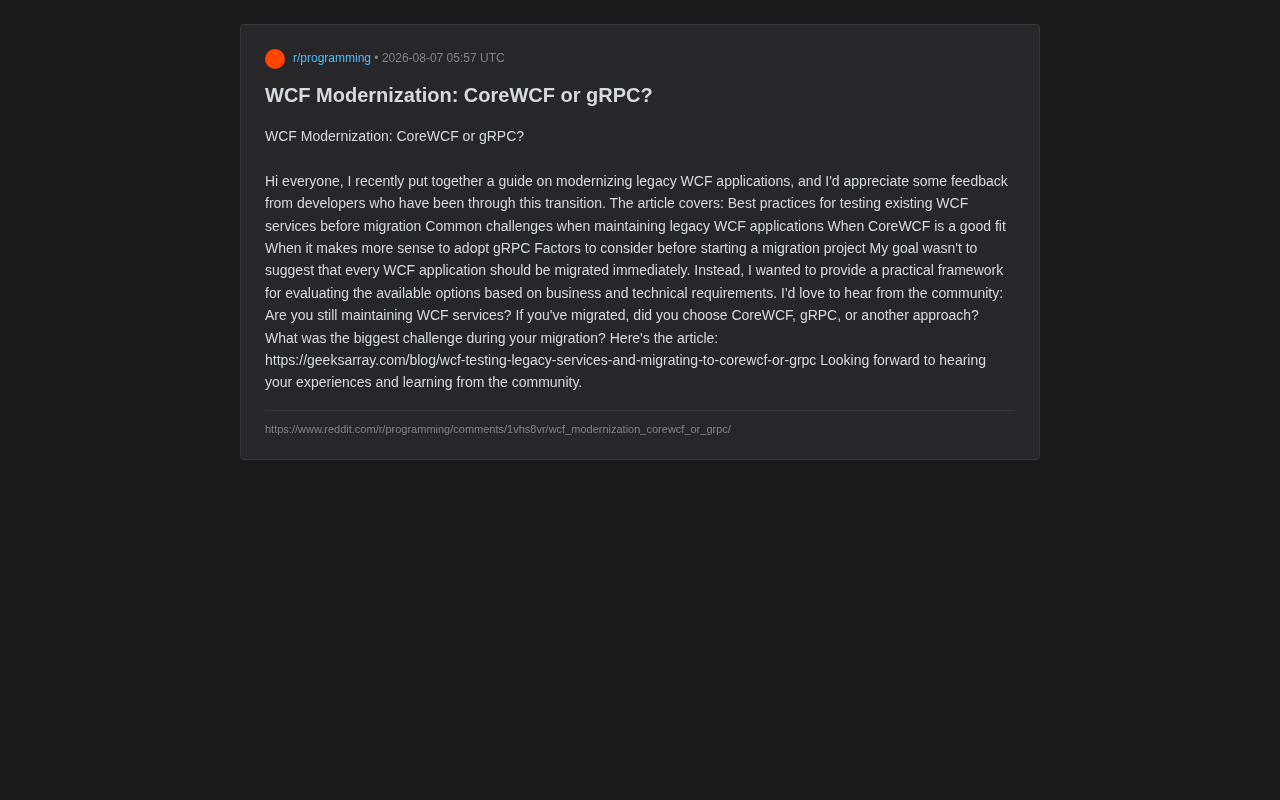
Recently, a developer shared a practical guide on WCF modernization migration on Reddit, soliciting experience and feedback from the community. The core topic addresses today's most typical technology selection dilemma—CoreWCF or gRPC? This article combines that discussion to outline the key decision framework for the migration process.
Critical Preparation Before Migration: Testing and Assessment
The author repeatedly emphasizes one point in the guide: not every WCF application needs to be migrated immediately. This is an extremely pragmatic stance. Many enterprise WCF services have been running stably for years, and hasty rewrites are not only costly but may introduce new risks.
Establishing a Test Baseline for Existing WCF Services
The most important step before migration is establishing comprehensive test coverage for existing WCF services. The original article specifically mentions "best practices for testing existing WCF services before migration." The logic behind this is: only when you can lock down the current service's behavioral contract with automated tests can you verify whether the new implementation maintains functional consistency after migration.
For Contract-First designed WCF services, you can write integration tests around ServiceContract and DataContract, simulating real client calls and recording expected input/output behavior. Contract-First is WCF's recommended design approach—defining the service interface before implementing concrete logic. This separation of interface and implementation makes it possible to test precisely against the contract. In practice, establishing a test baseline typically includes: using WCF Test Client or custom test clients to record real request/response pairs; writing integration tests to verify boundary conditions and exception handling paths for each operation; using contract validation tools to ensure WSDL definition completeness. Particularly for services involving complex Message Exchange Patterns (MEPs)—such as request-reply, one-way, and duplex patterns—corresponding test scenarios need to be established separately. This test suite becomes the most reliable "safety net" throughout the migration process.
Identifying Maintenance Pain Points in Legacy Systems
During the assessment phase, you also need to inventory the maintenance costs of current WCF applications: Does it depend on transport protocols that are no longer supported? Does it use advanced WCF-specific features (such as message queue bindings, reliable sessions, distributed transactions)? The level of support for these features in new technology stacks directly determines migration complexity.
CoreWCF Migration: The Preferred Path for Smooth Transition
CoreWCF is a community-led, Microsoft-supported open-source project aimed at bringing WCF's server-side capabilities to .NET Core / .NET 5+. Its greatest value lies in compatibility.
The CoreWCF project was initially launched by community developers, and in 2019 Microsoft officially announced support without directly maintaining it. In April 2022, CoreWCF 1.0 was officially released, marking the project as production-ready. It's hosted under the .NET Foundation and jointly maintained by Microsoft employees and community contributors. CoreWCF currently supports common bindings like BasicHttpBinding, NetTcpBinding, and WSHttpBinding, but not all WCF features have been implemented—for example, MSMQ transport and peer-to-peer (P2P) networking have not yet been ported. The project adopts an incremental release strategy, gradually expanding feature coverage with each version.
When to Choose CoreWCF
If your scenario meets the following conditions, CoreWCF is often the safer choice:
- The existing system heavily relies on SOAP, WS-* protocols, or WSDL contracts;
- There are many clients that are difficult to update simultaneously (e.g., external partners still calling your service);
- You want to complete the runtime migration from .NET Framework to modern .NET with minimal code changes;
- There are no short-term plans to restructure the service communication model.
CoreWCF allows you to migrate services to a modern runtime hosted on Kestrel or IIS while preserving existing [ServiceContract] definitions. This means existing clients can continue working with virtually no changes—an ideal vehicle for the "survive first, optimize later" strategy.
gRPC as a WCF Replacement: Future-Oriented Architecture Restructuring
Unlike CoreWCF's "compatibility first" approach, gRPC represents a more thorough architectural upgrade. gRPC was open-sourced by Google in 2015 as the public version of its internal RPC framework, Stubby. Built on the HTTP/2 protocol, it natively supports multiplexing, flow control, header compression, and bidirectional streaming. Protocol Buffers (protobuf), serving as both its Interface Definition Language (IDL) and default serialization format, is 3-10x faster in serialization speed compared to XML (the format used by SOAP), and generated messages are typically 1/3 to 1/10 the size of XML. gRPC supports four communication patterns: unary RPC, server streaming, client streaming, and bidirectional streaming. .NET has provided first-class gRPC support since .NET Core 3.0, allowing gRPC services to be hosted directly in ASP.NET Core via the Grpc.AspNetCore package.
When gRPC Makes More Sense
The original article points out that in certain situations, "adopting gRPC makes more sense than CoreWCF." This typically occurs when:
- You're undertaking broader architectural modernization (e.g., moving to microservices);
- You have high performance and throughput requirements where binary serialization advantages are significant;
- You need to support multi-language clients (gRPC's cross-platform capabilities far exceed SOAP);
- Both client and server are controlled by the same team, enabling synchronized interface evolution.
From a transport layer perspective, traditional WCF supports multiple transport protocols: HTTP (BasicHttpBinding), TCP (NetTcpBinding), Named Pipes (NetNamedPipeBinding), and MSMQ (NetMsmqBinding). Among these, NetTcpBinding offers the best performance for .NET-to-.NET communication but is limited to Windows platforms. HTTP/2, gRPC's underlying protocol, introduces binary framing, multiplexing (multiple parallel requests on a single connection), server push, and HPACK header compression compared to HTTP/1.1. This means gRPC inherently has the ability to efficiently handle large numbers of concurrent calls over a single TCP connection, whereas traditional WCF's HTTP binding based on HTTP/1.1 requires establishing multiple connections under high concurrency.
It's important to note that gRPC is not a "one-to-one" replacement for WCF. It doesn't support SOAP, isn't natively compatible with WSDL, and certain advanced WCF features (such as distributed transactions and some duplex callback patterns) need to be redesigned. Therefore, choosing gRPC means you're willing to pay the restructuring cost for long-term benefits.
CoreWCF vs gRPC: Decision Framework
The author explicitly states in the guide that the goal is not to advocate "all WCF should be migrated immediately," but to provide an assessment framework based on business and technical requirements. This point is particularly valuable because technology selection is never black and white.
An actionable decision path can be summarized as:
- Contract Compatibility: Can external clients be modified? If not, lean toward CoreWCF.
- Performance Requirements: Do you need high throughput and low latency? If so, consider gRPC.
- Scope of Modernization: Is this a runtime upgrade or an architectural restructuring? The former favors CoreWCF, the latter favors gRPC.
- Team Capability and Time Budget: gRPC has a steeper learning curve—assess your team's readiness.
It's worth adding that these two approaches are not mutually exclusive. In an incremental migration strategy, you can first use CoreWCF to migrate services to a modern .NET runtime while keeping existing clients working, then introduce gRPC for new feature modules, achieving coexistence of old and new protocols through an API gateway or reverse proxy layer. This "dual-track parallel" strategy is especially common in large enterprises.
Real Migration Experiences from the Community
One of the core purposes of posting this on Reddit was to collect migration experiences from frontline developers. The author posed three questions worth asking within every team: Are you still maintaining WCF services? If you've already migrated, did you choose CoreWCF, gRPC, or another approach? What was the biggest challenge during migration?
These questions themselves remind us that the true difficulty of technology migration often lies not in the code, but in legacy system coupling, client coordination, and validating unknown behaviors. This is precisely why "establishing a test baseline before migration" is so important.
Conclusion: Incremental Migration Is the Most Pragmatic Strategy
There's no one-size-fits-all answer for WCF modernization. CoreWCF is a stable transitional bridge, while gRPC is the performance-oriented choice for the future. For most enterprises, the most rational approach is perhaps: first lock down the current state with tests, use CoreWCF to complete the runtime migration, then gradually evolve toward gRPC when business windows allow. Paying down technical debt is never a one-shot deal—it's a sustained campaign with a measured cadence.
Related articles

grok2api: In-Depth Analysis of the Multi-Account Grok API Gateway Open Source Project
In-depth analysis of grok2api, a Go-based multi-account Grok API gateway supporting Grok Build, Web, and Console modes with load balancing and high availability.

Post-Mortem and Lessons from OpenAI's Accidental DDoS Attack on Hugging Face
A post-mortem of OpenAI's accidental DDoS on Hugging Face, analyzing the technical causes of unexpected traffic floods, AI infrastructure fragility, and defense strategies for large-scale API consumers.

ChinaTextbook Open-Source Textbook Repository: Deep Dive into the GitHub Project with 70K+ Stars
ChinaTextbook has earned 76K+ GitHub stars by aggregating Chinese PDF textbooks. This deep dive analyzes why it went viral, the educational equity demand behind it, copyright risks, and future directions.