Wealth Management Client Onboarding: AI Alone Isn't Enough

The bottleneck in wealth management onboarding isn't AI's point capabilities but the missing process orchestration layer.
The article highlights a paradox in wealth management client onboarding: even when document collection, identity verification, and compliance checks each complete their tasks, onboarding may still stall—the problem lies in the handoffs between steps, not point failures. AI excels at unstructured information processing like document classification and field extraction, but struggles with process orchestration and exception judgment, which involve institutional risk appetite and regulatory context. A healthy onboarding architecture should have three layers—execution, state, and orchestration—yet most institutions severely underinvest in orchestration. The conclusion: investing in orchestration capability may yield higher returns than polishing individual AI models; evaluate AI by whether its output has structured state and traceable trails, and design processes around the client application.
The "Last Mile" Dilemma in Onboarding
Most wealth management firms adopt a "stack the systems" strategy in their digital transformation: introducing AI document recognition, automated KYC, and intelligent risk scoring, each of which performs well on its own. But when they are assembled into a single onboarding workflow, the client experience may actually become more fragmented.
The core phenomenon highlighted in the original article is this: onboarding stalls often occur after "every system has finished its own piece of work." Documents are collected but not automatically routed to the next step that needs them; verification is complete but the results require manual transfer between multiple screens. AI optimizes the efficiency of individual point tasks, while onboarding is a continuous, cross-system process. The sum of point-level efficiencies does not equal end-to-end fluidity.
This insight is especially important for wealth management, because its onboarding process involves far more upstream steps than an ordinary retail bank account: investment objective assessment, risk tolerance questionnaires, source-of-funds review, and product suitability matching—each of which may produce information that downstream steps need to consume.
What AI Is Good At, and What It Isn't
Placing AI within the onboarding process requires distinguishing which type of problem it solves.
AI's Strength: Processing Unstructured Information
Document classification, field extraction, preliminary authenticity screening of identity documents—these are capabilities AI has already matured in. A large amount of time in wealth management onboarding is consumed by processing passports, proof of address, and source-of-funds documents, and AI can indeed significantly compress manual review time in this area.
KYC (Know Your Customer) is the customer identification and due diligence obligation that financial institutions must fulfill before establishing a business relationship, typically including identity verification, proof of address, source-of-funds and source-of-wealth review, and screening against sanctions and politically exposed person (PEP) lists. In wealth management scenarios, KYC also extends to suitability management requirements: institutions must assess a client's investment objectives, risk tolerance, and financial situation to ensure that recommended products match the client.
These requirements make the prerequisites for onboarding far more numerous than for an ordinary account: a single application may simultaneously produce identity information, risk assessment results, source-of-funds explanations, and suitability conclusions, and each type of information may be repeatedly consumed by multiple downstream steps. Therefore, KYC is not only a compliance action but also the most important information-production step in the process—whether its output can be structured and passed downstream directly determines whether subsequent steps require manual re-entry.
AI's Weakness: Process Orchestration and Exception Handling
What truly slows down onboarding is often exceptions: subtle inconsistencies between document information and declared content, client circumstances triggering additional review requirements, compliance rule conflicts across jurisdictions. These scenarios require holistic awareness of process state and cross-system coordination capability, not the recognition accuracy of a single model.
In other words, AI can tell you "what is written in this document," but it struggles to independently judge "whether this information discrepancy is worth pausing the entire onboarding process for three days." The latter involves the institution's risk appetite, regulatory environment, and client relationship judgment—it is a problem for the orchestration layer.
Process orchestration refers to a coordination layer within a business process composed of multiple systems and steps that decides "what to do next, who should do it, and under what conditions it should be triggered." It differs from point automation: point automation solves "how to complete this task faster," while orchestration solves "how tasks connect in sequence, how state is passed, and how exceptions are routed." Technically, orchestration is typically implemented using workflow engines (such as BPMN process engines), state machines, or event-driven architecture, with core capabilities including state persistence, conditional routing, timeouts and retries, and human task assignment.
In onboarding scenarios, the orchestration layer's typical responsibilities include: determining whether the extraction results of a document meet the prerequisites for downstream verification, deciding whether to pause or escalate when compliance rules conflict, and precisely routing exceptions requiring human judgment to review roles with the appropriate authority. Without an orchestration layer, these decisions degenerate into manually moving information between systems and communicating by email—which is precisely the root cause of end-to-end process slowdowns.
What's Really Missing Is the Orchestration Layer, Not a Smarter Model
The implicit conclusion of the original article deserves elaboration: the bottleneck in wealth management onboarding is not intelligence but coordination.
A healthy onboarding architecture should consist of three layers: the execution layer (AI and automation tools completing specific tasks), the state layer (tracking which node each client application is currently at and which prerequisites have been satisfied), and the orchestration layer (deciding the next action based on state and routing exceptions to the correct human role).
Most institutions invest the most in the execution layer, barely maintain the state layer through ticketing systems, and rely essentially on human experience and email communication for the orchestration layer. This is precisely the root cause of "every system has finished its work, yet the process is stuck": no one is responsible for answering "who should do what now."
For wealth management institutions, investing in orchestration capability may yield higher returns than continuing to polish individual AI models. A system that can clearly present application status, automatically trigger the next step, and precisely route exceptions to the right reviewer can shorten onboarding cycles more than a document model with a few percentage points higher recognition accuracy.
The state layer plays the role of "single source of truth" in the onboarding architecture: it records, per client application, the current node, completed prerequisites, pending tasks, and historical action trails. Compared with piecing together state through ticketing systems, an independent state layer ensures that the same application has a consistent and traceable state view across multiple subsystems such as documents, verification, compliance, and suitability.
The value of the state layer is especially evident in exception scenarios: when a step is paused due to information inconsistency, the state layer can clearly mark "which condition it is stuck on and who is responsible for resolving it," preventing applications from silently languishing between systems. From an engineering perspective, the state layer typically uses the application ID as the primary key, paired with an event log for audit traceability—which is also a basic requirement for explainability and regulatory examination in highly regulated industries.
Implications for Industry Practice
First, when evaluating AI solutions, beyond point accuracy, ask how it hands off results to upstream and downstream systems. An AI tool that does not output structured state or leave a traceable trail will throw its efficiency gains back into the manual handoff step.
Second, onboarding process design should shift from a "system perspective" to an "application perspective." A client submits one application, not five separate tasks to five systems. Only by tracking state with the application at the center can the real bottlenecks be exposed.
Third, the design quality of exception-handling channels often determines the floor of the onboarding experience. AI can easily be fast on standard cases, but clients' memories of the onboarding experience usually come from how that one problematic instance was handled.
What wealth management client onboarding needs is not smarter AI, but the layer of infrastructure that lets AI's output truly flow. This judgment applies equally to other highly regulated industries that are advancing AI adoption.
One-line Summary
The bottleneck in wealth management onboarding is not AI's point capabilities but the missing process orchestration layer.
Paragraph Summary
The article points out a paradox in wealth management client onboarding: even when every system—document collection, identity verification, compliance checks—has completed its task, onboarding may still stall; the problem lies in the connections between steps rather than in point failures. AI excels at processing unstructured information such as document classification and field extraction, but struggles to independently handle process orchestration and exception judgment, which involve institutional risk appetite and the regulatory environment. The article proposes that a healthy onboarding architecture should include three layers—execution, state, and orchestration—and that most institutions are severely underinvested in the orchestration layer. The conclusion: investing in orchestration capability may yield higher returns than continuing to polish individual AI models; when evaluating AI solutions, focus on whether their output has structured state and traceable trails, and process design should track state with the client application at the center.
Related articles

VERS: Editing Activation Explanations to Halve Reasoning Model Tokens
VERS guides reasoning models by editing activation explanations, cutting 45.8% of tokens on GSM8K with only a 0.82 pp accuracy drop and transferring to larger models, but losing accuracy on competition problems.

Finding Errors Is Not Enough: Selective Model Escalation for Entity-Targeted Sentiment Analysis
This study explores selective model escalation for entity-targeted sentiment analysis, comparing data collection ordering, uncertainty-driven re-examination, and model routing—finding that minority-class priority only helps at very small data volumes, the oracle upper bound far exceeds actual gains, and escalation must be tailored to each dataset.
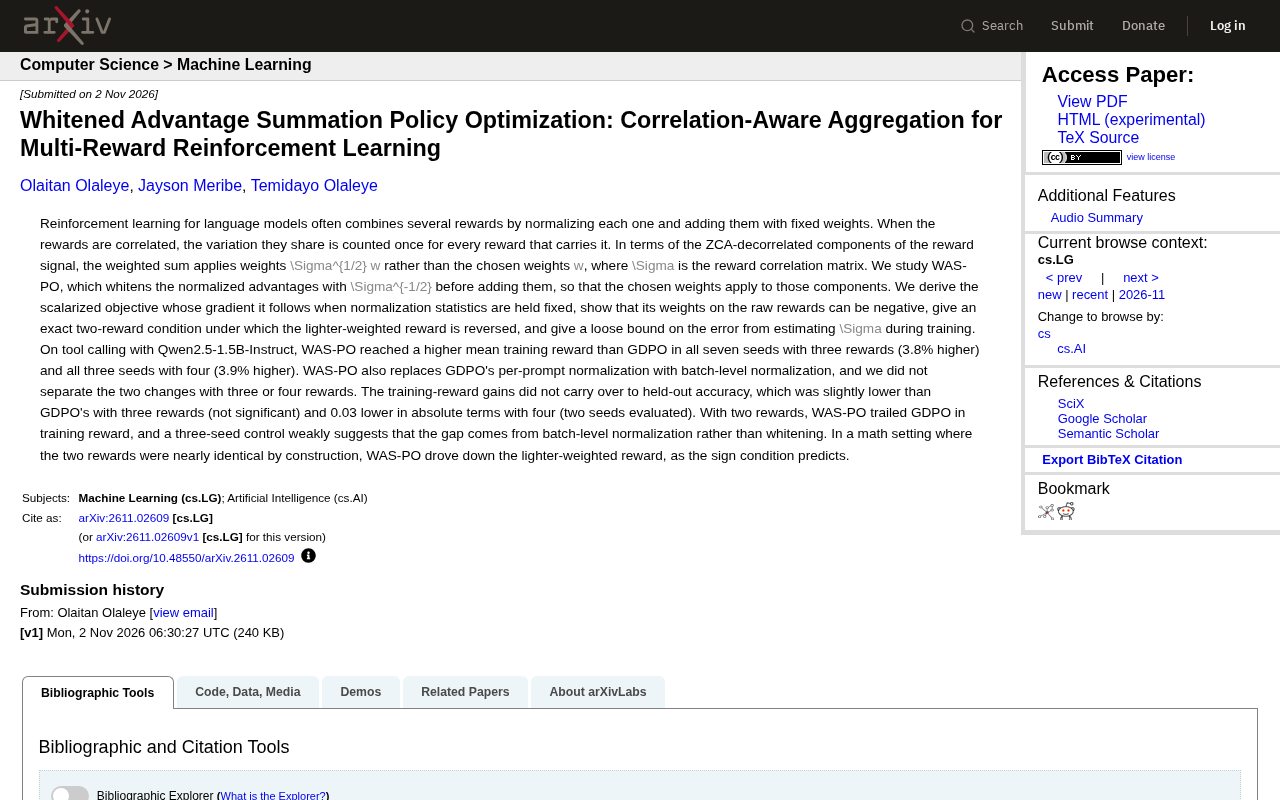
WAS-PO: Using Whitened Advantages to Solve the Correlation Trap in Multi-Reward Reinforcement Learning
WAS-PO paper proposes whitening advantages to correct correlation bias in multi-reward RL: when rewards are correlated, naive weighted summation effectively applies Σ^{1/2}w instead of w. Experiments show training reward improves steadily, but held-out accuracy does not improve in sync, and under two rewards it actually falls behind.