WeatherNext 3: How AI Weather Forecasting Powers Renewable Energy Grids

Google WeatherNext 3 brings AI weather forecasting to wind and solar energy, delivering turbine-height and solar radiation data for smarter grid management.
Google's WeatherNext 3 is an AI-powered weather forecasting system built for the energy industry, providing turbine-height wind speed and solar radiation data tailored to the dispatch needs of wind farms, solar PV operators, and grid managers. Compared to traditional numerical weather prediction, AI models offer significant advantages in speed and spatial resolution. Applied to energy use cases, this capability can reduce dispatch errors from renewable energy integration, lower reliance on fossil fuel peaking units, and help clear technical barriers to higher green energy penetration. The article notes that forecast accuracy details and coverage scope have not yet been fully disclosed, and real-world performance still requires independent validation.
Why Weather Forecasting Is Central to the Energy Transition
One often-overlooked variable in the shift toward renewable energy is weather. Wind and solar power are inherently intermittent and variable — wind speed and cloud cover directly determine how much green electricity the grid can access at any given moment. For grid operators, maintaining a precise balance between supply and demand depends heavily on the ability to predict weather.
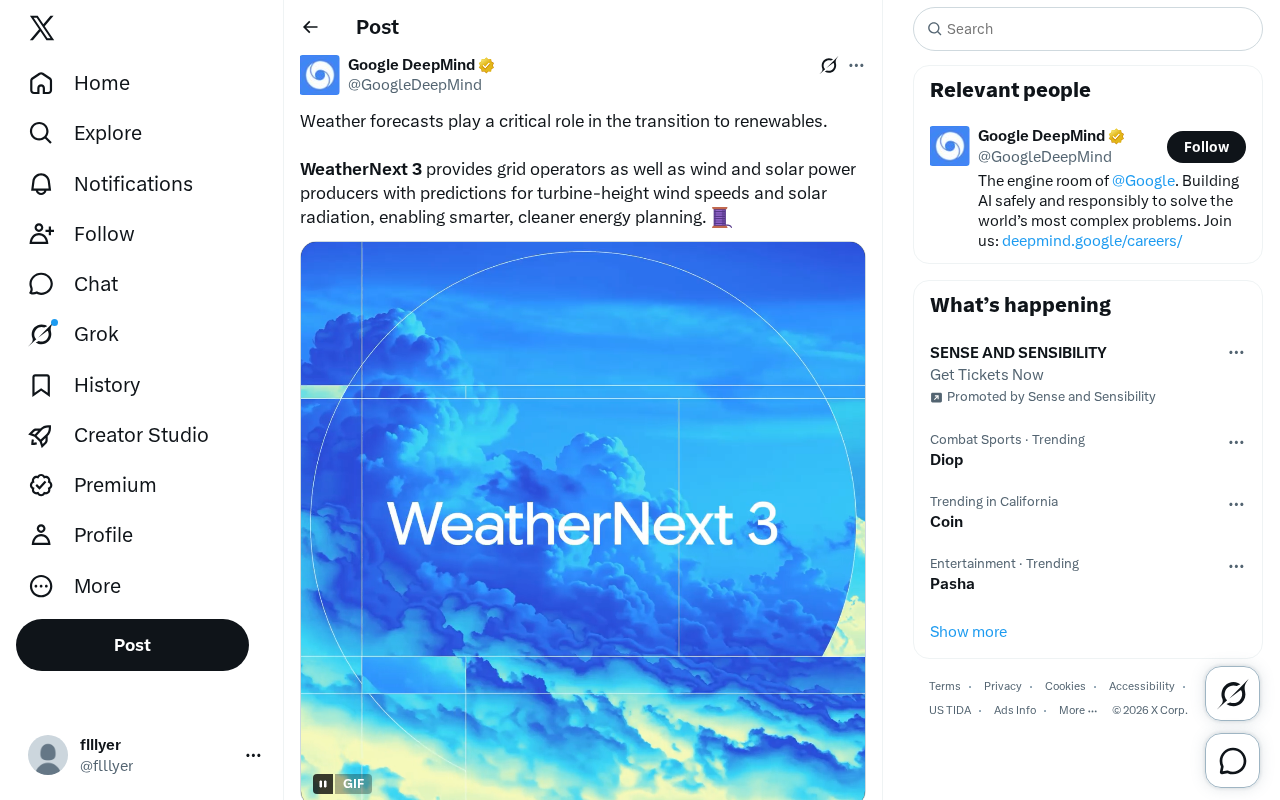
Google's WeatherNext 3 is designed to address exactly this challenge. According to the company's official social media posts, the system provides critical meteorological forecast data to grid operators and wind and solar power enterprises, enabling smarter and cleaner energy planning.
What Key Forecasts Does WeatherNext 3 Provide?
Unlike traditional weather forecasts that focus on surface temperature and precipitation probability, WeatherNext 3 delivers two highly specialized types of forecast data tailored to the real-world needs of the energy industry:
Turbine-Height Wind Speed Forecasts
Wind turbine rotors are typically mounted tens to hundreds of meters above the ground, where wind speeds can differ significantly from surface-level readings. WeatherNext 3 specifically provides turbine-height wind speed forecasts, meaning wind farm operators can more accurately estimate future power output rather than extrapolating from rough ground-level data.
Solar Radiation Forecasts
For solar PV plants, the intensity of solar radiation is the primary driver of power generation. Cloud cover and seasonal shifts affect how much radiant energy reaches the panels. WeatherNext 3's solar radiation forecasts give PV operators advance visibility into their generation curves, enabling better grid integration and energy storage strategies.
Real-World Value for Grid Operations
High penetration of renewable energy introduces new challenges for grid management: when wind and solar output suddenly drops, operators need to quickly dispatch backup power to fill the gap; when generation is excessive, it can lead to curtailment. These dispatch decisions rely heavily on forecasting power generation hours or even days ahead.
More accurate weather forecasts translate directly into fewer dispatch errors. Grid operators can better plan reserve capacity and reduce dependence on fossil fuel peaking units, while power generators can make more optimal bidding and trading decisions in electricity markets. Broadly speaking, improvements in forecasting capability help remove technical barriers to integrating a higher proportion of clean energy into the grid.
Grid balancing is technically described as "frequency regulation" and "peak shaving": frequency regulation covers real-time power balancing at the seconds-to-minutes scale, while peak shaving addresses capacity allocation over hours to days. The variability of renewable energy primarily impacts the peak shaving layer. Current approaches include pumped-storage hydro, electrochemical storage, demand-side response, and cross-regional transmission interconnection. Regardless of the approach, knowing in advance how wind and solar output will fluctuate can significantly reduce the reserve capacity required. According to research by the International Renewable Energy Agency (IRENA), each order-of-magnitude improvement in forecast accuracy can reduce system reserve capacity requirements by roughly 10%–20%, corresponding to substantial cost savings. This is precisely the market value WeatherNext 3 is targeting.
The Industry Significance of AI Weather Models
The WeatherNext series represents a new wave of AI-driven weather prediction. Compared to traditional numerical weather prediction (NWP) based on physical equations, AI models can often deliver comparable accuracy while dramatically improving computation speed and spatial resolution. Connecting this capability directly to energy-specific needs — turbine-height wind speeds, solar radiation — illustrates how general-purpose AI technology is finding its way into vertical industry applications.
One important caveat: the publicly available information is based primarily on a brief official announcement. Technical details regarding forecast accuracy, temporal resolution, and coverage area have not yet been fully disclosed. For energy companies considering adopting such tools, real-world effectiveness still awaits more independent validation and deployment case studies.
Traditional NWP relies on systems of atmospheric physics equations, numerically solved on supercomputers by discretizing atmospheric states — a process that can take hours and typically achieves horizontal resolutions of several to tens of kilometers. AI weather models (such as Google DeepMind's GraphCast and Huawei's Pangu-Weather) instead train deep neural networks on vast historical atmospheric reanalysis datasets, learning the implicit dynamics of atmospheric behavior. Inference speeds can be hundreds to thousands of times faster, and outputs can be produced at finer spatial scales. The WeatherNext series extends this approach — building on general-purpose AI weather models and further optimizing for specific altitude levels and physical variables required by the energy industry, making it a "vertically customized" deployment. It's worth noting that AI models still have weaknesses in forecasting extreme weather events, which happen to be the greatest threats to grid security — a boundary condition that must be continuously monitored in real-world deployments.
Conclusion
The energy transition isn't just about building more wind turbines and solar panels — it's about reliably delivering that unstable clean power into the grid. AI weather tools like WeatherNext 3, purpose-built for energy scenarios, are becoming an easy-to-overlook yet critically important piece of this puzzle. As the share of renewable energy continues to climb, the value of accurate weather forecasting will only grow.
Related articles

Gemini 4 Argon Hands-On: AI Builds Board Games, Constructs Temples, and Trains Robots Autonomously
Gemini 4 Argon hands-on roundup: AI autonomously builds a desk racetrack and temple in Blender, writes a ray tracing engine, trains a humanoid robot to sink 7 shots, plus API pricing and developer access.

The Magic Octagonal Coin: Why Only 9% of People Can Predict Its Flip?
Only 9% of people can correctly predict the Magic Octagon coin flip. This article explains its spatial rotation mechanism, common cognitive pitfalls, and a new hypothesis based on Relevance Theory, exploring the limits of human spatial reasoning.

Sam Altman: AI Is Entering the Era of Scientific Discovery — Math Breakthroughs Will Replicate in Biology and Energy
Sam Altman says AI is entering the era of scientific discovery — math breakthroughs will replicate in biology, materials science, and energy to help develop new drugs and energy sources.