What a Gemini User Post Reveals About Building Long-Term Trust in AI Products

What one Reddit post about Gemini tells us about trust, loyalty, and competition in the AI market.
A brief Reddit post praising Gemini and expressing belief in its future improvement serves as a lens for examining how AI products build lasting user trust. This article explores Gemini's rocky but improving history, the behavioral economics behind AI user loyalty, and the three key strategies — continuous improvement, transparent communication, and community reputation — that determine whether AI products earn long-term user commitment.
A Reddit Post That Got Us Thinking
Recently, a Reddit user posted a short but thought-provoking message: "Appreciate it Gemini," followed by "I'm a believer that Gemini will get better!" This seemingly simple statement actually cuts to the heart of one of the most important questions in today's AI assistant market — how do you build and sustain user trust?
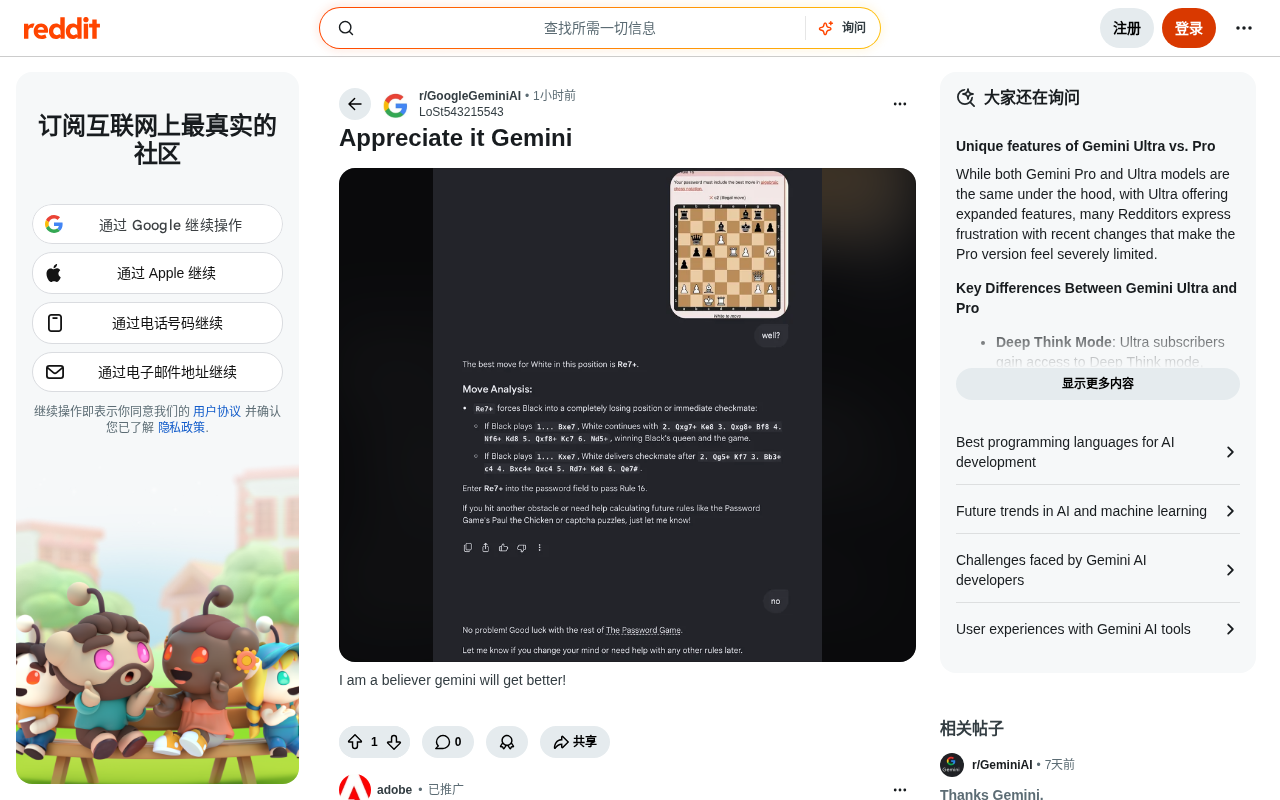
Reddit serves as a uniquely reliable barometer for AI product reputation — one that other platforms struggle to match. Founded in 2005, Reddit's subreddit structure and upvote/downvote system create a decentralized content filtering mechanism. Unlike feed-based platforms like Weibo or Twitter, content on Reddit has a longer shelf life, with popular discussions continuing to generate engagement for weeks. Communities like r/MachineLearning (2M+ subscribers) and r/ChatGPT (which crossed 5 million subscribers within months of ChatGPT's launch) attract engineers, researchers, and early tech adopters whose assessments tend to carry more professional depth and reach than those of mainstream consumers. From a product research perspective, Reddit is even used by internal teams at Anthropic, OpenAI, and others as an "unstructured data source" for user feedback, helping product teams surface real pain points. Dedicated communities like r/Gemini and r/ChatGPT have become go-to spaces where users share authentic experiences and compare product capabilities. Unlike the algorithmically curated Twitter/X or brand-managed YouTube comments, Reddit's voting system and anonymous culture lend its commentary a higher degree of credibility — which is exactly why a seemingly ordinary post can serve as a meaningful window into user sentiment.
In a market defined by fierce competition among AI products, a user who publicly declares their "belief" in a product is sending a signal worth analyzing carefully. It reflects that Google Gemini has built a degree of emotional buy-in among certain users — while also suggesting the product is still in a phase where users are being asked to be patient.
Gemini's Current State and What Users Actually Expect
A Product Still in Rapid Iteration
Google Gemini, Google's flagship AI model launched after a significant internal reorganization, has gone through multiple version updates and brand pivots since its debut. In February 2023, Google hastily launched Bard in response to the ChatGPT wave — but an early demo turned into a costly mistake when Bard incorrectly answered a question about the first image of an exoplanet taken by the James Webb Space Telescope. Astronomers quickly called out the error on Twitter, and it spread rapidly, wiping over $100 billion off Alphabet's market cap in a single day and sending the stock down more than 8%. Google subsequently undertook a major AI strategy overhaul, merging DeepMind and Google Brain into Google DeepMind and rebranding the product as Gemini. The December 2023 launch of Gemini 1.0 marked a strategic shift from playing catch-up to asserting technical leadership — Gemini Ultra outperformed GPT-4 on multiple benchmarks for the first time, with particular strength in multimodal understanding (simultaneous processing of images, audio, and video). The Gemini 1.5 and 2.0 series, released in 2024, further extended this multimodal advantage. This rebrand wasn't just cosmetic — it reflected Google's strategic intent to deeply integrate AI capabilities into its core product lines, including Search and Workspace. The path from Bard to the Gemini series has been anything but smooth. Users have experienced both genuinely impressive capabilities and frustratingly inconsistent responses.
The phrase "I'm a believer that Gemini will get better" says a lot about where users actually stand: they acknowledge the product's shortcomings but are willing to give it time and extend their trust. This "use it while hoping it improves" mindset is characteristic of users across all AI products that are still finding their footing.
The Deep Value of Emotional Affinity in AI Products
It's worth noting that this user chose the word "believer" — a term with strong emotional resonance. The behavioral economics concepts of the "Endowment Effect" and "sunk cost" psychology play important roles in how loyalty forms around AI assistants. The Endowment Effect, introduced by behavioral economist Richard Thaler in the 1980s, describes how people systematically value things they already own more than equivalent things they don't. In the AI assistant context, this effect is particularly pronounced: conversation histories, Custom Instructions, and personalized configurations like GPTs or Gems that users build up over time in ChatGPT or Gemini create meaningful switching barriers. The more time a user invests in training an AI to match their habits, the higher the psychological cost of moving to a competitor. OpenAI's research data suggests that users who engage with the Custom Instructions feature show approximately 40% higher month-two retention than those who don't.
At the same time, the cognitive science concept of "parasocial relationships" also applies to AI interaction — through prolonged conversations, users develop one-sided emotional bonds with AI, sometimes experiencing something like the feeling of knowing an old friend. This helps explain why some users had strong emotional reactions when the voice of GPT-4o changed after an update. This dynamic is similar to the lock-in logic of traditional SaaS products, but AI adds an emotional dimension: users project a kind of "collaborative partner" identity onto the AI through sustained interaction. This anthropomorphic emotional bond is a moat that purely functional products struggle to replicate. In the tech industry, fostering something close to genuine belief in a product is far more valuable than simple feature satisfaction. Once established, this emotional connection dramatically raises both user tolerance and loyalty — and it represents exactly the kind of competitive asset Google Gemini should be working to deepen.
Three Key Paths to Building User Trust in AI Products
Continuous Capability Improvement Is the Foundation
The reason users are willing to "believe the product will get better" is that they've already observed meaningful progress. For Gemini, Google needs to keep delivering substantive updates at a pace users can feel. Every real improvement to the model's capabilities is a deposit into the user trust account.
If a product stagnates for too long, even the most loyal supporters will eventually lose patience. Keeping the pace and visibility of technical progress clear is therefore essential to sustaining user trust.
Transparent Communication and Expectation Management
Another critical factor is expectation management. This is a well-established concept in corporate communications, but AI products add a unique complication: the "emergent capability" nature of AI models means that even development teams can't always accurately predict the product's limits. When OpenAI launched GPT-4, it deliberately kept a low profile and pursued a "surprise" release strategy, avoiding the hype trap it had fallen into with GPT-3. Google, by contrast, has faced competitive pressure that has led it to announce products publicly before they were fully ready — setting expectations that reality couldn't match. Academic research on AI credibility (including a 2023 report from MIT Media Lab) shows that users are far more accepting of AI that "admits mistakes and explains why" than AI that either fails silently or tries to rationalize errors. When users clearly understand where a product currently stands — what it can and can't do — they become more forgiving of occasional shortcomings. Gemini's 2024 "Double-check" feature, which lets users verify AI responses against Google Search sources with a single click, is a product-level implementation of exactly this transparent communication strategy. Conversely, when marketing overpromises and the actual experience falls short, trust collapses quickly. Gemini needs to find the right balance between promotional messaging and authentic capability — avoiding the "higher expectations, bigger disappointment" trap.
The Double-Edged Sword of Community Reputation
Tech communities like Reddit are critical battlegrounds for AI product word-of-mouth. A single positive post can prompt more people to give a product a try; negative sentiment can spread just as fast. This "Appreciate it Gemini" post may be brief, but as a positive voice within the community, it has a subtle yet real influence on how the product is perceived.
What One Comment Tells Us About the AI Competitive Landscape
The Strategic Value of Loyal Users
Today's AI assistant market is defined by "platform ecosystem" competition, not just model performance benchmarks. ChatGPT leverages OpenAI's plugin ecosystem and enterprise API market; Claude uses Anthropic's Constitutional AI safety framework to differentiate in enterprise compliance scenarios; and Gemini's core moat lies in the 3 billion+ users covered by the Google account ecosystem, plus deep integration with Gmail, Google Drive, YouTube, and other products. In a fiercely contested market among ChatGPT, Claude, Gemini, and other leading AI assistants, cultivating a base of loyal users willing to grow alongside a product is one of the most coveted assets any company can build. These users don't just contribute usage data — they become organic brand advocates in the community. Google's 2024 launch of "Gemini for Google Workspace" embeds AI capabilities directly into enterprise workflows, allowing users to call on AI without ever leaving their existing environment. This "invisible integration" strategy dramatically reduces enterprise users' motivation to switch. If Gemini can leverage the Google account ecosystem to enable cross-product memory and personalization, the user lock-in effect will deepen further, reinforcing the strategic value of this base.
The user represented by this post is part of exactly the loyal core Gemini needs in a competitive fight. How to convert that initial emotional affinity into deep, long-term engagement is a strategic question Google will need to keep answering.
User Patience Is Itself a Competitive Resource
Interestingly, users' patience — their belief that a product "will get better" — actually buys vendors a valuable window for iteration. From a strategic perspective, this kind of ecosystem lock-in is more durable than pure technical superiority. As Microsoft's embedding of Copilot into Office 365 has demonstrated, when AI becomes part of an existing workflow rather than a standalone tool, the cost of switching grows exponentially. In an AI industry defined by rapid change, earning users' tolerance for time means a vendor has more room to experiment, fail, and improve — and that is itself a hidden competitive advantage.
Conclusion: User Trust Is the Deepest Moat in AI
A short Reddit post reminds us just how precious — and fragile — user trust is during an AI product's growth journey. For Gemini, this user's "belief" is both encouragement and obligation — it means the company must keep delivering on the promise of getting better.
In a world of relentlessly advancing AI, the deepest long-term competitive moat may not be the most advanced model parameters. It may be the community of users who are willing to grow alongside a product, in a relationship of mutual trust. For every AI product out there, earning and protecting that trust is the hardest — and most worthwhile — work of all.
Key Takeaways
Related articles

GitHub Daily · August 18: The Rise of Agent Memory and Multi-Agent Frameworks
GitHub Trending Aug 18: AI Agent infrastructure dominates with memory databases, multi-agent frameworks, and Web3+AI scaffolds leading the charge.

The Design Philosophy of Agent Skills: Making AI Interrogate Your Development Methodology
Deep analysis of Matt Pocock's open-source Skills repo: Grill Me interrogation-style alignment, Wayfinder decision mapping, smart/dumb zones, and the shift from tactical to strategic programming.

Spring AI 2.0 in Practice: Core Agent Development Capabilities and Code Generation Assistant Project
Deep dive into Spring AI 2.0 core updates, covering Agent autonomous reasoning, tool calling, and iterative loops, with a hands-on Claude Code-style assistant project using ChatClient, Streaming, Memory, Tools, and MCP.