What Are Decision Models? A Quick Breakdown of Three Types

Decision models fall into three types—predicate, choice, and score—answering yes/no, which category, and how strong.
Based on a technical explainer video, the article summarizes decision models into three question paradigms: predicate questions output binary true/false results, suitable for hard rules such as safety detection and compliance checkpoints; choice questions pick one from preset categories, suitable for ticket routing and intent recognition; score questions output continuous values to measure degree, suitable for sentiment analysis, risk scoring, and priority ranking. The three types can be combined into a layered pipeline: first predicate interception of obvious anomalies, then choice classification, and finally score ranking. The article emphasizes keeping model responsibilities single and selecting by question form, and notes that this decomposition thinking is more controllable and maintainable than directly calling a large model to make all judgments.
The core value of decision models lies in answering simple questions in a minimalist way, thereby accelerating business judgment processes. According to a technical explainer video, the question formats corresponding to decision models can be grouped into three types: predicate questions, choice questions, and score questions. Mastering these three types of models enables quick deployment of rules or lightweight AI logic in scenarios such as safety detection, intent classification, and sentiment analysis.
Predicate Questions: The Binary "Yes or No"
Predicate questions are the most basic decision model, referred to in the video as "null" (possibly denoting a null value or boolean judgment in some rule language). It outputs only two results: true or false, yes or no. Typical questions include "Is this request safe?" "Is this request positive?" "Does a certain condition hold?" Such models are suited for hard rule checkpoints, such as risk control interception and compliance validation. Because the answer is black or white, they are simple to implement and respond extremely fast, but they cannot express nuances of "degree" or "category."
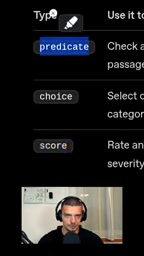
The video screenshot further emphasizes that a predicate is essentially a binary question and does not involve intermediate states. In engineering practice, such models are often used as a first-layer filter to quickly eliminate obviously violating or obviously permitted requests before handing them to more complex models.
The term predicate originates from logic and linguistics, referring to the part that asserts properties or relations of objects, with a result that is always true or false. In programming, predicates typically manifest as functions returning boolean values, such as is_safe(request). Common rule engines in engineering (such as Drools, JSON Logic) and policy languages (such as OPA/Rego) all take predicates as core building blocks: each rule is a conditional expression, and a match triggers an action. Abstracting business judgments as predicates allows direct mapping to the evaluation flow of these engines, achieving millisecond-level filtering, and rules can be versioned and audited—this is precisely why they are widely used in risk control and compliance checkpoints.
Choice Questions: The Classification "Which One"
Choice questions require the model to pick one answer from preset categories. For example, "Is this a billing issue, a technical issue, or a delivery issue?" The video calls this classification-style question a choice. Unlike predicates, choice questions are not limited to true/false but are multi-choice-one classification tasks. They are suitable for customer service ticket routing, content tagging, intent recognition, and similar scenarios.
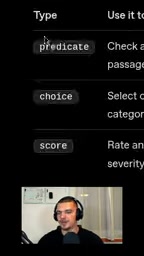
When implementing a choice model, the category set must be clearly defined in advance; otherwise, the model cannot give valid answers. The examples mentioned in the video cover common business triage needs, demonstrating that such models are very practical in operational automation. Note that choice questions by default assign each sample to only one category; if multi-label situations exist, they need to be split into multiple predicate questions or introduce more complex structures.
Choice questions correspond in machine learning to single-label multi-class classification tasks, whose output space is a set of mutually exclusive categories. Common implementations include logistic regression, naive Bayes, gradient boosted trees, and embedding-based nearest neighbor classifiers; in LLM scenarios, the output is constrained to enumerated values via prompts. The key engineering constraint is that the category system must be closed and complete—if a new category not covered by the training set appears, the model can only force it into a known class, leading to misrouting. Therefore, practical systems often set an "other/unknown" fallback class and pair it with a confidence threshold, routing to human handling when below the threshold. Multi-label scenarios (where one sample can belong to multiple categories simultaneously) require sigmoid multi-output or splitting into multiple independent binary classifiers.
Score Questions: The Degree "How Strong"
Score questions output a numerical value to measure the strength of some attribute. Examples given in the video include "How positive is this message?" "How dangerous is this request?" Score models are suitable for sentiment analysis, risk scoring, priority ranking, and other scenarios requiring continuous values. Compared with predicates and choices, score models retain more information but are also more susceptible to threshold settings—how many points count as "dangerous" often needs to be determined based on business experience.
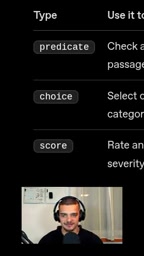
The three types of models are not mutually exclusive. Common combinations in practical systems: first use a predicate model to intercept obviously unsafe requests, then use a choice model to classify business types, and finally use a score model to prioritize the remaining requests. The video author emphasizes that these models were designed with the intent of "quick answers to simple questions," so do not expect a single model to solve complex reasoning; keeping model responsibilities single actually makes them easier to maintain and explain.
Score questions correspond to regression tasks or ordinal classification. In sentiment analysis, continuous scores from -1 to 1 or 1-5 star ratings are commonly used; risk scoring is often mapped to a 0-100 risk score. Unlike classification, score models output ordinal or continuous values, so evaluation metrics focus on MAE, RMSE, or Spearman correlation coefficient rather than accuracy. Threshold setting is the difficult part of deployment: usually the optimal point is selected based on business cost curves (such as the cost ratio of false interception versus missed release) rather than simply taking the median. Additionally, scores often need calibration so that they can be interpreted as probabilities or stable quantiles, facilitating cross-model and cross-time comparisons.
How to Choose the Right Decision Model
The key to deciding which type of model to use is the form of the business question itself. If the answer has only two possibilities with clear boundaries, prioritize the predicate model; if classification from limited categories is needed, use the choice model; if quantifying degree or ranking is needed, use the score model. The video does not elaborate on specific implementation technologies, but from the description, these models can correspond to rule engines, traditional machine learning classifiers, or lightweight AI interfaces; selection requires weighing accuracy, latency, and interpretability.
For AI application developers, understanding these three question paradigms helps break down vague business requirements into executable model tasks. For example, "determine whether a user review is negative" can be split into a predicate question (is it negative) plus a score question (degree of negativity), serving different downstream actions respectively. This decomposition thinking is more controllable than directly calling a large model to make all judgments, and it is easier to locate problems.

Overall, the concept of decision models is not complex, but the classification is clear and highly practical. Although the video content is brief, it points out the common foundation of rule-based AI and classification-based AI: first think clearly about which kind of question you want to ask, then choose the appropriate model form.
One-line Summary
Decision models fall into three types—predicate, choice, and score—answering yes/no, which category, and how strong, respectively.
Paragraph Summary
Based on a technical explainer video, the article summarizes decision models into three question paradigms: predicate questions output binary true/false results, suitable for hard rules such as safety detection and compliance checkpoints; choice questions pick one from preset categories, suitable for ticket routing and intent recognition; score questions output continuous values to measure degree, suitable for sentiment analysis, risk scoring, and priority ranking. The three types can be combined into a layered pipeline: first predicate interception of obvious anomalies, then choice classification, and finally score ranking. The article emphasizes keeping model responsibilities single and selecting by question form, and notes that this decomposition thinking is more controllable and maintainable than directly calling a large model to make all judgments.
Related articles
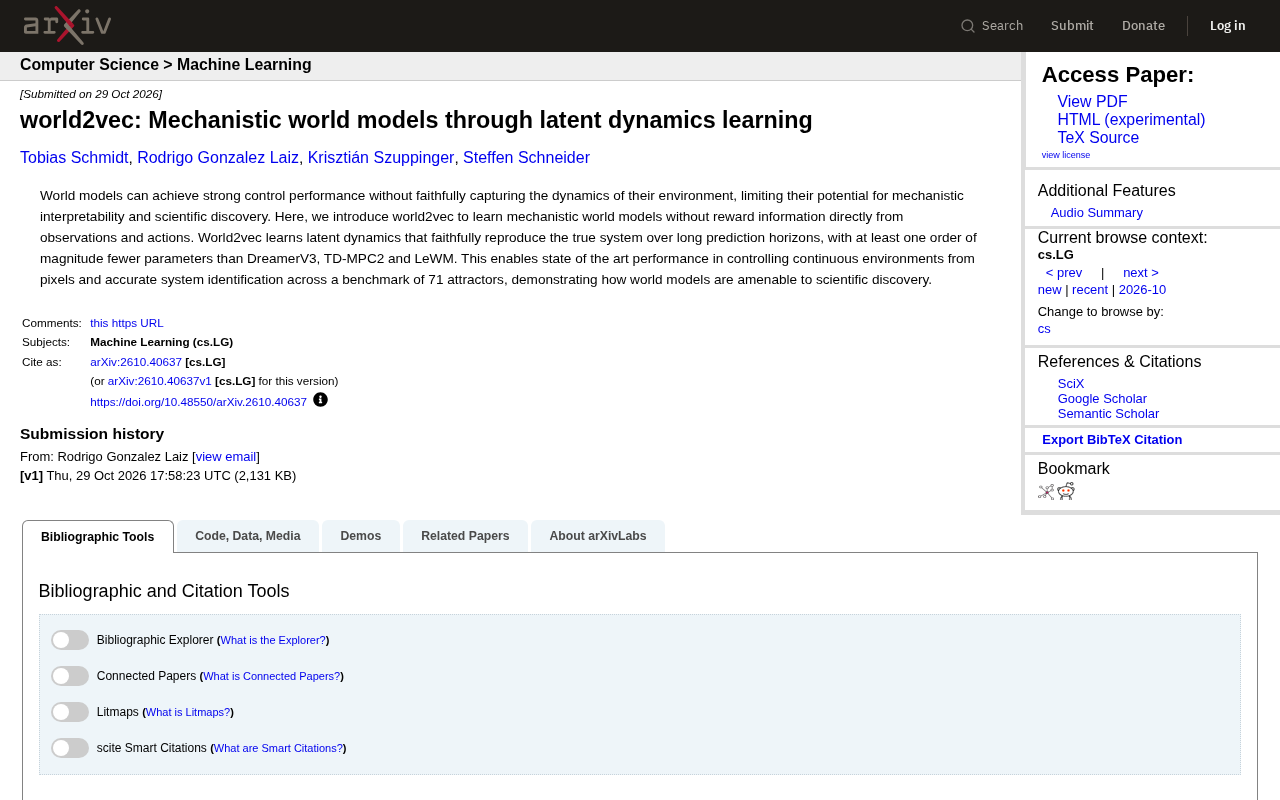
world2vec: Building Mechanistic World Models with Latent Dynamics Learning
world2vec proposes a reward-free method for learning mechanistic world models via latent dynamics, faithfully reproducing systems over long horizons with at least an order of magnitude fewer parameters than DreamerV3, TD-MPC2, and LeWM, and achieving accurate system identification on 71 attractor benchmarks.

A New KL-DRO Paradigm: Adaptive Scenario Generation Around a Learned Density Model
KL-DRO research proposes centering the KL ball on a learned density model instead of the empirical distribution, with adaptive scenario generation guiding sampling toward the worst case. Experiments show lower cost under distribution shift when records are scarce and the model can extrapolate, with comparable in-distribution cost.

ODE Samplers for Discrete Diffusion Models: Exponential Residual Flows Accelerate Generation
Discrete diffusion models lack deterministic ODE sampling? This article introduces Exponential Residual Flows (ERFs), which introduce continuous residual variables per token to construct piecewise ODEs for deterministic sampling and support consistency distillation acceleration. Superior to prior methods on code and text generation tasks.