What Are Large Language Models? A Deep Dive into Parameters, Models, and the Essence of AI LLMs

A systematic breakdown of AI large models through models, parameters, and training data.
This article explains the essence of AI large models from fundamental concepts. A model is a simplified representation of the complex world, mapping real-world information through high-dimensional vectors. Parameters (weights and biases) determine a model's expressive power. The "large" in large models encompasses three dimensions: massive parameters, massive training data, and massive computation. The article also covers Transformer architecture, SFT and RLHF alignment techniques, and provides practical model selection advice for developers.
Many people talk about large models every day, yet few can give a clear definition. What exactly is a large model? To answer this question, we need to break down what "model" and "large" each mean in "large model." This article starts from the most fundamental concepts to help you truly understand the essence of AI large models.
What Is a Model? — A Simplified Representation of the Complex World
To understand large models, you first need to grasp the concept of a "model." In fact, models are everywhere in our daily lives:
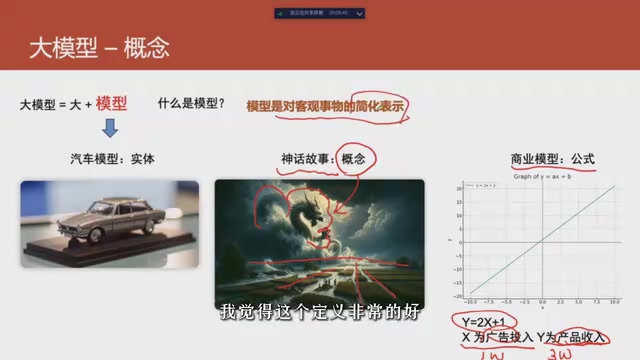
- A car model is a scaled-down replica of a real car
- Mythological stories are conceptual explanations of natural phenomena (e.g., "the Dragon King is angry" to explain floods)
- Mathematical formulas like
y = 2x + 1are abstract descriptions of the relationship between advertising spend and product revenue
These seemingly unrelated things share a common essence: a model is a simplified representation of objective reality.
Why do we need simplification? Because the real world is overwhelmingly complex. Just describing a "person" involves countless dimensions — gender, age, height, education, appearance, voice — and can even be broken down to the number of pores or the length of fingernails. To map this complex information into the computer world, we need a simplified representation — in deep learning, this typically exists in the form of high-dimensional vectors.
A high-dimensional vector is simply an ordered list of numbers, such as [0.2, -0.5, 0.8, 0.1]. "High-dimensional" means this list is very long, potentially containing hundreds or even tens of thousands of numbers. In natural language processing, this technique is called Word Embedding, first popularized at scale by Google's Word2Vec model released in 2013. The core idea behind word embeddings is: semantically similar words are close to each other in vector space. For example, the vector distance between "king" and "queen" is much shorter than between "king" and "apple." Even more remarkably, vectors can be used in arithmetic — the classic example being "king - man + woman ≈ queen." This method of transforming discrete text into a continuous numerical space allowed computers to truly "understand" semantic relationships for the first time.
Parameters: The Key to Describing a Complex World
From Simple Formulas to Massive Parameters
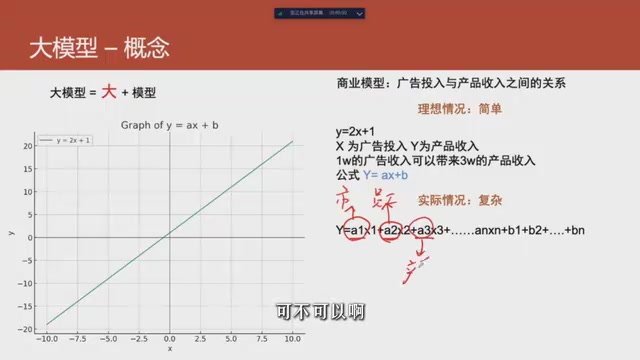
Let's return to the advertising spend and product revenue example. In an ideal scenario, y = ax + b (where a=2, b=1) could describe the relationship with just two parameters. But reality is far more complex — product revenue depends not only on advertising spend but also on weather, market conditions, employee motivation, product popularity, geographic location, and many other factors.
Two parameters are clearly insufficient. So we introduce more:
- a1, a2, a3... correspond to weights for different dimensions
- b1, b2, b3... serve as biases, ensuring results aren't distorted by noise
Whether weights or biases, they are collectively called parameters. The more parameters a model has, the richer the real-world details it can capture.
From a mathematical intuition standpoint, weights determine the importance of input signals — the larger the weight, the greater the influence of that input factor on the final result. Biases function like a "baseline," allowing the model to output a non-zero value even when all inputs are zero, thereby increasing model flexibility. In neural networks, each neuron in every layer has its own weights and biases. Take a simple three-layer neural network as an example: if the input layer has 100 nodes, the hidden layer has 200 nodes, and the output layer has 10 nodes, just the connections between the first and second layers alone account for 100×200=20,000 weight parameters, plus 200 biases. As networks grow deeper and wider, the parameter count explodes — this is the fundamental reason why deep learning models routinely have billions of parameters.
Parameter Count Determines Expressive Power
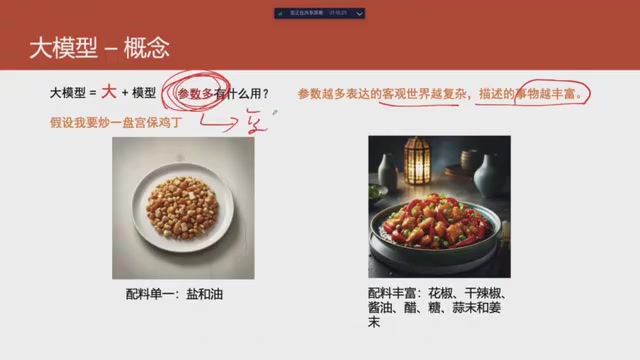
Some might ask: is more always better? Here's a vivid analogy — cooking Kung Pao Chicken with just salt and oil will technically work, but adding Sichuan peppercorns, dried chilies, soy sauce, vinegar, sugar, minced garlic, and minced ginger makes the flavor far richer.
Parameters function like these seasonings — they collectively express the complexity of the objective world. Take the Chinese character for "cat" as an example. In its vector representation, each dimension describes a different meaning:
- One position might represent "is an animal"
- Another represents "relationship with dogs"
- Yet another might represent "to crouch (verb)" or "a certain brand"
Vector dimensions vary greatly across models:
| Model | Vector Dimensions |
|---|---|
| GPT-3.5 | 12,288 dimensions |
| OpenAI Embedding Model | ~1,288 dimensions |
| Qianfan Platform | 648 or 684 dimensions |
The longer the dimension, the stronger the expressive power — but the computational cost also increases.

What Makes Large Models "Large"?
Exponential Growth in Parameter Scale
With an understanding of parameters, the "large" in "large model" becomes easy to grasp — "large" primarily means a massive number of parameters. Let's look at the parameter growth trend in the GPT series:
| Model | Parameters |
|---|---|
| GPT-1 | 110 million (0.11B) |
| GPT-2 | 1.5 billion (1.5B) |
| GPT-3 | 175 billion (175B) |
From 110 million to 175 billion — an exponential increase. Among open-source models, the largest version of the LLaMA series reaches 70B (70 billion parameters), which is also a considerable scale.
The underlying architecture of the GPT series is the Transformer, proposed in the landmark 2017 paper "Attention Is All You Need" by a Google team. The core innovation of the Transformer is the Self-Attention mechanism, which allows the model to attend to all other words in a sentence simultaneously when processing any given word, unlike previous Recurrent Neural Networks (RNNs) that had to process words sequentially. This parallelized design not only dramatically improved training efficiency but also enabled the model to capture long-range semantic dependencies. GPT (Generative Pre-trained Transformer) uses the decoder portion of the Transformer, pre-training by "predicting the next token." From GPT-1 to GPT-3, the model architecture itself didn't fundamentally change — the main improvements came from scaling up parameters and training data. This validates the Scaling Law: within a certain range, model performance continues to improve as parameter count and data volume increase.
A key number worth remembering: GPT-3 has 175 billion (175B) parameters. This figure is frequently referenced in industry discussions and serves as an important benchmark for measuring large model scale.
More Parameters ≠ The Whole Story of Large Models
But is having many parameters enough? The answer is no. More parameters only provide the capacity to express a complex world, but the model must also learn sufficient knowledge to truly understand that complexity.
This brings us to the scale and quality of training data. Large model training data typically comes from publicly available text on the internet, including web pages, books, academic papers, code repositories, Wikipedia, and more. For GPT-3, the training dataset contained approximately 499 billion tokens (roughly understood as words or word fragments), sourced from Common Crawl (filtered web data), WebText2, Books1, Books2, and English Wikipedia. In terms of computation, training GPT-3 consumed approximately 3,640 PetaFLOP/s-days of compute, using thousands of NVIDIA V100 GPUs, with estimated training costs between $4.6 million and $12 million. This is why the barrier to developing large models is extremely high — requiring not only top-tier algorithm teams but also massive hardware investments and power consumption. OpenAI CEO Sam Altman has revealed that GPT-4's training cost exceeded $100 million.
So the "large" in large models actually encompasses three layers of meaning:
- Large parameter scale — the model has sufficient capacity
- Large training data — the model has sufficient knowledge sources
- Large computation — training requires enormous computational resources
All three are indispensable, collectively forming what we call "large models" today.
Large Models: Being "Smart" and "Learning Bad Habits"
An interesting phenomenon: the more parameters a model has, the smarter it becomes — but it learns bad things just as easily as good things.
During training, large models learn virtually all publicly available knowledge on the internet — the good and the bad. What we do with Prompts isn't fundamentally "teaching" the model anything new; rather, it's awakening the model's memory of existing knowledge. The model itself doesn't inherently know what it should or shouldn't say.
This is also why you can find various cases on GitHub of people "jailbreaking" GPT into inappropriate personas. For open-source model usage, it's recommended to choose SFT (Supervised Fine-Tuning) versions — models that have undergone supervised fine-tuning. These models have been optimized for specific domains, producing more stable and reliable outputs.
It's worth understanding that SFT is only the first step in making large models "controllable." OpenAI also introduced RLHF (Reinforcement Learning from Human Feedback) in ChatGPT. The RLHF process works as follows: the model first generates multiple responses to the same question, human annotators rank these responses, these rankings train a "reward model," and finally a reinforcement learning algorithm (such as PPO) teaches the large model to generate responses humans prefer. It's the combination of SFT + RLHF that enabled ChatGPT's qualitative leap from "powerful but uncontrollable" to "both smart and well-behaved" — this is also known as Alignment — aligning the model's behavior with human values and intentions.
Practical Advice for Developers: How to Choose the Right Large Model
For regular developers, you don't necessarily need to pursue the largest parameter count when using open-source models. With LLaMA, for example, the 7B version already performs well on most common tasks with excellent cost-effectiveness. Core principles for model selection:
- Task-matching first: Choose the appropriate parameter scale based on your actual use case
- Prefer fine-tuned versions: SFT versions are more stable in practice than base models
- Balance performance and cost: Larger parameters mean higher inference costs — don't blindly chase scale
Once you understand the two core concepts — "a model is a simplified representation of the complex world" and "'large' refers to a quantum leap in parameter scale" — you've grasped the most essential meaning of large models. When you move on to advanced topics like RAG, LangChain, and AI Agents, this foundational understanding will help you better comprehend the entire AI technology ecosystem.
Simply put, the relationship between these technologies can be understood as follows: The large model is the "brain," RAG is the "reference book," LangChain is the "development toolbox," and AI Agent is the "autonomous individual capable of taking action." RAG (Retrieval-Augmented Generation) retrieves relevant documents from external knowledge bases before generating answers, solving the problems of outdated knowledge and "hallucinations" (fabricating facts) in large models. LangChain is an open-source framework for building large model applications that packages common needs like prompt management, chain calling, memory management, and tool integration into standardized components, significantly lowering the development barrier. AI Agents take large models beyond just "talking" to "doing": through planning, reasoning, and calling external tools (such as search engines, code executors, and API interfaces), they autonomously complete complex tasks. Mastering the foundational concepts in this article gives you a solid foundation for exploring these cutting-edge directions.
Key Takeaways
- The essence of a model is a simplified representation of objective reality, mapping complex real-world information to the computer world through high-dimensional vectors
- The "large" in large models is primarily reflected in parameter scale — GPT-3 has 175 billion parameters; more parameters mean greater capacity to express world complexity
- Weights and biases are collectively called parameters, analogous to cooking seasonings — the richer they are, the more precisely they describe the real world
- The essence of prompting is awakening the large model's existing knowledge memory, not teaching it new information
- When using open-source models, choose SFT (supervised fine-tuned) versions; 7B parameter scale can meet most common task requirements
Related articles
Deep Dive into AI Agent Skill Design: …
Deep Dive into AI Agent Skill Design: Engineering Practices from Anthropic and Perplexity
A deep dive into Skill design philosophy from Anthropic's Claude Code team and Perplexity's Agent team, covering the Tax Test, Gotchas Flywheel, progressive disclosure, and Eval-First practices for building high-quality AI Agent skill systems.
Deep Dive into OpenAI's Official GPT-5…
Deep Dive into OpenAI's Official GPT-5.6 Prompting Guide: The Shift from Manual to Automatic
A deep dive into OpenAI's official GPT-5.6 Sol prompting guide: conciseness-first, outcome-oriented design, autonomy boundaries, tool routing, and reasoning intensity tuning.
 Deep Dives
Deep Dive into How OpenClaw (Open-Source Crayfish) AI Agent Works
Deep analysis of OpenClaw AI Agent internals: System Prompt, tool calling, SubAgents, Skill system, memory, and Context Engineering explained.