What Does "Safety" Really Mean in Robot Learning? Reflections from CoRL 2026

Over 50 safety papers at CoRL 2026 show safety is becoming a day-one co-design property of robot systems.
Based on a researcher's Reddit observations after browsing 600+ accepted CoRL 2026 papers, the article notes that beyond the surge of VLA models, safety appears frequently in concrete forms—collision avoidance, humanoid dynamic balance, safe crowd navigation, robustness to missing sensors, and policy safety action boundaries—with over 50 related papers. The author asks what lies between a model "knowing what to do" and a robot "safely executing," concluding it is a full stack of co-design from hardware and control stack to policy layer. CMU's Pixel platform, using commercial arms under $15,000 to convert UMI human demonstrations into collision-aware whole-body behaviors, gains credibility from its honesty about robot data corrections. The conclusion: safety is shifting from an end-of-project checklist item to a system-level design premise.
Safety Is No Longer an After-the-Fact Check, but a Design Premise
A researcher preparing to attend CoRL 2026 shared on Reddit his observations after browsing through more than 600 accepted papers: VLA (vision-language-action) models appeared in large numbers as expected, but what truly surprised him was how frequently "safety" showed up in extremely concrete forms—over 50 papers related to safety, most of them tackling practical problems such as collision avoidance, humanoid balance maintenance, safe navigation among crowds, robustness under missing sensor data, and preventing learned policies from executing unsafe actions.
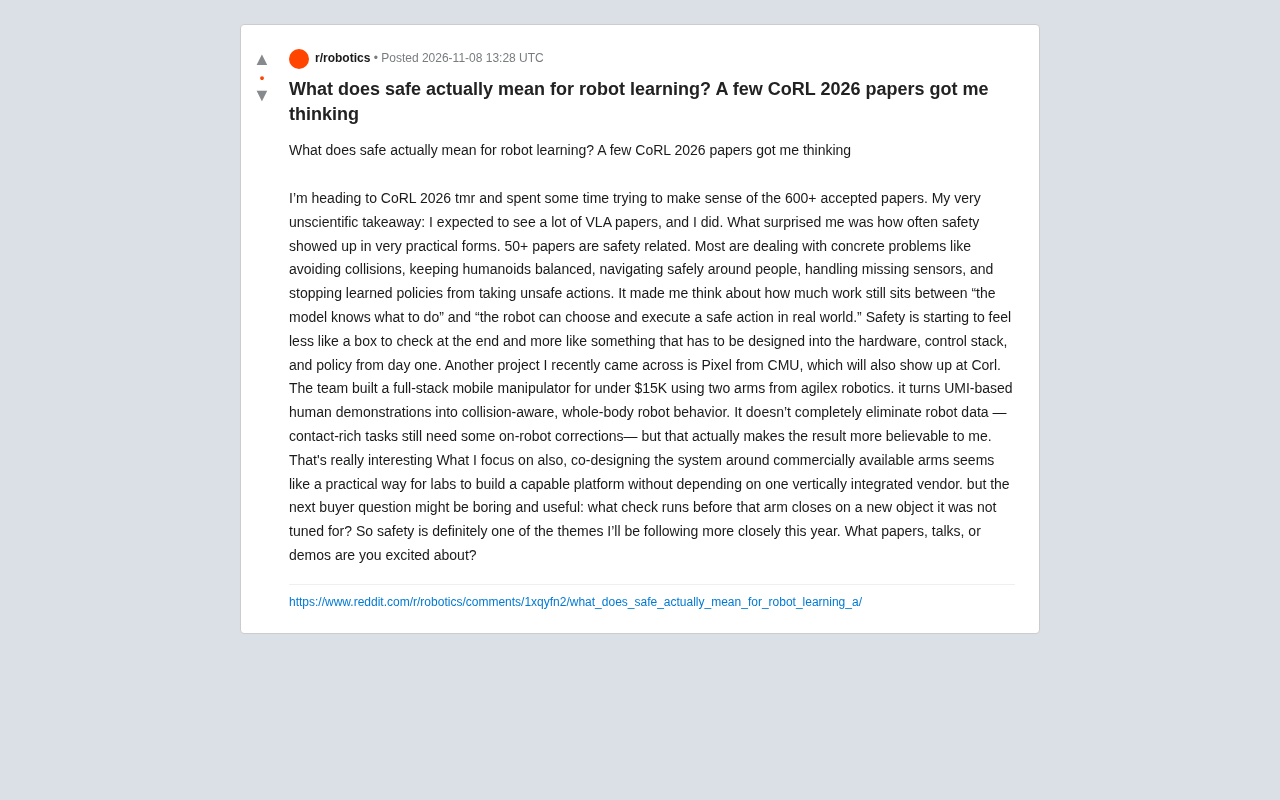
This observation touches on a question that is widely discussed but rarely answered systematically: between a model "knowing what to do" and a robot "being able to safely select and execute actions in the real world," exactly how much engineering and design work lies in between? Judging from the distribution of these papers, the answer may be: an entire stack of co-design spanning hardware, control stack, and policy layer.
VLA (vision-language-action) models are a class of embodied intelligence architectures that unify visual perception, natural language instructions, and robot action generation into a single model. A typical approach uses a pretrained vision-language model as the backbone, encodes language instructions and camera images into multimodal representations, and then decodes them through an action head into end-effector poses, joint targets, or discrete action sequences. Their advantage lies in leveraging internet-scale image-text pretraining to achieve semantic generalization, enabling robots to understand open-ended instructions like "put the red cup to the left of the sink"; the cost is that action outputs lack formal safety guarantees and may generate physically infeasible or dangerous commands in out-of-distribution scenarios—which is precisely the root of the "policy-layer safety" problem highlighted in this article.
Three Concrete Battlegrounds of Safety
Collisions and Physical Constraints
Collision avoidance is the most intuitive category among safety papers. Whether robotic arm grasping or mobile manipulation, the system needs to predict and exclude trajectories that would lead to physical contact risks before action execution. The difficulty in this line of work is not collision detection itself, but making learned policies internalize collision constraints as part of action selection during inference, rather than relying on an external emergency-stop module.
Humanoids and Dynamic Balance
The safety challenge for humanoid robots lies in dynamic stability. Maintaining balance is not static posture maintenance, but continuous adjustment under perturbations, terrain changes, and contact uncertainty. Related papers focus on how to enable learned control policies to still make safe responses when approaching the boundary of instability, which requires safety mechanisms to be deeply coupled with control frequency and state estimation accuracy.
Missing Sensors and Policy Safety Boundaries
In real deployments, sensor dropouts, occlusions, or noise are the norm. Some papers specifically address the problem of "how not to make dangerous actions when perceptual inputs are missing," while others attempt to define safe action sets for learned policies, preventing them from outputting high-risk commands under out-of-distribution states.
Out-of-distribution states refer to perceptual or state inputs encountered during robot operation that significantly deviate from the training data distribution—for example, sudden lighting changes, unseen objects, temporary sensor failure, or abnormally close human-robot distances. Learned policies often exhibit overconfident erroneous outputs in out-of-distribution states, and errors accumulate and amplify through closed-loop execution, so simply increasing model capacity does not bring safety guarantees. Common engineering responses include: using uncertainty estimation or anomaly detection to identify out-of-distribution inputs at inference time and trigger degraded strategies, using safety filters to project or clip policy outputs, and introducing domain randomization during training to expand the policy's robust operating domain.
CMU's Pixel: Safety Lessons from a Low-Cost Platform
The original poster also mentioned CMU's Pixel project—a full-stack mobile manipulation platform based on two AgileX Robotics arms with a total cost under $15,000, which will also appear at CoRL. Its core idea is to convert UMI-based human demonstrations into collision-aware whole-body robot behaviors, rather than relying entirely on robot data collection.
One detail worth noting: the author specifically points out that Pixel does not completely eliminate robot data—contact-intensive tasks still require corrections on the robot—but it is precisely this that makes the results more credible. This honesty actually strengthens the work's persuasiveness and suggests a pragmatic path: using commercial robotic arms for co-design, so that labs can build capable platforms without being locked into a single vertically integrated vendor.
The author then poses a seemingly boring but extremely practical question: when this robotic arm goes to grasp a new object it has never been tuned for, what checks does it perform before closing? This question pulls safety from paper metrics back to the deployment site—the buyer's next question is often not how powerful the model is, but how the system provides a fallback when facing unseen situations.
UMI (Universal Manipulation Interface) is a handheld data collection paradigm: an operator holds a lightweight device equipped with a gripper and camera to complete demonstrations, and the system converts human hand trajectories into robot-executable end-effector trajectories through visual localization and motion reconstruction, thereby bypassing expensive teleoperation equipment and real-robot teaching. Its key value lies in low data collection cost and strong scene diversity, but when converting to robot behaviors, it must handle kinematic feasibility, collision constraints, and differences in contact dynamics—which is why Pixel emphasizes "collision-aware whole-body behavior conversion."
From "Checklist Item" to "Designed from Day One"
Synthesizing the observations from the original thread, a trend judgment gradually becomes clear: safety is shifting from a checkbox at the end of a project to a design dimension that must be embedded from day one into hardware selection, control stack, and policy training. The existence of over 50 safety-related papers shows that the community has recognized that an after-the-fact safety layer cannot compensate for a policy's inherent unsafe tendencies, nor can it replace physical constraint design at the hardware level.
The implication for researchers and engineering teams is: safety is not the responsibility of a single module, but a system-level property. Collision awareness needs to enter the demonstration data conversion pipeline, balance constraints need to enter the training objectives of control policies, and safe action boundaries need to be jointly modeled with perceptual uncertainty. The author says he will continue to follow this topic this year, and also asks the community: which papers, talks, or demos are you most looking forward to?
(This article is based on a single-source conference observation from Reddit; the paper counts and project details cited are all from the original thread and have not been independently verified.)
Safety filters are a class of runtime assurance mechanisms in control and robotics, positioned between the learned policy and the low-level controller, performing online corrections to the policy's desired actions so that they satisfy hard constraints such as collision, joint limits, torque, or stability. Typical methods include control barrier functions and safety-set projection based on reachability analysis. The difference from "external emergency stop" is that safety filters solve a constrained optimization at every control cycle, minimizing modifications to the policy while preserving task intent as much as possible, thereby turning safety from a discrete switch action into a continuous action-space constraint.
Related articles

Hermes Agent Beginner's Guide: Hands-On with a Self-Evolving AI Agent
A beginner's guide to Hermes Agent, the open-source self-evolving AI agent that gained 41.7K GitHub stars in two months—covering Harness Engineering, the learning loop, three-layer memory, WSL installation, and hands-on configuration.

AI Agent in Action: Building a Smart Office Assistant with WorkBuddy
A practical case study shows how Tencent WorkBuddy batch-converts and archives files, compares chat LLMs with AI Agents, and analyzes WorkBuddy's credit system, use cases, and positioning for office automation selection.

From Single-GPU Bottlenecks to Hundreds of Billions of Parameters: 6 Key Questions in Large Model Distributed Parallelism
Based on a Bilibili tutorial, this article organizes core knowledge of large model distributed parallelism: starting from decoder-only architecture's token-by-token generation and the essence of X times W computation, it analyzes six key questions including data parallelism, tensor parallelism, and pipeline parallelism under single-GPU bottlenecks. Suitable for learners in private deployment and model training scenarios to build systematic understanding.