What Industrial Robots Teach AI: Reliable Execution Is the Real Barrier

Standard Bots uses demonstration learning plus deployment correction to prove AI reliability matters more than model capability.
Standard Bots' industrial robot AI tech stack shows a path different from mainstream AI: using pretrained models to learn from human demonstrations, then continuously improving through operator correction feedback in real deployments. This approach focuses on reliable execution rather than capability ceilings—pushing failure rates from 1% to one in ten thousand. The closed-loop methodology is transferable to AI coding assistants, intelligent customer service, and other general applications.
Industrial robots have near-obsessive demands for "reliability"—a single failure can mean a halted production line, scrapped parts, or even a safety incident. The AI tech stack at Standard Bots offers an interesting case study: they use pretrained models to learn factory tasks from demonstrations, then continuously improve through error-correction feedback from real deployments. For an AI industry currently obsessed with chasing model capabilities, this approach may be a sobering dose of reality.
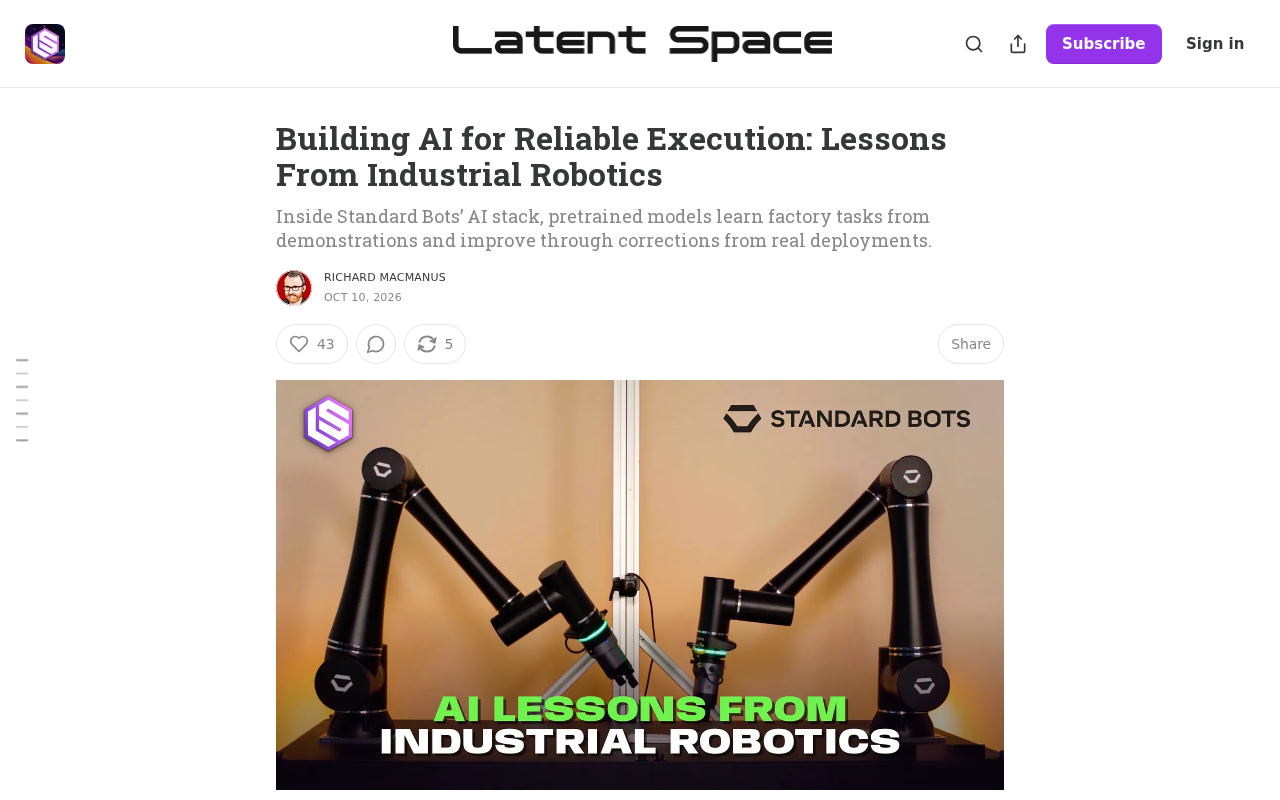
Learning From Demonstration: Letting Robots "See" Rather Than "Compute"
Traditional industrial robots rely on precise programming: every grasp, movement, and placement action requires engineers to manually write trajectories and parameters. Once a workpiece shifts position or changes shape, the entire program may fail.
Standard Bots takes a different path. According to information disclosed about their AI tech stack, they use pretrained models to let robots learn tasks from human demonstrations. This means operators complete tasks through teaching, and the model extracts generalizable operational strategies rather than memorizing hardcoded coordinate sequences.
The advantage of this approach is strong adaptability. In factory environments, part placement angles, lighting conditions, and conveyor speeds can all fluctuate. Demonstration learning gives the model a degree of generalization ability, reducing dependence on perfect conditions.
The takeaway for the AI industry: rather than chasing benchmark high scores in simulated environments, let models learn "good enough and robust" strategies from real task demonstrations. Industrial scenarios don't care about model parameter counts—only task success rates.
Imitation learning and behavior cloning are the technical foundations of demonstration learning. Imitation Learning refers to agents learning policies by observing expert demonstrations, rather than relying on hand-designed reward functions. The most direct approach is Behavior Cloning: training models using state-action pairs from demonstrations as supervisory signals. But behavior cloning has a classic flaw—the distribution shift problem: once the model enters states not covered by demonstration data during inference, errors accumulate progressively and lead to task failure. In industrial scenarios, this is often the root cause of grasp slippage or path deviation. To address this, researchers proposed methods like DAgger (Dataset Aggregation), where experts provide corrective annotations for deviation states during model execution. This aligns precisely with Standard Bots' deployment correction mechanism—front-end imitation learning provides the initial policy, while back-end correction feedback continuously fixes distribution shift.
Deployment Correction: Real Feedback Drives Iteration
More noteworthy is the second layer of mechanism: improving models through error correction in real deployments.
This is essentially a continuous learning loop. When robots encounter failures during actual operation—such as grasp slippage or path deviation—operators intervene to correct them. This correction data flows back into the model training pipeline, progressively improving handling of edge cases.
This approach isn't unprecedented in industrial settings, but Standard Bots' way of combining it with pretrained models deserves attention. Pretraining gives the model baseline capabilities, while deployment correction solves the "last mile" problem: those long-tail situations that can't be imagined in the lab and only emerge on real production lines.
Many AI teams stop iterating once models go live, or rely on offline data for periodic retraining. Industrial robot practice shows that the value of online correction feedback far exceeds expectations, especially when task fault tolerance is extremely low.
Continual Learning faces a core challenge: catastrophic forgetting. When models update on new data, they may overwrite previously learned capabilities. Correction data in industrial settings is naturally imbalanced—large amounts of normal operation samples plus a small number of correction samples. If directly fine-tuned, models tend to overfit to correction examples while sacrificing general performance. In practice, techniques like replay buffers to retain historical samples, Elastic Weight Consolidation (EWC) to constrain important parameter updates, or parameter-efficient fine-tuning (like LoRA) are commonly used to mitigate this. Additionally, there's latency between correction signals and model updates—production lines can't stop to wait for training to complete. Therefore, engineering mechanisms like shadow deployment, A/B testing, and hot model switching are needed to ensure update safety and rollback capability. These details determine whether the "deploy-correct-improve" loop can actually work on real production lines.
Reliable Execution: The Underrated Dimension of AI Capability
Current AI discussions focus heavily on model capability ceilings—stronger reasoning, larger contexts, fewer hallucinations. But industrial robots remind us that reliable execution is an independent and equally critical dimension.
A model with 99% task success rate sounds good. But on a production line executing thousands of times daily, a 1% failure rate means a dozen-plus failures every day. Industrial scenarios demand 99.99% or higher.
Closing those last few percentage points doesn't rely on stronger model architectures, but on systematic engineering investment: demonstration data quality, correction mechanism design, failure case root-cause analysis, and coordination between model updates and production line operations.
This has direct reference value for AI application developers. Whether you're building an AI coding assistant, intelligent customer service, or automation workflow tool, the "demonstration learning + deployment correction" loop approach can be borrowed—first let the system build baseline capabilities from human demonstrations, then continuously refine through feedback from real usage.
From a reliability engineering perspective, the gap between 99% and 99.99% isn't a linear improvement—it requires systematic Failure Mode and Effects Analysis (FMEA). Industrial settings commonly use MTBF (Mean Time Between Failures) and MTTR (Mean Time To Repair) to measure system reliability, and minimize the impact of single points of failure through redundancy design, anomaly detection, and graceful degradation strategies. For large model applications, this means introducing confidence calibration, output validation, and human fallback mechanisms, rather than simply pursuing model metrics. Treating reliability as a system property that can be engineered and decomposed—rather than a quality expected to emerge from models on its own—is the most important cognitive transfer from industrial robot practice to the AI industry.
From Factory to General: Transferable Methodology
Standard Bots' practice reveals an often-overlooked fact: industrial robots and today's large model AI applications face the same class of engineering challenges—how to maintain stable output in uncontrollable real environments.
The factory's answer is: don't pursue one-step perfection, but establish a "deploy-correct-improve-redeploy" cycle. Each cycle doesn't require dramatically improving model capabilities—just solving currently exposed problems. Accumulating small gains, reliability gradually approaches production requirements through iteration.
The value of this methodology lies in its universality. It doesn't depend on specific model architectures or training techniques, but is an engineering process. For any team pushing AI into real production environments, this is experience worth taking seriously.
The next phase of AI industry competition may not be about whose model is smarter, but about who can achieve industrial-grade reliability.
One-line Summary
Standard Bots uses demonstration learning plus deployment correction to prove that AI reliability matters more than model capability.
Paragraph Summary
Standard Bots' industrial robot AI tech stack demonstrates a path different from mainstream AI development: using pretrained models to learn tasks from human demonstrations, then continuously improving through operator correction feedback in real deployments. This approach doesn't chase model capability ceilings, but focuses on reliable execution—pushing failure rates from 1% down to one in ten thousand across thousands of daily operations. The article points out that industrial scenarios' demanding reliability requirements reveal an underrated dimension of the current AI industry: a 99% success rate means a dozen-plus failures daily on a production line. Demonstration learning provides a generalization foundation, deployment correction solves long-tail scenarios, and the closed-loop methodology formed by both can be transferred to general applications like AI coding assistants and intelligent customer service.
Related articles

Gemini 4 Argon Hands-On: AI Builds Board Games, Constructs Temples, and Trains Robots Autonomously
Gemini 4 Argon hands-on roundup: AI autonomously builds a desk racetrack and temple in Blender, writes a ray tracing engine, trains a humanoid robot to sink 7 shots, plus API pricing and developer access.

The Magic Octagonal Coin: Why Only 9% of People Can Predict Its Flip?
Only 9% of people can correctly predict the Magic Octagon coin flip. This article explains its spatial rotation mechanism, common cognitive pitfalls, and a new hypothesis based on Relevance Theory, exploring the limits of human spatial reasoning.

Sam Altman: AI Is Entering the Era of Scientific Discovery — Math Breakthroughs Will Replicate in Biology and Energy
Sam Altman says AI is entering the era of scientific discovery — math breakthroughs will replicate in biology, materials science, and energy to help develop new drugs and energy sources.