What Is an FDE (Forward Deployed Engineer)? A Deep Dive into AI's Newest Role

FDEs embed directly at client sites to bridge the gap between powerful AI models and real business needs.
FDE (Forward Deployed Engineer) is a new role born from the AI deployment wave. FDEs embed on-site at client organizations, observe real workflows, and build fully custom AI solutions from scratch. The role exists because most enterprises lack the engineering capability to apply large models to their specific needs, while off-the-shelf SaaS products fall short. Unlike classical software delivery, FDE operates on a first-principles approach centered entirely on client needs — and its most critical skill is requirement convergence: preventing vague wishlist thinking and avoiding the AI-generated spaghetti code that results from it.
The New Species of the AI Era: What Does an FDE Actually Do?
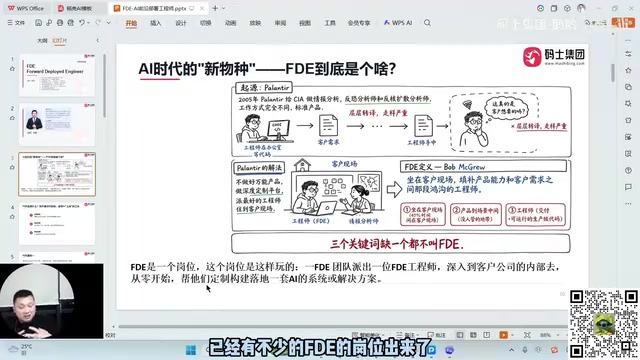
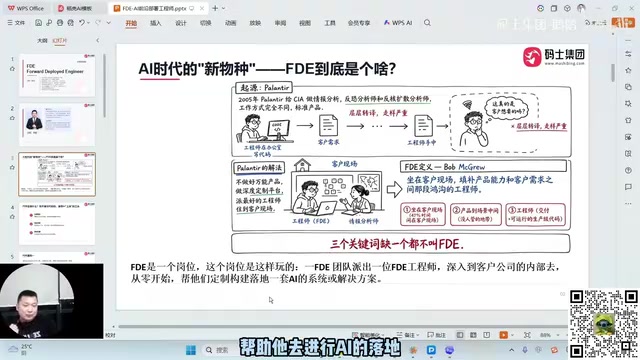
FDE (Forward Deployed Engineer) is quietly gaining traction both globally and in China. At its core, it's not a technology — it's a clearly defined role. A dedicated team or engineer embeds directly at a client's site to help enterprises design, build, and deploy a complete AI system or solution from scratch.
Unlike traditional software delivery models, FDE is defined by one key principle: go on-site. Engineers don't sit in an office taking remote requirements. They physically visit a client's headquarters or locations, observe real business workflows, develop a deep understanding of pain points, and then build AI solutions tailored to those specific scenarios. This model has already gained traction overseas, and FDE roles are now emerging in China as well — with dedicated companies offering FDE as a service.
Why Did the FDE Role Emerge?
The root cause is a glaring industry bottleneck: AI models keep getting more powerful, but enterprises can't actually put them to use.
Whether it's a new DeepSeekAd model or the latest releases from OpenAI and other leading Western labs, model capabilities are advancing rapidly. But for the vast majority of traditional enterprises, there's a gap between powerful general-purpose models and their actual business operations that feels impossible to bridge. These companies have a love-hate relationship with AI — they fear it will disrupt the real economy, yet they desperately want to use it to gain a competitive edge, and they have no idea how to actually integrate it into their business.
That's exactly the problem FDE is designed to solve: getting powerful AI capabilities to genuinely land in specific business scenarios, rather than staying stuck at the demo and concept stage.
A Concrete Example: The AI Deputy Store Manager for a Chain Brand
Consider a real-world scenario involving a chain bubble tea or coffee brand. Suppose a brand has a thousand stores nationwide and wants to use AI to improve performance and service quality — they could bring in an FDE team. After embedding in the headquarters and a selection of stores, the engineers might build a custom "AI Deputy Store Manager" system: one thousand stores, one thousand accounts, each with its own dedicated AI deputy manager.
This AI deputy manager isn't just a generic Q&A bot plugged into DeepSeek or OpenAI. It's deeply integrated with the company's own business operations. After closing time, a store manager can interact with it via text messages, photos, or even casual complaints. If a manager says "sales were bad today, foot traffic was low," the AI will ask about the weather, request photos of the surrounding area, and even pull in surveillance data from nearby cameras to help analyze the real reasons behind the performance dip. It tackles the core challenge of "AI that can't actually land in a business."
This gap between model capability and enterprise application is often called the "last-mile" problem in the industry. Large models perform impressively on general benchmarks, but real enterprise scenarios involve proprietary data, domain-specific terminology, complex internal approval workflows, and legacy IT system integrations — none of which a general-purpose model knows anything about. Techniques like RAG (Retrieval-Augmented Generation), fine-tuning, and Function Calling can help close this gap, but assembling these building blocks into a reliably functioning business system demands extensive engineering experience. Most traditional enterprises lack that AI engineering capability internally, and off-the-shelf SaaS products can't cover highly customized needs. FDE emerged precisely to fill this void.
The Fundamental Difference Between FDE and "Classical Software Development"
Traditional SaaS or software delivery is essentially: I sell you the software, you use it the way I designed it. This approach is sometimes called "classical programming" or legacy software delivery. FDE represents a complete inversion of that logic.
Every system and service should ultimately return to a first-principles question: does it meet the customer's needs? FDE operates around that principle. If you're a business owner who wants to use AI to gain a competitive edge and improve results, FDE goes directly and builds it for you — no detours, no standard packaged products. The solutions are almost always fully custom. What's built for Luckin Coffee is designed around Luckin's specific pain points and scenarios.

One real case involved an instructor working as an FDE embedded inside an education platform, rebuilding the backend and the entire learning platform. The resulting feature looked deceptively simple: a user could ask "which teacher should I learn Redis core practices from?" and the system, connected to the large model, would return a direct recommendation with a link to the course — along with aggregated Q&A from past learners about Redis learning and source-code courses. The feature isn't complex, but what matters is that it genuinely connects the large model to the business's actual content.
The Hardest FDE Skill: Turning Wild Ideas into Something Deliverable
The true value of an FDE lies in controlling the boundaries of requirements.
When working with clients, FDEs typically encounter two extremes. The first is "blank-mind" mode — a store manager or project owner has no idea what they want AI to do, so when you ask them, they can't tell you. The second is "everything-is-possible" mode — after getting a surface-level introduction to AI, they become convinced it can do anything, and their requests go wildly out of scope. In practice, many of those ideas simply cannot be implemented.
Why Vibe Coding Produces "Spaghetti Code"
This dynamic mirrors a familiar scenario for anyone who's used AI coding tools. When working with Claude Code, Codex, or similar tools, you can throw out ideas freely. The AI acts like an architect and hands you ten, twenty different approaches, then starts implementing them one by one — two hours on the first feature, three hours on the second, a week later you're sitting on a mountain of code.
The problem: every piece of code looks useful, but none of it is actually useful. None of it maps to what you really wanted to build or the actual scenario you had in mind. One solution covers 20% of your needs, another covers 30% — and 20% to 30% alignment is essentially the same as no alignment at all.
This is precisely where FDE earns its keep. It's not about letting AI stack up features freely. It's about deeply understanding the business first, then precisely converging requirements down to solutions that can actually be deployed and actually generate business value. This also explains why investors are paying attention: whoever can truly deliver powerful AI capabilities into the hands of enterprises is positioned to capture the next wave of value.
Vibe Coding is a concept introduced by OpenAI co-founder Andrej Karpathy in early 2025. It describes a mode of development where engineers rely almost entirely on AI assistance, rarely read or deeply understand the code, and simply describe what they want by "feel" — accepting whatever the AI outputs. Tools like Claude Code, Cursor, and Codex have made this workflow practical. The appeal is an extremely low barrier to entry: anyone can quickly spin up a working prototype. The downside is equally clear: when requirements are vague or sprawling, AI tends to over-deliver rather than be precise, generating large volumes of plausible-looking but tightly coupled, hard-to-maintain code modules. This is the direct counterpoint to the FDE principle of "requirement convergence" — Vibe Coding amplifies ambiguity in requirements, while the core value of FDE is eliminating that ambiguity before a single line of code is written.
Final Thoughts
FDE represents a shift in how AI gets deployed — moving away from selling standardized software toward embedding on-site, delivering custom solutions, and converging requirements with precision. At a moment when "models are powerful but enterprises can't use them" has become a universal bottleneck, the people who can bridge the gap between model capability and real business scenarios are becoming increasingly rare. For practitioners looking to enter the AI industry, FDE may be a direction worth watching closely.
Note: This article is based on content from a Bilibili course. The role definitions and case studies cited come from a single course source. Readers are encouraged to cross-reference with additional materials.
Related articles

Gemini 4 Argon Hands-On: AI Builds Board Games, Constructs Temples, and Trains Robots Autonomously
Gemini 4 Argon hands-on roundup: AI autonomously builds a desk racetrack and temple in Blender, writes a ray tracing engine, trains a humanoid robot to sink 7 shots, plus API pricing and developer access.

The Magic Octagonal Coin: Why Only 9% of People Can Predict Its Flip?
Only 9% of people can correctly predict the Magic Octagon coin flip. This article explains its spatial rotation mechanism, common cognitive pitfalls, and a new hypothesis based on Relevance Theory, exploring the limits of human spatial reasoning.

Sam Altman: AI Is Entering the Era of Scientific Discovery — Math Breakthroughs Will Replicate in Biology and Energy
Sam Altman says AI is entering the era of scientific discovery — math breakthroughs will replicate in biology, materials science, and energy to help develop new drugs and energy sources.