What Is Codex? A Complete Guide to OpenAI's AI Coding Agent and How It Differs from ChatGPT

Codex is OpenAI's AI coding agent that acts autonomously on code, complementing ChatGPT's conversational explanations.
Codex is OpenAI's AI coding agent built to get hands-on work done, not just chat. Unlike ChatGPT — which explains concepts and leaves users to copy-paste code themselves — Codex acts like a developer sitting beside you, autonomously reading projects, editing code, running tests, and reporting results. The article highlights a broader shift in development: from writing code by hand to directing AI to write it, with developers increasingly valued for their ability to define requirements and review AI output. Mastering tools like Codex, while retaining solid programming fundamentals, is key to staying competitive in the AI-assisted development era.
What Exactly Is Codex
Codex is an AI coding agent developed by OpenAI. Unlike a typical chat tool, its core purpose is to get work done for developers — not just answer questions.
The moment you hear "agent," it implies autonomous task execution. Codex doesn't just generate code — it can read code, understand project structure, fix bugs, run tests, execute commands, and run scripts. In other words, it covers most stages of a programming workflow, rather than operating purely at the conversation level.
For developers, the value of tools like this lies in offloading repetitive, mechanical coding tasks to AI — freeing you to focus on defining requirements and reviewing results. If you just want to chat casually and have AI generate a small snippet you can copy-paste yourself, tools like Doubao, DeepSeekAd, or ChatGPT are perfectly sufficient. But Codex is designed to be a hands-on programming assistant that actually does the work.
On a technical level, Codex runs inside a sandboxed cloud environment with its own file system and command-line access. This is fundamentally different from a regular chat window: it holds a real "workspace" where it can clone repositories, install dependencies, execute shell commands, and observe the output — just like a human developer would. This architecture is known as the combination of Tool Use + long-context reasoning — the model doesn't just predict text; it actively calls external tools (such as a terminal or file read/write interfaces) to gather feedback, then decides its next action based on that feedback. This creates a "think → act → observe" loop that continues until the task is complete.
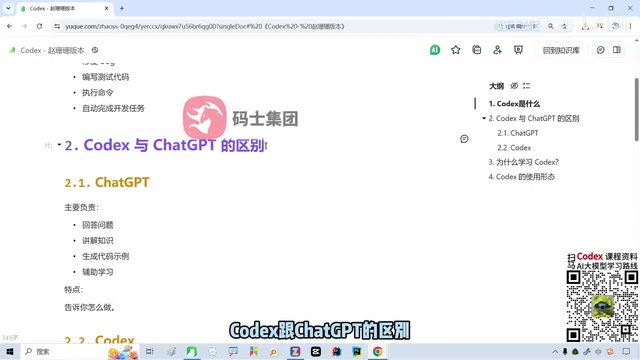
The Core Difference Between Codex and ChatGPT
Many people see Codex for the first time and assume it's just ChatGPT — after all, Codex is also powered by OpenAI's large language models. But the two products serve completely different purposes.
ChatGPT: The Talker
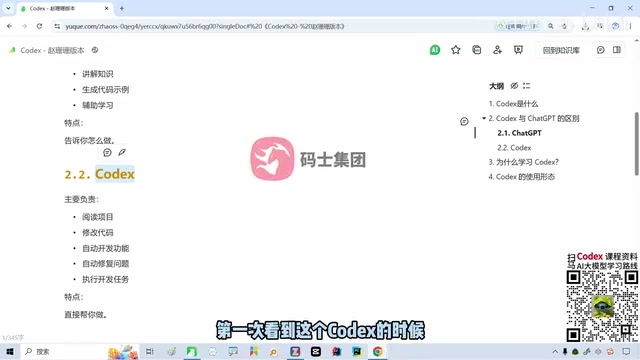
ChatGPT is more like a teacher. If you ask it "How do I implement a login feature in Spring Boot?", it will explain the concept and provide example code — but then you need to Ctrl+C, Ctrl+V it into your IDE and debug it yourself. ChatGPT excels at answering questions, explaining concepts, supporting learning, and generating code snippets. At its core, it's a conversational knowledge assistant.
Codex: The Doer
Codex is more like a programmer sitting right next to you. You tell it directly, "Build the login feature for me," and it will read through the project, modify and generate code, run tests, debug issues autonomously, and only report back once everything is working: "Done."
One-line summary: ChatGPT talks, Codex acts. ChatGPT tells you how to do something; Codex goes ahead and does it for you. Understanding this distinction makes it clear that Codex isn't a simple replacement for ChatGPT — it's a different product form built on top of the same underlying model.
Why Developers Should Learn Codex
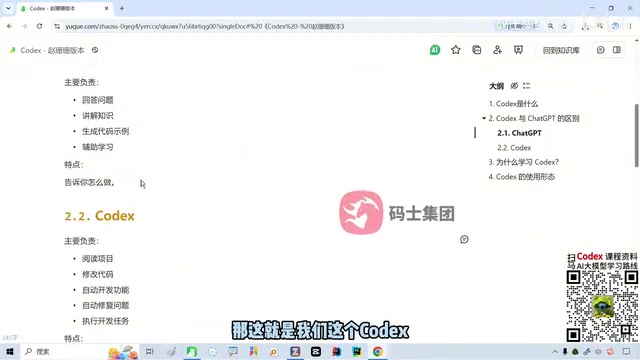
We have entered the era of AI-assisted development. In the past, coding meant writing every line by hand. That model is shifting — developers define requirements, AI coding agents handle the bulk of the code, and developers take responsibility for reviewing and refining the output.
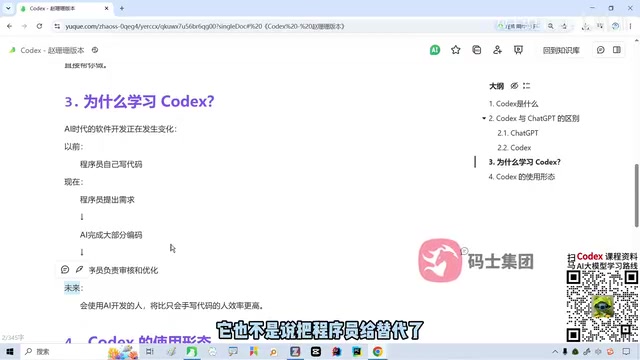
This means tools like Codex and Claude Code won't replace developers. If anything, the opposite is true: reviewing and optimizing AI-generated code still demands solid programming fundamentals. If you have no programming knowledge, you can't understand the logic AI writes, can't judge its quality, and certainly can't serve as a meaningful gatekeeper.
A Shift in the Development Paradigm
The developers who will be truly competitive in the future aren't the ones who type code the fastest — they're the ones who are best at communicating requirements to AI. The entire development paradigm has evolved from "write the code yourself" to "direct AI to write the code." Those who can leverage AI tools will have a significant productivity advantage over those who still code purely by hand.
This is the fundamental reason to learn tools like Codex, Claude Code, and Trae: they are a means of augmenting your coding capabilities, and those who master them will have a clear edge in efficiency.
This new collaborative paradigm is commonly referred to in the industry as Prompt Engineering or, more broadly, AI-Driven Development. The ability to clearly communicate requirements to AI fundamentally requires developers to decompose vague business goals into specific, verifiable technical tasks — including defining inputs and outputs, setting boundary constraints, and specifying technology stack preferences. This overlaps significantly with traditional "requirements writing" skills, but with a greater emphasis on immediacy and iterative feedback. You need to quickly judge whether AI output has drifted from the intended goal and correct it with precise language. As a result, programming fundamentals, systems design thinking, and clear communication are set to become the most critical composite competencies for developers in the AI era.
Summary
As OpenAI's AI coding agent, Codex's core capability lies in autonomously completing programming tasks — reading, modifying, testing, and debugging code — rather than simply generating it through conversation. Its relationship with ChatGPT can be described as "same origin, different form": one talks and explains, the other rolls up its sleeves and executes.
For developers, the key to staying competitive in the age of AI-assisted development is understanding this new collaborative model — and building the ability to clearly express requirements to AI while critically reviewing its output. Upcoming tutorials will walk through environment setup, core features, and hands-on project walkthroughs step by step.
Related articles

Huberman's Rational Supplement Guide: A Five-Layer Health Framework and Scientific Decision-Making
Stanford neurobiology professor Huberman proposes a rational supplement framework: behavior and nutrition are the foundation, basic combination supplements serve as insurance, and sleep/hormonal/cognitive directions should stick to single-ingredient experiments. Omega-3 is the top single-ingredient choice, and melatonin is not recommended.

The Unsung Painter Behind Gilded Age Manhattan Interior Design
HN discussion highlights the painter behind Gilded Age Manhattan interiors: he created murals and decorative paintings but was long overlooked as his work was seen as architectural appendage.

Can AI Agents Be Socially Engineered? Understanding Prompt Injection and Tool Permission Risks
Through Invariant Lab's GitHub Issue injection and Brave's AI browser attack, this article analyzes how Prompt Injection induces AI Agents to perform unauthorized actions, and offers protection advice across three layers: least privilege, tool validation, and operation auditing.