What Is JEV Everyone's Talking About on Reddit? A Clear Breakdown of Its Meaning and Uses

JEV is trending in r/LocalLLaMA but no one's explaining it — here's how to decode unknown AI abbreviations.
The abbreviation "JEV" recently started flooding Reddit's r/LocalLLaMA community, prompting a confused newcomer to ask what it means. The original post offers no definitive answer — whether JEV is a new LLM or a tool remains unconfirmed. The article uses this as a case study to offer a practical framework for decoding unknown technical terms: trace the earliest community posts, consult GitHub READMEs and Hugging Face model cards, and cross-verify multiple independent sources before drawing conclusions.
A Term That Suddenly Took Over the Feed
Recently, users in the r/LocalLLaMA community have been noticing a repeatedly appearing abbreviation — JEV. One Reddit user asked bluntly in a post: "I've been seeing JEV everywhere in LocalLLaMA since yesterday and have absolutely no idea what it is. Is it some new LLM? Or something else entirely?"
This post captures a frustration shared by many newcomers: a term suddenly dominates discussions with no clear context or explanation, leaving readers completely in the dark. This "term goes viral before the explanation catches up" phenomenon is actually quite common in the fast-moving open-source LLM community.
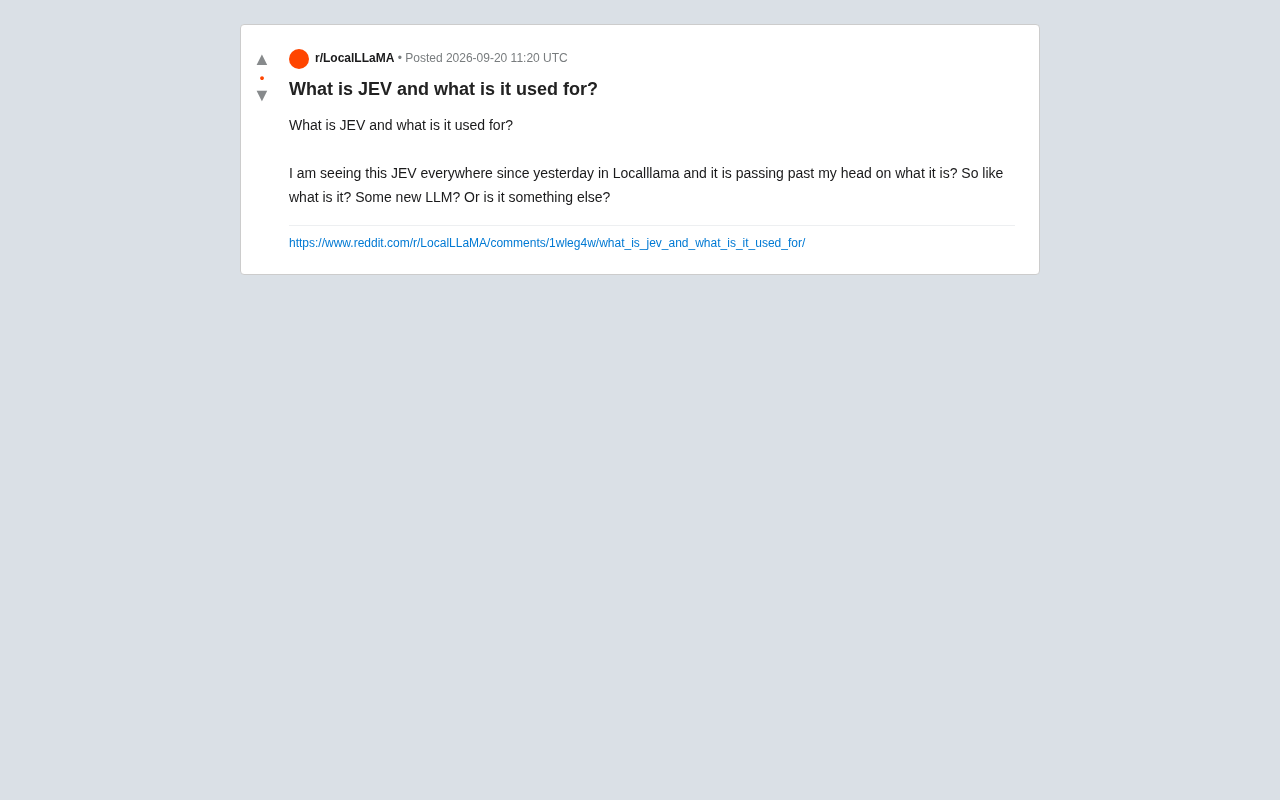
r/LocalLLaMA is a Reddit community dedicated to running large language models (LLMs) locally. It draws together developers, researchers, and tech enthusiasts whose discussions span model quantization, inference acceleration, hardware compatibility, and new model benchmarks — making it one of the fastest-moving public communities in the open-source LLM ecosystem. Because the community's members range from seasoned engineers deeply involved in development to complete beginners, highly technical jargon and casual conversation coexist at an intense information density. Newcomers often need time to get comfortable with the terminology.
Why These Abbreviations Suddenly Flood the Feed
In communities like LocalLLaMA, new models, tools, and frameworks drop at a relentless pace. Once a project gains traction in a small circle, its abbreviation can saturate headlines, comments, and threads almost overnight. For long-time community members, these abbreviations are understood shorthand; for newcomers, they often require extra searching just to follow the conversation.
This is precisely what makes the original post valuable — it makes an invisible information barrier visible. When a term appears frequently with no authoritative explanation, the most direct approach is to ask the community directly or go back to the project's original release page.
How to Find Answers Yourself When You Hit an Unknown Abbreviation
For terms like JEV that suddenly trend but lack a clear public definition, rather than waiting for someone to explain it, it helps to have a general troubleshooting approach:
Go Back to the Source
Start by using the search function in the original community where the term appeared (in this case, LocalLLaMA) to filter through past posts. Usually, the earliest posts mentioning it will include links to a project, GitHub repository, or Hugging Face page. The original release post almost always contains the most accurate definition.
Check the Official Repository and Documentation
If JEV points to an open-source project, the GitHub README and the Hugging Face model card will clearly state whether it's a model, an inference framework, a quantization method, or an evaluation tool. In open-source communities, abbreviations are often formed from the initials of a project name or an author's name.
Hugging Face is currently the primary platform for hosting and sharing models in the open-source AI space, where developers publish model weights, datasets, and demo applications. Each model page typically includes a "Model Card" describing the model's purpose, training data, performance metrics, and usage constraints. GitHub is the main platform for code repositories, and a project's README file is usually the most authoritative entry point for understanding what it does and how it's positioned. For abbreviations that suddenly trend in a community, searching these two platforms directly is often more reliable than relying on secondhand explanations, since they are the channels project authors use to publish original information.
Cross-Verify Multiple Sources
Explanations from a single comment aren't always reliable. It's worth comparing at least two or three independent mentions to see whether their descriptions of JEV are consistent, so you don't get misled by one user's misunderstanding.
What Can Actually Be Confirmed Right Now
To be honest: based solely on this Reddit question, it's impossible to determine exactly what JEV means. The original poster was also in the asking stage — no one in the thread provided an authoritative definition, no link pointed to a specific project, and no screenshot or citation explained its function.
So definitively calling JEV "some new LLM" or "some kind of tool" would be irresponsible. The reasonable position is this: JEV is a term currently spreading through the community, but publicly available information is still insufficient. Readers should head to the original community to verify the latest discussions themselves.
Advice for Open-Source Community Newcomers
This kind of confusion is something almost everyone encounters when joining an active technical community. Rather than feeling anxious about a flood of unfamiliar abbreviations, treat them as entry points for understanding the community ecosystem:
- When you encounter an abbreviation you don't know, search before asking — you'll usually find an answer faster that way;
- Look into the project repository behind the abbreviation to determine whether it's a model, a tool, or a benchmark;
- Stay cautious about unverified explanations in the community, and cross-check multiple sources.
New terminology is born every day in the open-source LLM space. Developing the habit of "verify first, believe later" is more valuable than memorizing any single term.
Related articles

Reinforcement Learning Takes On Getting Over It: Distributed Training Strategies Behind 63% Progress
A developer uses deep reinforcement learning to tackle Getting Over It. The agent climbs from the bottom to 63% progress but gets stuck at the anvil. The project is open-sourced, using divide-and-conquer training and CPU-only training, seeking community collaboration to break the bottleneck.

Sigma FP2 Released: The World's Smallest Full-Frame Camera Gets Sensor and Screen Upgrades
Sigma launches the FP2 full-frame camera, retaining its smallest-and-lightest design with three key upgrades: improved sensor, articulating LCD screen, and longer battery life—built for portable video creators.

AAAI 2027 Phase 2 Decisions Imminent: Community Debates Review Fairness and Submission Ecosystem
AAAI 2027 phase 2 review results are imminent, with the Reddit community debating reviewer consistency and process transparency. This article examines pre-decision sentiment, structural tensions in top conference review, and practical strategies for authors.