What Is Playground Skill? How HTML Interaction Solves the Pain Points of AI Coding Communication

HTML is emerging as a new medium to break through the plain-text interaction bottleneck in AI coding.
As large model capabilities advance rapidly, the plain-text interaction model of AI coding tools is hitting its limits: output-side information overload is hard to absorb, while input-side natural language is too vague and inefficient. Playground Skill addresses this by building renderable HTML interactive interfaces that enable two-way communication combining natural language with structured interaction data, dramatically improving collaboration efficiency for UI tuning, layout design, and data visualization. HTML won't replace Markdown — it becomes a vital complement in visual and interactive scenarios.
AI Coding Interaction Is Hitting a Wall
When using Coding Agents like Cursor, Claude Code, or Codex, the interaction pattern is almost always the same: describe your requirements in natural language, and the model outputs code or text. This approach worked well for a long time, but as large model capabilities have advanced rapidly, one problem has become increasingly apparent — the existing interaction medium can't keep up.
It's worth clarifying what these tools actually are. Cursor is an AI-native code editor built on VS Code, with built-in LLM-powered code completion and chat features. Claude Code is Anthropic's command-line coding assistant that can understand codebases and execute edits directly in the terminal. Codex is OpenAI's coding agent that can autonomously write, test, and commit code in a cloud sandbox. All three fall under the category of Coding Agents — AI systems that don't just generate code snippets, but understand project context, autonomously plan task steps, and use tool chains to complete end-to-end development work. They represent a paradigm shift in AI-assisted programming from "code completion" to "autonomous coding."
Recently, a Claude engineer published an article on the use of HTML in AI programming that sparked widespread discussion. The core argument is straightforward: HTML is emerging as a new interaction medium between humans and Coding Agents, and in many scenarios it's better suited for two-way communication in the AI era than plain-text Markdown.
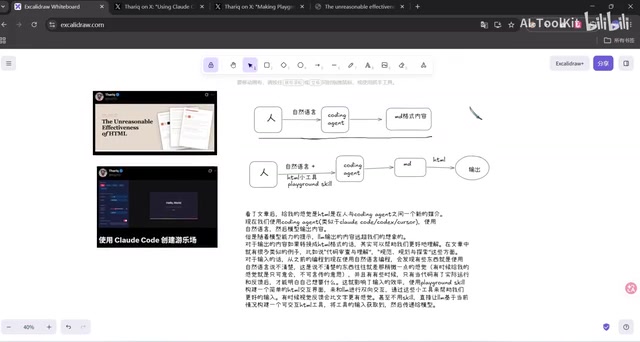
The Output Problem: Model Capabilities Overflow What Plain Text Can Handle
Information Overload Makes Reading Code a Cognitive Burden
Today's large models produce output far beyond what was once expected. In a single conversation, a model might generate hundreds of lines of code, detailed architectural explanations, and comparisons of multiple approaches — all presented as plain text or Markdown. The cost of reading and understanding this is extremely high.
Nearly all mainstream AI coding tools default to Markdown as their output format. Markdown was created in 2004 by John Gruber, designed to be a readable, writable plain-text format that converts to HTML. It supports basic formatting elements like headings, lists, code blocks, and tables, and has been widely adopted in technical documentation and chat interfaces. However, Markdown is fundamentally a static, linear markup language — it has no interactivity (no sliders, buttons, or other controls), no dynamic rendering (no real-time response to user actions), and limited precision for two-dimensional spatial layout. As AI output evolves from simple code snippets to complex interface designs and multi-dimensional data comparisons, Markdown's expressive power starts to fall short.
Here's a common scenario: you ask an AI to generate a complex front-end page, and it returns hundreds of lines of HTML/CSS/JS. You stare at the code, trying to mentally reconstruct what the rendered result will look like — that process itself is a massive cognitive burden.
This relates to Cognitive Load Theory, introduced by educational psychologist John Sweller in 1988. The theory states that human working memory has limited capacity, and when the amount of information to process simultaneously exceeds that capacity, the efficiency of comprehension and decision-making drops sharply. When reading large blocks of code, developers must simultaneously maintain variable states, control flow, DOM structure, and visual mappings in their heads. This "mental compilation" process generates extremely high extraneous cognitive load. Visual rendering essentially offloads that cognitive burden to the computer, freeing the developer's working memory to focus on higher-level design decisions.
Rendering Output as HTML: What You See Is What You Get
If the model's output is directly transformed into a renderable HTML page, the experience changes entirely:
- Visual presentation: Code is no longer abstract characters — it becomes an interactive interface you can see
- Much lower comprehension barrier: What you see is what you get; no need to "compile" code in your head
- Higher information density: An interactive chart conveys far more than a paragraph of text
In short, HTML helps us more efficiently absorb the increasingly powerful output of large models, rather than being overwhelmed by a flood of information.
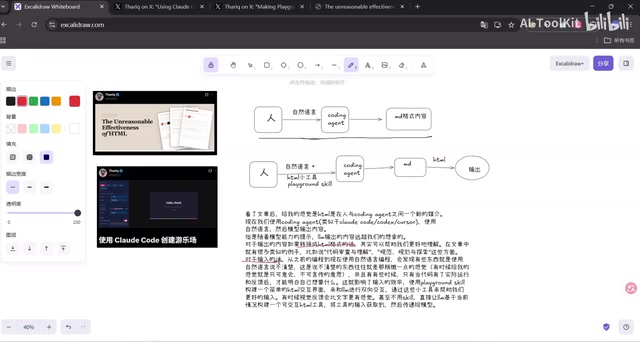
The Input Problem: What to Do When Natural Language Can't Express What You Mean
Natural Language Has Inherent Expressive Limits
The output-side problem is "too much information." The input-side problem is more fundamental — natural language itself has expressive limits.
The evolution of programming follows a clear path: from machine code to high-level languages, and now to describing requirements in natural language. Each step lowered the barrier to entry, but natural language programming has its own inherent flaws.
Looking back at the history of programming languages, it's essentially a story of ever-increasing abstraction. First generation: machine code (binary 0s and 1s). Second generation: assembly language (mnemonics replacing binary). Third generation: high-level languages (C, Java, Python — syntax closer to human thinking). Fourth generation: domain-specific languages and visual programming tools. Natural language programming can be seen as the latest stage in this evolution — describing intent in everyday human language, with AI translating it into executable code. Each increase in abstraction level dramatically lowers the barrier to programming, but also introduces new "impedance mismatch" problems: the higher the abstraction level, the weaker the ability to precisely control low-level details. The ambiguity and polysemy of natural language is the concentrated expression of this mismatch.
In practice, you've almost certainly encountered situations like these:
- "Move the button a little to the right" — how many pixels?
- "Make the color a bit darker" — how dark exactly?
- "Make the layout a bit more compact" — what's the standard for compact?
This "I know it when I see it" dilemma is especially pronounced in UI/UX development. Often, you can only accurately articulate what you want once the interface is actually in front of you.
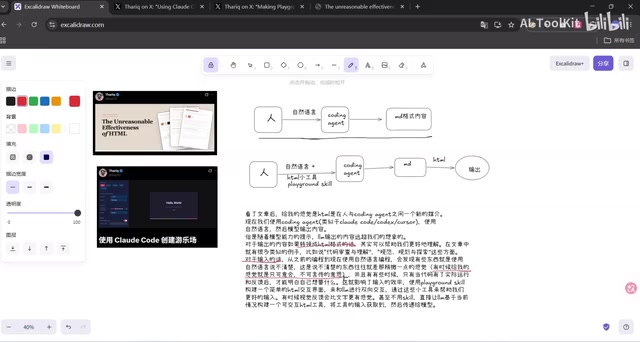
The Efficiency Trap of Multi-Turn Text Conversations
Poor expression directly kills iteration efficiency. A simple UI adjustment might require multiple rounds of back-and-forth:
- Round 1: Describe the requirement in text
- Round 2: See that the result is wrong, correct it in text
- Round 3: Still not right, keep tweaking in text
- ……
Every round involves using words to describe something that is fundamentally visual and interactive — naturally inefficient. This is one of the most common bottlenecks in current Coding Agent workflows.
Playground Skill: An HTML-Based Solution for Two-Way Interaction
What Exactly Is Playground Skill
The core solution described earlier is Playground Skill — building simple HTML interactive interfaces to enable two-way interaction between humans and large models.
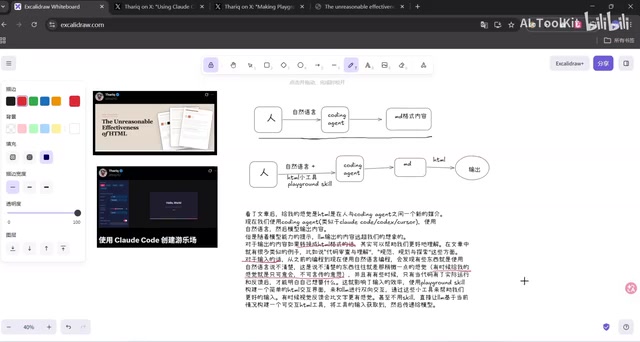
It breaks the traditional "plain text input → plain text output" pattern by introducing a key intermediate layer:
- Input side: Natural language descriptions + interaction data from HTML widgets (slider values, color picker results, drag-and-drop coordinates, etc.)
- Output side: Renderable HTML interfaces + interactive components
From a technical implementation perspective, the core idea of Playground Skill is to have the large model generate self-contained HTML/CSS/JavaScript code snippets that are instantly rendered as interactive interfaces in a sandboxed environment (typically an iframe). User interactions with the interface (such as dragging elements, adjusting sliders, selecting colors) produce structured event data. This data is captured and fed back to the large model as context, along with the user's natural language instructions, forming the input for the next round of conversation. This architecture creates a closed loop of "generate → render → interact → feedback → regenerate." From a security standpoint, HTML rendering typically runs in a restricted iframe sandbox, with mechanisms like Content Security Policy (CSP) limiting access to external resources and preventing dangerous operations, ensuring that generated code poses no security risk to the user's system.
Four High-Value Application Scenarios
This HTML interaction model has particularly clear advantages in the following scenarios:
- UI parameter fine-tuning: Directly adjust parameters using sliders, color pickers, and other controls — no more vague descriptions like "a bit bigger" or "more red"
- Page layout design: Drag interface elements to express layout intent, far more precise than writing a descriptive paragraph
- Data visualization adjustments: Display and adjust data presentation through interactive charts
- Rapid prototype validation: Generate interactive prototypes, discover and express new requirements through actual hands-on use
Traditional Mode vs. Playground Skill Mode
| Dimension | Traditional Text Mode | Playground Skill Mode |
|---|---|---|
| Input method | Pure natural language | Natural language + interaction data |
| Output format | Text / code | Renderable HTML interface |
| Feedback experience | Mental "compilation" required | What you see is what you get |
| Iteration efficiency | Multiple rounds of text description | Direct manipulation + text supplement |
| Best use cases | Logic-based, algorithm-based tasks | UI/UX, visualization, prototype design |
The Interaction Medium Determines the Upper Limit of AI Coding Efficiency
Marshall McLuhan was one of the most influential media theorists of the 20th century. In his 1964 book Understanding Media: The Extensions of Man, he proposed the classic thesis "The Medium is the Message." Its core meaning: what truly shapes human society is not the specific content carried by a medium, but the form and characteristics of the medium itself. For example, television's influence lies not in what programs it broadcasts, but in the fact that as a visual, instantaneous medium, it reshaped the way people receive information.
Applied to the context of AI programming, the choice of interaction medium directly determines the efficiency ceiling of human-machine collaboration. What determines the efficiency of that collaboration is not just how well you write prompts or how capable the model is — it's also what expressive dimensions and feedback capabilities the interaction medium itself provides. The shift from plain text to HTML interactive interfaces is fundamentally an upgrade in the dimensionality of the interaction medium — from one-dimensional linear text to a two-dimensional interactive space.
The strength of plain-text Markdown lies in its simplicity and universality, but it is fundamentally one-dimensional and linear. HTML (HyperText Markup Language), since its creation in 1993, has evolved from a simple document markup language into a powerful application platform. The modern HTML5 specification natively supports Canvas drawing, SVG vector graphics, drag-and-drop APIs, form controls (range sliders, color pickers, date pickers, etc.), Web Audio, WebGL 3D rendering, and much more. More critically, HTML has a complete event system (click, input, drag, etc.) that can capture every user interaction and convert it into structured data. This means that when a user drags a slider, the result is not a vague "a bit bigger" but a precise value (e.g., padding: 24px). This structured data can be directly understood and processed by large models, fundamentally eliminating the ambiguity of natural language. HTML's native support for two-dimensional layout, interactive events, and dynamic rendering precisely fills the gaps that natural language has when expressing visual and interactive requirements.
Of course, HTML won't completely replace Markdown. A more reasonable conclusion is: in scenarios that require precise expression of visual and interactive intent, HTML will become an important complement to natural language, with the two together forming a more efficient human-machine interaction interface.
As large model capabilities continue to grow, what we need is not just more powerful models, but also more fitting interaction methods to unlock their full potential. The HTML interaction paradigm represented by Playground Skill is an important step in exactly that direction.
Key Takeaways
- Large model output capabilities are growing rapidly, and plain text/Markdown can no longer carry the richness of that output; HTML's visual rendering capabilities help users better understand the results
- Natural language has expressive limits — many visual and interactive requirements are "easier shown than said," which seriously hampers input efficiency
- Playground Skill builds HTML interactive interfaces to enable two-way communication combining natural language and interaction data, significantly improving human-machine collaboration efficiency
- HTML won't completely replace Markdown, but will become an important complement to natural language in visual and interactive scenarios
- Upgrading the interaction medium is just as important as improving model capabilities — both together determine the efficiency ceiling of AI programming
Related articles
Deep Dive into AI Agent Skill Design: …
Deep Dive into AI Agent Skill Design: Engineering Practices from Anthropic and Perplexity
A deep dive into Skill design philosophy from Anthropic's Claude Code team and Perplexity's Agent team, covering the Tax Test, Gotchas Flywheel, progressive disclosure, and Eval-First practices for building high-quality AI Agent skill systems.
Deep Dive into OpenAI's Official GPT-5…
Deep Dive into OpenAI's Official GPT-5.6 Prompting Guide: The Shift from Manual to Automatic
A deep dive into OpenAI's official GPT-5.6 Sol prompting guide: conciseness-first, outcome-oriented design, autonomy boundaries, tool routing, and reasoning intensity tuning.
 Deep Dives
Deep Dive into How OpenClaw (Open-Source Crayfish) AI Agent Works
Deep analysis of OpenClaw AI Agent internals: System Prompt, tool calling, SubAgents, Skill system, memory, and Context Engineering explained.