What It Would Mean If GPT-6.1 Sol Max Scored 100% on FrontierMath Tier 4

Unverified Reddit claim says GPT-6.1 Sol scored 100% on FrontierMath Tier 4 — but sources and methodology remain unconfirmed.
An unconfirmed Reddit post claims a model called "GPT-6.1 Sol (max)" achieved a perfect score on Epoch AI's FrontierMath Tier 4 benchmark — the hardest tier in one of the most rigorous math evaluation suites for LLMs, where most frontier models historically score in the single to low double digits. The article urges caution: data contamination, a "tier-4-v2" version update, and the multi-sample strategy implied by "max" all complicate direct interpretation. The model name itself has no official backing. Without verifiable evidence, the claim should be treated as an unverified lead.
A Benchmark Result That's Generating Buzz
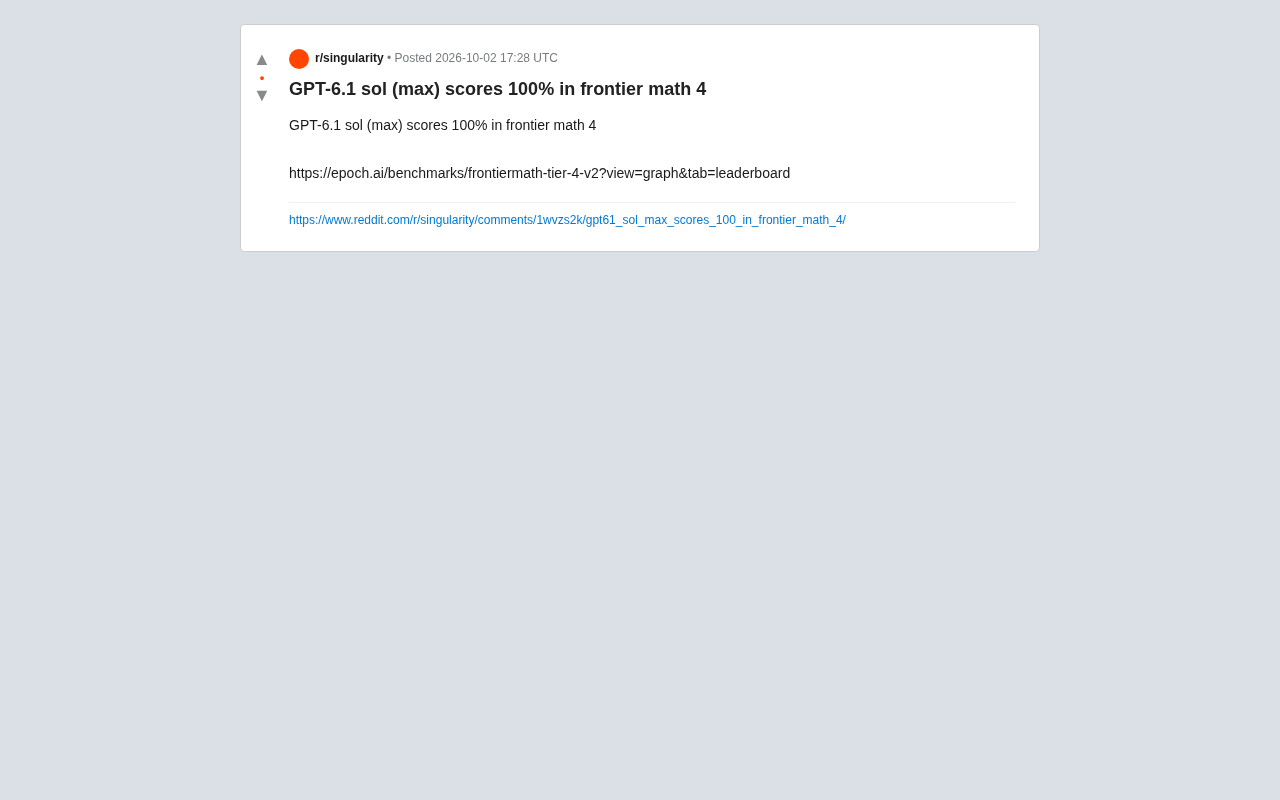
A Reddit post claims that a model called "GPT-6.1 Sol (max)" achieved a perfect 100% score on the FrontierMath Tier 4 benchmark, with a link to the Epoch AI leaderboard as supporting evidence. The claim spread quickly through the community — FrontierMath has long been considered one of the most rigorous tests of mathematical reasoning for large language models, and any score approaching perfection immediately invites scrutiny.
It's worth noting upfront that the verifiable source material here is extremely thin: just an external link to the Epoch AI leaderboard and a screenshot. The model name "GPT-6.1 Sol (max)" has not been confirmed through any official channel. This article is therefore better read as an analysis and contextualization of the claim, rather than a report on confirmed facts.
What Makes FrontierMath So Hard
FrontierMath is a mathematics benchmark developed by Epoch AI. Unlike common datasets such as GSM8K or MATH, it deliberately includes high-difficulty problems that require genuine mathematical expertise to solve. These problems are drawn from research-level mathematical contexts and are specifically designed to challenge state-of-the-art models even when they have access to tools.
Tier 4 represents the hardest difficulty level in the benchmark. Most frontier models have historically scored in the single digits to low double digits on this tier. That's precisely why a score of "100%" — if accurate — would represent a landmark leap in mathematical reasoning: near-perfect performance on the hardest available category.
GSM8K covers elementary school word problems, and the MATH dataset targets competition math at the AMC/AIME level — both have been largely conquered by mainstream large models in recent years and no longer serve as effective differentiators. FrontierMath was designed to fill that gap: problems are authored by professional mathematicians, spanning research-level areas like number theory, algebraic geometry, and combinatorics, and are specifically designed to avoid problem types with publicly available solutions — minimizing the chance that a model is recalling rather than reasoning. When Epoch AI released the benchmark, they emphasized that its problems correspond to scenarios a PhD-level mathematics student or professional researcher would struggle with, not just the hardest problems in a competition training curriculum. The Tier 1–4 stratification roughly maps to the depth of background knowledge and length of non-trivial derivation required. Tier 4 typically involves cross-domain knowledge integration and multi-step reasoning, making it the tier that demands the highest degree of genuine mathematical understanding.
Why a Perfect Score Warrants Skepticism
Perfect scores on benchmarks have historically been a signal that warrants extra scrutiny. In AI evaluation, extreme results tend to come with several possible explanations: the model genuinely achieved a capability breakthrough; there was data contamination, where test problems or close variants appeared in training data; or the evaluation configuration, problem version, or scoring methodology changed.
The linked page includes a version label of "tier-4-v2," indicating that the benchmark itself has been updated. Problem sets may differ across versions, making direct cross-version score comparisons methodologically unsound. Additionally, the "max" suffix typically implies a higher compute budget or a multi-sample aggregation strategy, which is not equivalent to standard single-pass evaluation. Without methodological details, a single percentage figure tells us very little about what the number actually means.
Data contamination is a structural challenge that has long plagued evaluation in this field. Large language models are trained on hundreds of billions to trillions of tokens of web text — if a test problem or a highly similar variant appeared within that crawl, the model is effectively recalling rather than reasoning. FrontierMath addresses this by keeping problems non-public and restricting access to authorized submitters only. But as the benchmark goes through version iterations and accumulates more external submissions, the risk of leakage compounds over time. The multi-sample strategy implied by the "max" suffix — such as majority voting or best-of-N sampling — also deserves attention: by sampling the same problem dozens or hundreds of times and selecting the best result, a model can substantially boost its pass rate in probabilistic terms. But this is fundamentally different from the reliability of single-pass generation in real deployment, and that gap is especially pronounced on hard problems.
Uncertainty Around the Name and Source
The name "GPT-6.1" itself invites scrutiny. None of the available material includes an official release announcement, technical report, or independently verifiable secondary source. Unconfirmed model names appearing in community posts are not unusual — they're sometimes internal codenames, aliases, or even misidentifications and placeholders.
The reasonable stance for readers is to treat this as an unverified lead, not an established fact. To confirm it, you'd need at minimum the original entry on the Epoch AI leaderboard, information about who submitted the model, the evaluation date, and whether methodology details were disclosed. Until those are available, any conclusion about "mathematical reasoning having been solved" is premature.
Potential Implications for the Field
Setting aside the question of authenticity, claims like this generate attention because they touch on a core question: where is the frontier of mathematical reasoning for advanced models? High-difficulty benchmarks like FrontierMath exist precisely to keep setting a ceiling. Once a benchmark is saturated, the evaluation community typically responds with harder versions or entirely new benchmarks to maintain discriminative power.
If a credible source were to confirm a result like this in the future, it would prompt a reassessment of what models can do in formal reasoning, symbolic computation, and multi-step proof — and it would accelerate the pace at which benchmark developers push toward harder evaluation. Until then, the more useful takeaway from this episode is a reminder: when confronted with a stunning score, verify the source and method before drawing conclusions.
The evaluation community refers to the phenomenon of benchmarks becoming obsolete after being "maxed out" as benchmark saturation. Historically, the conquest of ImageNet led to adversarial alternatives like ObjectNet and ImageNet-A. In language understanding, GLUE saturation gave rise to SuperGLUE, which in turn gave way to BIG-Bench and BIG-Bench Hard. Mathematical reasoning is following the same pattern: if FrontierMath loses its discriminative power, Epoch AI or others will likely introduce a next-generation benchmark requiring formal proof verification — interfacing with theorem provers like Lean or Coq — to rigorously audit symbolic reasoning end-to-end, rather than relying solely on whether a final numerical answer is correct.
Summary
The claim that GPT-6.1 Sol (max) scored 100% on FrontierMath Tier 4 remains at the level of community rumor — lacking official confirmation and methodological detail. FrontierMath's authority as a high-difficulty math benchmark is well-established, and it's precisely for that reason that any perfect score demands stricter scrutiny. Until cross-verifiable evidence is available, the right approach is to stay attentive — but not credulous.
Related articles

Gemini 4 Argon Hands-On: AI Builds Board Games, Constructs Temples, and Trains Robots Autonomously
Gemini 4 Argon hands-on roundup: AI autonomously builds a desk racetrack and temple in Blender, writes a ray tracing engine, trains a humanoid robot to sink 7 shots, plus API pricing and developer access.

The Magic Octagonal Coin: Why Only 9% of People Can Predict Its Flip?
Only 9% of people can correctly predict the Magic Octagon coin flip. This article explains its spatial rotation mechanism, common cognitive pitfalls, and a new hypothesis based on Relevance Theory, exploring the limits of human spatial reasoning.

Sam Altman: AI Is Entering the Era of Scientific Discovery — Math Breakthroughs Will Replicate in Biology and Energy
Sam Altman says AI is entering the era of scientific discovery — math breakthroughs will replicate in biology, materials science, and energy to help develop new drugs and energy sources.