What Should AI Agent Audit Logs Record? Five Core Elements Explained

Five essential elements every AI Agent audit log must capture for accountability and compliance.
As AI Agents evolve from advisors to autonomous executors, traditional identity-centric audit logs become inadequate. This article breaks down five core elements that Agent audit logs must capture—session context, tool calls, permission decisions, delegation events, and approvals—and explains why structured, queryable events are essential for incident reconstruction, compliance, and accountability in the Agent era.
When Humans Are No Longer the Ones Clicking the Button
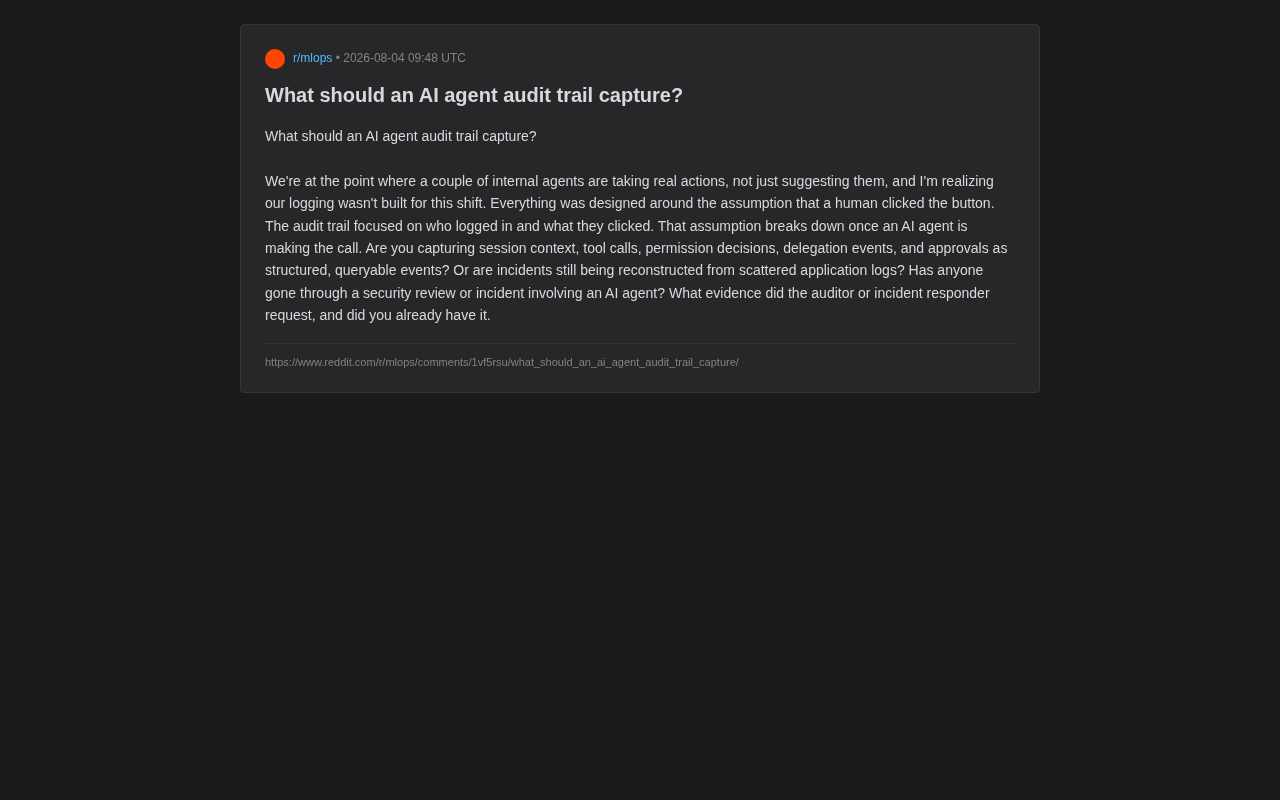
As AI Agents transition from "advisors" to "executors," enterprise logging and auditing systems face a fundamental challenge. A Reddit developer posed a pointed question in the community: "When AI Agents start actually taking actions, rather than just providing suggestions, what should our audit logs record?"
The AI Agents referred to here are AI systems with autonomous planning, decision-making, and execution capabilities—known as Agentic AI. Unlike traditional passive AI (such as Q&A systems or recommendation engines), Agentic AI can decompose complex goals into subtasks, autonomously select and invoke tools, adjust strategies based on intermediate results, and collaborate with humans or other Agents when necessary. This concept evolved rapidly between 2023-2024 as large language models (LLMs) and tool-calling capabilities matured, with representative frameworks including LangChain's Agent module, AutoGPT, and Microsoft's AutoGen. In enterprise settings, these Agents are being deployed in customer service, code generation, data analysis, IT operations, and other domains, gradually transitioning from an "advisor" role to an "executor" role.
Behind this question lies a long-overlooked assumption: all audit trails in the past were built on the premise that "a human clicked the button." Logging systems focused on who logged into the system and what they clicked. But when the decision-making entity shifts from humans to AI Agents, this assumption completely breaks down.
"Everything was designed around the assumption that a human clicked the button. That assumption breaks down once an AI agent is making the call."
This isn't a marginal technical detail—it's a structural gap that security, compliance, and operations teams must confront head-on as Agentic AI lands within enterprise systems.
Why Traditional Audit Models Fail in the Agent Era
From "Identity-Centric" to "Behavior-Centric"
Traditional audit trails are essentially identity-centric: recording user identity, login time, pages visited, and actions clicked. This system is built on the foundations of Identity and Access Management (IAM) and Security Information and Event Management (SIEM). Typical audit log entries include user identity markers (such as usernames, IP addresses), timestamps, operation types (such as CRUD operations), operation targets (such as files, database records), and operation results. Its legal basis comes from accountability requirements in compliance frameworks like SOX, GDPR, and HIPAA—where the object of "accountability" is always a natural person or legal entity, not an autonomously running software system. This model works well in a human-operated world because every action has a clear, accountable human subject.
But AI Agents introduce several entirely new dimensions:
- Autonomous decision-making: Agents may make a series of decisions without real-time human intervention
- Tool call chains: A single task may trigger multiple API calls, database queries, and external service requests
- Delegation and proxy: Agents may delegate subtasks to other Agents or subprocesses
- Dynamic permission usage: Agents may cross multiple permission boundaries during execution
When an Agent automatically completes a series of operations and you need to reconstruct "why it did that" after the fact, if all you have are scattered application logs, rebuilding the event chain becomes a near-catastrophic undertaking.
The Nightmare of Incident Reconstruction
The original poster raised a critical operational question: Are incidents still being reconstructed by piecing together scattered application logs? This is exactly the reality many teams face today. When an AI Agent executes an operation it shouldn't have—such as deleting production data or sending information to the wrong recipient—security responders need to quickly answer:
- What session context was the Agent in at the time?
- Which tools did it invoke? What parameters were passed?
- How were its permission decisions made?
- Was there a human approval step? Who approved it?
If this information is scattered across a dozen different systems' logs—or worse, was never recorded at all—a single security review becomes a long and painful archaeological expedition.
Core Elements of AI Agent Audit Logs
Based on the framework proposed in the original post, an audit logging system designed for the Agent era should record the following as structured, queryable events, rather than unstructured text streams:
1. Session Context
Every Agent action should be linked to a complete session context: what was the original request that triggered the task, what was the Agent's goal, and what was the current conversation or task state. Context is the prerequisite for understanding "why the Agent made a particular decision."
2. Tool Calls
An Agent's capability boundaries are largely determined by which tools it can invoke. In modern AI Agent architectures, tool calling is the core mechanism through which Agents interact with the external world. When an Agent decides to execute an operation, it sends requests to external services through Function Calling interfaces. Taking OpenAI's Function Calling as an example, the model generates structured JSON parameters, and the system then routes these parameters to the corresponding API endpoints. A complex task may involve chained calls: the Agent first queries a database to retrieve user information, then calls an email API to send a notification, and finally updates the status in a CRM system. Each step in such a chain may involve different permission domains and data sensitivity levels, and any uncontrolled link could lead to a security incident.
Therefore, every tool call should record: which tool was called, what parameters were passed, what results were returned, and whether the call succeeded. These are the most critical traceable nodes in the Agent's behavioral chain.
3. Permission Decisions
When an Agent attempts to access a resource or perform an operation, the system's authorization/denial decisions must be recorded. This is not only relevant for compliance but also serves as direct evidence for determining "whether the Agent exceeded its authority."
4. Delegation Events
In multi-Agent architectures, when one Agent delegates a task to another Agent or subtask, this behavior needs to be explicitly recorded. Otherwise, the chain of responsibility breaks at the delegation point, making it impossible to trace back to the final executor.
Multi-Agent Systems are an important development direction for current Agentic AI, with typical frameworks including CrewAI, Microsoft AutoGen, and LangGraph. In these architectures, an "Orchestrator Agent" decomposes complex tasks and assigns them to multiple specialized "Execution Agents." Delegation mechanisms introduce new accountability challenges: when a sub-Agent performs an incorrect operation, should responsibility be attributed to the orchestrator Agent that initiated the delegation, the sub-Agent that performed the operation, or the engineering team that designed the system? This is similar to delegated authority issues in corporate management, but in Agent systems it happens faster, the chains run deeper, and intermediate processes often lack human visibility. Therefore, complete recording of delegation events—including delegator identity, delegatee identity, the specific task scope delegated, and permission boundaries—is key to maintaining accountability chain integrity.
5. Approvals
For high-risk operations, Human-in-the-Loop (HITL) approval steps are typically established. HITL is a design pattern for introducing human oversight and intervention in AI systems. In Agent systems, it usually appears in several forms: Approval Gates, where the Agent pauses before executing high-risk operations and waits for human confirmation; Escalation, where the Agent proactively requests human intervention when encountering situations beyond its capability range or confidence threshold; and Periodic Review, where humans regularly inspect the Agent's operation history and provide feedback. The design of these mechanisms requires balancing automation efficiency with security controls—too much human intervention undermines the Agent's value, while too little introduces uncontrollable risk. The key is dynamically adjusting approval requirements based on the risk level of operations.
Who approved it, when it was approved, and which specific action was approved—these are all hard evidence for auditing and compliance.
From Passive Reconstruction to Active Queryability
Structured Events Are Key
A phrase worth emphasizing from the original post is "structured, queryable events." This is fundamentally different from traditional text logs. When audit information is stored as structured events, security teams can directly query "all Agent operations where permissions were denied in the past 24 hours" instead of searching through massive logs with regular expressions like finding a needle in a haystack.
This effectively requires enterprises to build audit capabilities as a first-class citizen into the architecture when designing Agent systems, rather than patching them in after the fact. Observability should cover the Agent's complete decision chain, not just the final execution result.
Observability is an engineering practice that evolved from the distributed systems domain (particularly microservices architecture), traditionally comprising three pillars: Logs, Metrics, and Traces. In AI Agent scenarios, these three pillars need expansion. Tools like LangSmith, Phoenix (Arize AI), and Langfuse are providing specialized observability solutions for LLM applications, recording prompts, completions, token consumption, and latency for each LLM call. But Agent-level observability also needs to cover higher-level information such as Chain of Thought reasoning paths, decision branches, and tool selection logic. This requires treating observability as an architecture-level requirement during the system design phase, rather than an add-on capability at runtime.
Think from the Perspective of Auditors and Responders
The question posed at the end of the original post has immense practical value: "Has anyone gone through a security review or incident involving an AI Agent? What evidence did auditors or incident responders request, and were you already prepared?"
This points us to an important validation methodology: reverse-engineer audit requirements. Rather than guessing what to record, imagine a real security review or incident post-mortem, think about what evidence investigators would request—then ensure that evidence is being captured completely and in a structured manner when events occur. If you wait until a review begins to discover that critical evidence is missing, it's already too late.
Accountability Infrastructure for the Agent Era
AI Agents are transforming from tools into "digital employees," and every decision they make and every action they execute needs the same—or even higher—standards of accountability as human operations. Audit logs are no longer just compliance documents; they are the core infrastructure for understanding, debugging, and assigning responsibility for AI system behavior.
For teams currently deploying Agentic AI, now is the time to re-examine logging and auditing systems—laying the foundation while you still have "just one or two internal Agents" is far wiser than trying to retrofit after Agents are deployed at scale.
Related articles

DeepCell: One-Click AI Generation of Documents, Spreadsheets, and Slides
DeepCell tops Product Hunt with one-click generation of documents, spreadsheets, and slides, using the .deepcell format for linked updates, designed for System 2 tasks like modeling and sales reviews.

Doneas: 15-Minute Daily Accountability Calls That Keep Indie Developers From Procrastinating
Doneas is a daily accountability tool for indie developers: plan tasks on Monday, join a 15-minute call with five builders each day, and log deliveries on a public progress page. This article analyzes its core mechanics, effectiveness, and potential issues around retention and matching.

Fastlane 2.0: Fully Automated AI Ad Campaigns, From Creative to Optimization
Fastlane 2.0 is an AI ad automation tool: enter your website and it learns your brand, generates video and image ads, and runs and optimizes them on Meta, TikTok, Instagram, and YouTube.