When a Highway Becomes an Instrument: The 101 Plays Itself Turns Live Traffic Into Music

A live LA freeway camera becomes a browser instrument, with every passing car triggering a musical note.
The 101 Plays Itself, created by Jay Judah, is an interactive art experiment that taps a live Caltrans camera on LA's US-101 freeway, uses computer vision to detect cars crossing a trigger line, maps each vehicle to a musical note, and synthesizes audio in real time via the Web Audio API. Sparse morning traffic and dense rush-hour jams naturally produce contrasting rhythms — the composer is the city itself. The project blends data sonification and generative art, showcasing how open public data can be creatively repurposed, and earned 81 upvotes on Product Hunt (ranked 8th for the day).
A Los Angeles Freeway, Transformed Into a Browser Instrument
On Product Hunt, a project called The 101 Plays Itself has been turning heads. The idea is simple yet elegant: take a live Caltrans traffic camera on the US-101 freeway near Studio City in Los Angeles, and turn it into a self-playing instrument.
The project's tagline says it all — "Five lanes of LA highway turned into an instrument." When you open the page, you're not watching a pre-recorded video. You're seeing the real, live traffic on southbound US-101 right now. Every time a car crosses a designated line in the frame, it triggers a note. Music is generated in real time in your browser, composed moment by moment by passing vehicles.
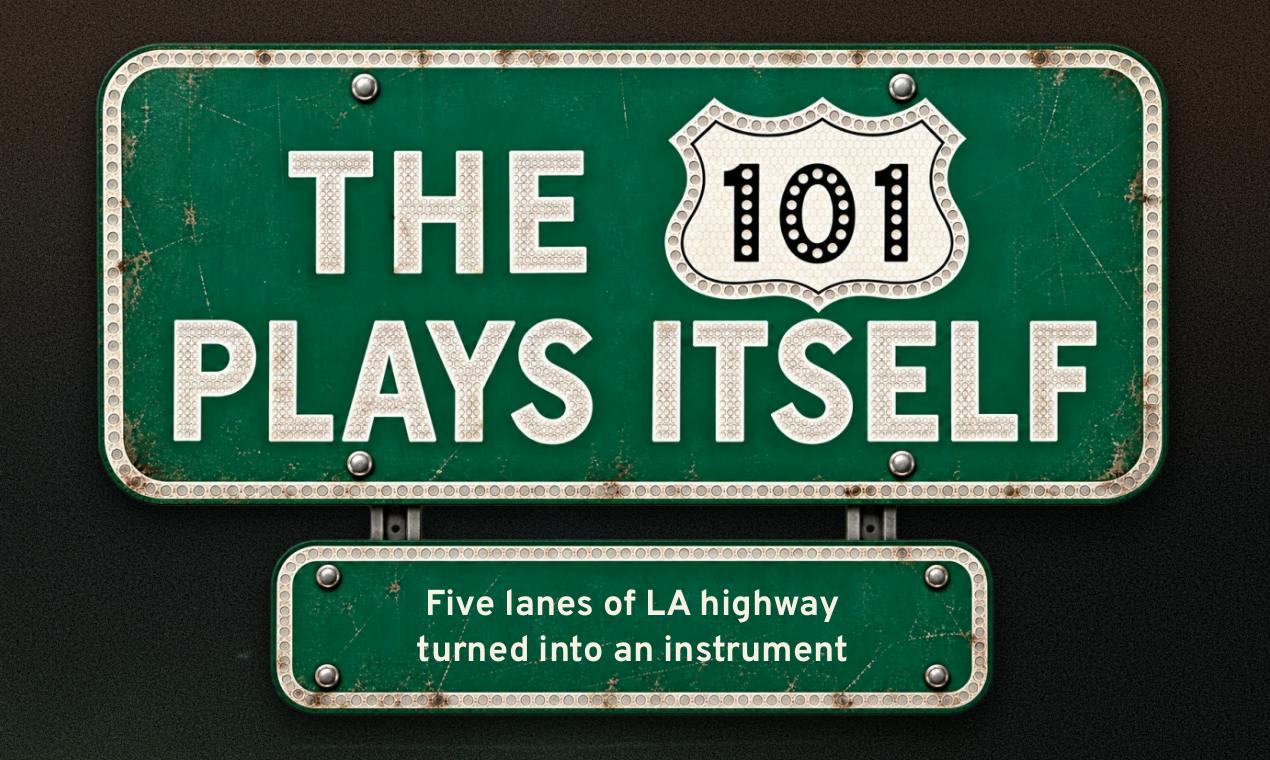
Created by Jay Judah, the project earned 81 upvotes on launch day, ranking 8th on the daily leaderboard under the Music and Cars categories.
The Technical Logic Behind "City as Instrument"
What makes this project fascinating is how it transforms something so mundane it's practically invisible — freeway traffic — into an ever-changing musical canvas.
Based on how it likely works, the pipeline goes something like this: pull in the publicly available Caltrans live camera feed, use computer vision to define a "trigger line" across the frame, detect each vehicle that crosses it, map those detection events to musical notes, and synthesize audio in real time on the client side — almost certainly using something like the Web Audio API.
In other words, the composer isn't a person — it's the unpredictable flow of real-world traffic. Sparse early-morning cars naturally produce sparse, sparse rhythms; rush-hour gridlock generates dense, rapid-fire patterns. This approach of "letting real data speak for itself" is a creative application of data sonification.
Data Sonification is the practice of translating non-audio data into sound signals — the acoustic counterpart to data visualization, and an important method in human-computer interaction and science communication. Its history stretches back to the early 20th century, when scientists used the clicks of a Geiger counter to perceive radiation intensity — one of the earliest widely accepted examples of data-as-sound. Modern applications range from NASA converting space telescope data into music, to real-time audio feedback from financial markets. The Web Audio API is a native browser interface for audio processing, allowing developers to perform oscillator synthesis, reverb, volume envelopes, and other complex audio operations entirely on the client side — no server required — making it core infrastructure for projects like this. The public camera feeds from Caltrans (the California Department of Transportation) are part of the city's open data infrastructure, originally built for traffic monitoring and planning, and here creatively "repurposed" as artistic raw material.
Why Projects Like This Deserve Attention
Translating real-time physical events into sound isn't a new concept, but packaging it as something anyone can experience instantly in a browser lowers the barrier considerably — and amplifies the delight.
It reflects several directions that feel genuinely valuable right now:
- Creative reuse of real-time data streams: Public urban sensors and camera feeds are typically used for traffic management. This project reveals their potential as artistic and experiential material.
- The browser as a platform: No installation needed. Open a link, listen, watch. Audio synthesis happens entirely on the client.
- A new way to connect with the city: When you realize the melody in your ears is being composed by real commuters driving past right now, it gives you a visceral sense of the city as a living system.
This kind of practice — transforming urban infrastructure into artistic media — belongs to the broader traditions of Generative Art and Situational Music. Generative art uses autonomous rules or systems to create work; the human artist sets the algorithm, rather than directly determining each note or pixel. Composer John Cage's 4'33" (1952) pioneered the idea of incorporating environmental sounds into a musical framework, while Brian Eno's concept of Ambient Music in the 1970s explored systems that run autonomously and generate music at random. The 101 Plays Itself can be seen as a contemporary extension of this lineage into the era of open data and browser technology — replacing the "chance operation" of a coin flip or natural environment with urban traffic, one of the most complex real-time systems we have.
A Small, Beautiful Experiment
From a product perspective, The 101 Plays Itself isn't chasing commercialization — it's closer to a concept piece / interactive art experiment. It has minimal comments (just 1), suggesting limited discussion, but 81 upvotes confirm that a sharp, «small-but-clever» creative idea can still resonate.
The lesson for developers and creators here is clear: a sufficiently crisp, sufficiently distinctive core idea — paired with an experience people can try instantly — tends to move people more than a pile of features. It's a reminder that AI and web technologies aren't only for boosting productivity. They can also help us see and hear the world we've grown too familiar to notice.
If you're interested in sound art, data sonification, or interactive web experiences, open up the site and listen for yourself — and hear what the traffic on LA's 101 freeway is playing for you right now.
Related articles

A Single Prompt Triggers a Global PHP Security Storm: Is AI a Savior or a Hidden Risk?
A single AI prompt triggered a global PHP security crisis affecting Wikipedia and the Internet Archive. This article reviews the incident, analyzes the OpenAI-Amazon controversy, and explores the security paradox of lowered vulnerability discovery barriers in the AI era and developer response strategies.

When AI Is Taken Away: How Reliance on Shortcuts Undermines Your Problem-Solving Resilience
A study of 1,222 people found that after using AI to answer questions, once AI was removed, people gave up on more problems than a control group that never used AI. The article analyzes the impact of AI reliance on learning resilience and metacognition, and explores design implications for AI learning tools.

Carta and NewView Partner to Let Startup Employees Cash Out Equity Early
Carta and NewView Capital partner to simplify startup tender offers, helping employees sell equity early. Analysis of the mechanism, liquidity pain points, and impact.