When AI Agents Generate Hundreds of PRs a Day, How Should the Development Workflow Be Restructured?

Coding agents cause a surge in PRs, requiring CI/CD to shift to risk-based review, intelligent testing, and automated merging.
The article discusses the impact of high-throughput code generation by coding agents (50-100 PRs/day) on traditional CI/CD processes. The core argument is that the bottleneck shifts from coding to review and testing, making line-by-line manual review infeasible. Community practices yield several approaches: risk-based review with auto-merge for low-risk changes and manual review for high-risk ones; testing strategy shifting from full regression to intelligent selection based on change impact, requiring agents to attach tests at generation time; parallel agent management designed like distributed systems, including independent workspaces, status monitoring, and automated conflict detection. Every stage of the pipeline—review, testing, merging, monitoring—needs restructuring, but risk classification accuracy, agent code explainability, and regression control remain unresolved challenges.
When Coding Agents Become the Main Development Force, Can Your CI/CD Keep Up?
A question from the Reddit community hits a pain point for many engineering teams today: when coding agents produce code far faster than humans and multiple agents run in parallel, 50 to 100 Pull Requests (PRs) a day becomes the norm. At such throughput, traditional code review, testing, and merge processes almost instantly break down.
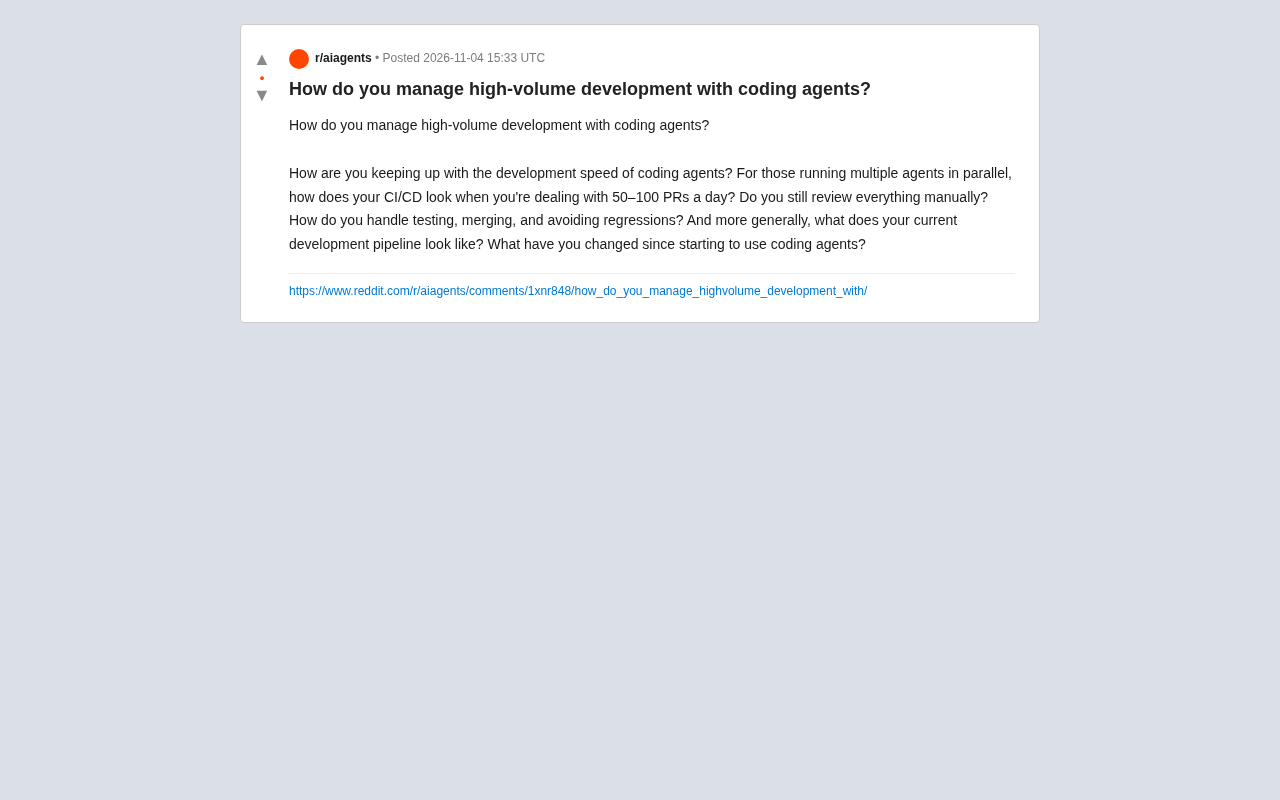
This question is not hypothetical. It comes from a practitioner's real confusion: "Are you still manually reviewing all PRs?" "How do you test and merge while avoiding regressions?" "What has changed in the development pipeline since introducing coding agents?" Behind these questions lies a deeper shift—AI-assisted development is moving from "point improvement" to "process restructuring."
Bottleneck Shift: Code Review Becomes the New Battleground
In traditional development, developers spend most of their time writing code, while review and testing are relatively manageable. Once coding agents boost code output by an order of magnitude, the bottleneck immediately shifts downstream. What does 50-100 PRs a day mean? If each PR takes an average of 15 minutes of manual review, that is 12.5 to 25 hours of pure review work per day—clearly not something a single engineer can handle.
The choice most teams face is: either add review manpower or change the review approach. Some practitioners have begun adopting a tiered strategy—enabling auto-merge for low-risk changes (e.g., formatting, documentation updates, simple refactoring), while retaining manual review for PRs involving core logic, security-sensitive areas, or complex dependencies. The key lies in how to accurately draw the boundary between "low risk" and "high risk," which itself requires a reliable automated judgment mechanism.
Risk-based Review is a strategy that dynamically allocates review resources according to the risk level of a change. In high-throughput coding agent scenarios, teams typically score PRs based on change type (documentation, formatting, configuration, core logic), impact scope (number of files, dependency depth), historical defect rate, and other dimensions. Low-risk PRs can be auto-merged or require only lightweight checks, while high-risk PRs mandate in-depth manual review. The implementation challenge lies in the accuracy of the risk classifier itself—misclassifying a high-risk change as low-risk allows defects to enter the main branch directly. A common industry practice is to build a scoring model combining static analysis, test coverage changes, and code ownership rules, and to set up a "circuit breaker" mechanism: when the rollback rate after auto-merge exceeds a threshold, the policy is automatically tightened.
Evolution of Testing Strategy: From Full Regression to Intelligent Selection
Code generated by coding agents is often syntactically correct and stylistically consistent, but may harbor hidden issues in business logic or boundary conditions. When the number of PRs surges, the cost of full regression testing balloons. Ideas emerging from community discussions include: dynamically selecting test sets based on change impact, mandating new or updated unit tests for agent-generated code, and introducing static analysis and security scanning as the first line of defense in the CI pipeline.
Some practitioners point out that coding agents are particularly good at code that "looks right," which paradoxically increases the weight of the testing phase. Some teams have begun requiring agents to attach test cases and change descriptions when submitting PRs, shifting part of the verification responsibility forward to the generation stage. This approach turns testing from "post-hoc inspection" into "generation-time constraints," but the prerequisite is that agents can be effectively configured and guided.
Change Impact Analysis (CIA) is a technique that determines which test cases a code change may affect through static or dynamic analysis. Common methods include: call-graph-based analysis of reachable paths from the change point, file-to-test mapping built from historical test failure data, and transitive closure computation using code dependency graphs. In CI, CIA can significantly reduce the test set that needs to be executed, compressing full regression from hours to minutes. However, its effectiveness depends on the completeness and accuracy of the dependency graph; for dynamic languages or reflection-heavy codebases, the risk of missed detection is higher. In practice, the test set selected by CIA is usually combined with a fixed smoke test of critical paths to balance speed and safety.
Collaboration Patterns for Parallel Agents: From Single-Threaded to Pipeline
Running multiple agents in parallel for development means teams need to manage the development process like a distributed system. Common practices include: assigning each agent an independent branch and workspace, monitoring PR status through automated tools and triggering corresponding CI tasks, and introducing automated conflict detection and semantic-level dependency analysis before merging.
Interestingly, the "50-100 PRs/day" mentioned in the question is not a fixed upper limit but describes an order of magnitude—as the number of agents increases, the number of PRs grows linearly or even superlinearly. What teams need to design is not a solution for a specific number but an elastically scalable process. Some community members suggest managing agents as "junior developers": giving them clear boundaries, templated task descriptions, and automated acceptance criteria, rather than expecting perfection from every output.
Semantic-level dependency analysis refers to analyzing not only textual conflicts but also semantic interactions between changes before merging. For example, two agents modify different implementations of the same interface—no textual conflict, but the combination may violate a contract or introduce behavioral inconsistency. Implementation approaches include AST-based change overlap detection, type-system-based contract compatibility checking, and using LLMs to reason about consistency of change descriptions. Such analysis typically serves as a supplementary layer to the merge gate, running before auto-merge. Because semantic analysis is computationally expensive, teams often enable it only for high-risk PRs or changes involving public APIs, forming a tiered gate.
Pipeline Restructuring: Which Stages Must Change?
Returning to the original question's follow-up on "what the development pipeline has become," the community discussion can be summarized into several key changes:
The review stage shifts from line-by-line manual review to rule- and risk-based sampling review, supplemented by automated code quality gates. The testing stage shifts from full regression to incremental impact analysis plus agent self-testing. The merge stage shifts from manual click-to-merge to state-machine- and policy-based auto-merge. The monitoring stage adds observability into agent behavior—for example, tracking each agent's output success rate and the distribution of rejection reasons.
The core logic behind these changes is consistent: freeing humans from repetitive judgments and focusing them on decisions that truly require experience and judgment. As for the specific toolchain choices, the community discussion has not reached a unified answer, which itself shows that this field is still evolving rapidly.
Unresolved Challenges
Some sober voices in the discussion also point out that the risks brought by high-throughput development cannot be ignored. The strategy of auto-merging low-risk PRs depends on accurate risk classification; once classification errs, problems enter the main branch directly. The explainability of agent-generated code is also a challenge—when a reviewer needs to understand a complex piece of logic written by an agent, the time and cognitive cost is no lower than for human-written code.
Moreover, the goal of "avoiding regressions" becomes more difficult under rapid iteration. Frequent code changes increase the probability of integration conflicts and hidden dependency breakage, requiring teams to invest more resources in test coverage and automation. Currently, no team claims to have fully solved these problems; most are seeking balance through dynamic adjustment.
Agent Observability draws on the ideas of distributed system monitoring, aiming to track the complete lifecycle of each coding agent: task reception, code generation, test execution, PR submission, review feedback, and merge results. Key metrics include output success rate, first-review pass rate, rollback rate, average fix rounds, and distribution of rejection reasons. These data are used not only to detect anomalous agents (e.g., frequently generating non-compliant code) but also to feed back into optimizing prompts and constraint rules. Implementation requires instrumenting the agent framework and feeding data into a unified monitoring dashboard. Without observability, teams cannot distinguish whether it is agent capability deficiency or process design flaw, making optimization impossible.
One-line Summary
Coding agents cause a surge in PR volume, and CI/CD must shift to risk-based review, intelligent testing, and automated merging.
Related articles
 Tech Frontiers
GitHub Daily · November 8: Agent Infrastructure Blooms Across the Board
GitHub Daily Nov 8: agent infrastructure dominates Trending—browser automation, design systems, skill libraries, VM runtimes, and context compression—while veteran tools warm up.
 Tech Frontiers
Comparing Routing Mechanisms of 10 Open-Source MoE Models: DeepSeek, Qwen, Mixtral, Llama 4, gpt-oss
A configuration-based comparison of routing mechanisms in 10 open-source MoE models, analyzing DeepSeek, Qwen, Mixtral, Llama 4, and gpt-oss on expert count, top-k, shared experts, gating, and load balancing.
 Tech Frontiers
Vibe Coding Step-by-Step Guide: Learn to Build Products with AI in Six Steps
Breaking down the six-step methodology of Bilibili's 748-episode Vibe Coding course, analyzing the usage boundaries and prompt techniques of Codex, Claude Code, and Cursor, and discussing who this AI coding course suits, who it doesn't, and how to avoid the trap of watching without acting.