When AI Meets Political Satire: The Media Storm Ignited by Hegseth's Remarks

A political satire show exposed Hegseth's controversial remarks and sexual assault settlement, sparking divided public opinion and reflection.
A YouTube political satire program focused on U.S. Secretary of Defense Pete Hegseth's past controversial remarks about women in combat and disclosed that he paid $50,000 to a sexual assault accuser, as well as a 2018 email in which his mother sharply criticized him for "abusing women." By citing specific amounts, the original email text, and timelines, the program built a chain of argument that sparked widespread discussion on social media. Supporters see it as a necessary examination of a public figure's consistency, while critics question whether it took things out of context. The incident reveals how politicians' past remarks and private communications become material for public oversight in the digital age, and it also shows the reach of satire between entertainment and oversight.
When AI Meets Political Satire: The Birth of a Media Storm
Recently, a clip from a political satire show on YouTube sparked widespread discussion online. The program focused on U.S. Secretary of Defense Pete Hegseth's past controversial remarks about women in combat, delivering sharp criticism through a late-night talk show format. This content is noteworthy not only because it touches on the sensitive topics of gender and the military, but also because it demonstrates the reach of political satire in the social media era.
The Core Controversy: Should Women Serve in Combat?
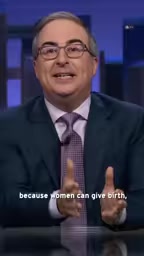
The Hegseth quote cited in the program was blunt: "Women should not be in combat at all. They are life-givers, not life-takers." He also stated that although he knows many outstanding female soldiers, "they should not be in my infantry battalion, not once."
This framing, which pits reproductive capacity against combat capability, struck the host as absurd. The host countered that claiming women cannot commit violence because they can give birth is completely untenable—any woman who has just given birth would likely prove the absurdity of that claim through action.
This binary logic essentially uses physiological traits to deny individual capability, and it feels especially jarring today, when gender equality is already a consensus.
Pete Hegseth is Trump's nominee for U.S. Secretary of Defense. He previously worked as a Fox News host and has long commented in conservative media. He has served in the Army National Guard but lacks senior military command and defense policy-making experience. Because of this, he faced especially strict scrutiny ahead of his Senate confirmation hearing, and his past remarks on issues such as women in combat and military diversity were resurfaced, becoming a focus of public debate.
The U.S. military has opened all combat roles to women since 2015, including frontline combat positions such as infantry and armor. This policy shift was based on years of operational experience and research reports, which concluded that gender is not the sole determinant of combat capability. Hegseth's remarks directly conflict with current policy, and his nomination for Secretary of Defense has therefore raised widespread concerns about whether the military's gender integration policies might be rolled back.
More Controversy: Sexual Assault Allegations and His Mother's Letter
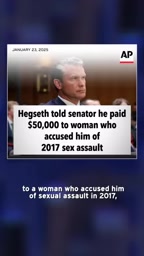
The program did not stop at criticizing his remarks. The host pointed out that before the Senate confirmed his nomination for Secretary of Defense, Hegseth paid $50,000 to a woman who accused him of sexual assault, although he denies the allegation. This fact forms a subtle contrast with his public statements.
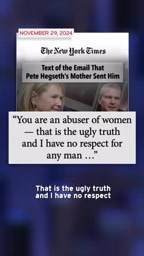
Even more shocking, according to 2018 emails obtained by The New York Times, Hegseth's mother, Penelope, once wrote to him: "On behalf of all the women (and I know it's many) you have abused in some way, I say... get some help and take an honest look at yourself." The email went further: "You are an abuser of women — that is the ugly truth... I have no respect for any man that belittles, lies, cheats, sleeps around, and uses women for his own power and ego. You are that man (and have been for years)."
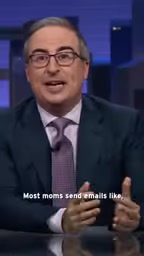
The host humorously contrasted the kinds of emails an ordinary mother might send—reminders about birthdays, book recommendations, complaints about not knowing how to use the TV—with the heavy weight of this letter: "Change yourself, sexual harasser." Although his mother later claimed to have retracted and apologized for the email, the content itself was shocking enough.
In the United States, a financial settlement between an accuser and the accused does not equal an admission of guilt, but such payments are often seen by the public as an indirect signal of moral responsibility. Hegseth's $50,000 payment occurred before the Senate confirmation process, and that timing has subjected him to greater scrutiny on political ethics grounds—critics argue the move may have been intended to keep litigation out of public view and thus avoid affecting the nomination process.
The 2018 emails obtained by The New York Times were private communications, and their publication itself has also sparked discussion about privacy and the boundaries of scrutiny of public figures. Hegseth's mother later claimed the email was written under emotional strain and that she had retracted and apologized for it, but the impact of the text was not diminished. This case is a typical example of how private communications become material for public oversight in the digital age.
Division and Reflection in Public Opinion
This content has been interpreted in two ways as it spread. Supporters argue that it is a necessary examination of a public figure's past words and actions, especially when he is poised to hold a key defense post, since his views on gender directly affect military policy. Critics question whether the program took things out of context and ignored the setting of Hegseth's remarks.
Regardless of stance, this incident reveals the importance of consistency between a politician's words and actions. In the social media era, past remarks and private communications can both become material for public discussion, and public scrutiny of those in power is becoming stricter.
From a technical perspective, what AI content creators can learn from this is that the reach of political satire depends not only on sharp viewpoints but also on solid facts and narrative rhythm. By citing specific amounts, the original email text, and timelines, the program built a chain of argument that is hard to refute. This is worth considering for any creator attempting in-depth commentary.
Political satire programs (such as late-night talk shows) serve both entertainment and oversight functions in the U.S. media ecosystem. Programs are usually presented within a comedic framework, but if the factual material they cite is solid enough, they can often produce serious political impact. The communicative advantage of such programs is that humor lowers the threshold for audience acceptance, while specific evidence (amounts, original email text, timelines) strengthens persuasiveness.
In the social media era, a clip from a program can be excerpted, remixed, and spread across platforms, with speed and scope far beyond traditional television broadcasts. This also means the risk of taking things out of context is amplified at the same time. When consuming this kind of content, it becomes especially important for audiences to distinguish between "satirical rhetoric" and "factual allegations." For AI content creators, understanding this communication mechanism helps in designing more effective narrative structures.
Conclusion
The discussion sparked by this YouTube content goes far beyond the entertainment scope of a late-night show. It touches on deep issues such as gender, power, and public responsibility, and it also shows the role of media in overseeing power. For readers concerned with social issues, this is undoubtedly a case worth pondering.
Related articles

Jensen Huang Returns to Nvidia: The Power Game Behind an "Aggro Reset"
Nvidia's board reappointed Jensen Huang as CEO less than two weeks after his scandal-driven resignation. This analysis explores the board's decision-making, Trump's political intervention, media power failure, and market reaction behind the dramatic return.

Why Voice AI Can't Understand Kenyans' Everyday Conversations
Swahili speech recognition hits 3.24% error on read text, but everyday Kenyan speech mixes English, Sheng slang, and accents—leaving mainstream voice AI struggling.

Data Centers Build Their Own Natural Gas Plants: AI Compute's Breakout Around a Decade-Long Grid Wait
Grid interconnection approvals can take a decade, so xAI and others are building off-grid natural gas plants to power AI clusters. This article analyzes the drivers, costs, and impact of behind-the-meter generation on AI infrastructure.